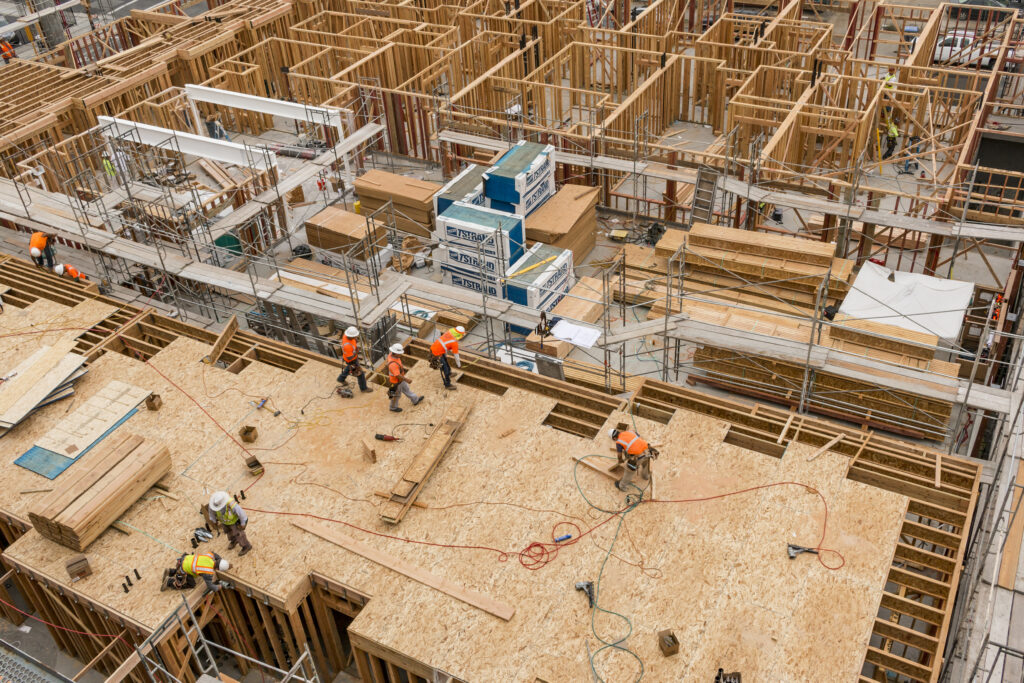
The data center construction labor shortage won’t be solved by hiring inside a single 12 to 24 month build. Builders keeping AI data centers on schedule protect their scarcest hours instead, the ones that belong to superintendents and MEP coordinators who direct every crew on site.
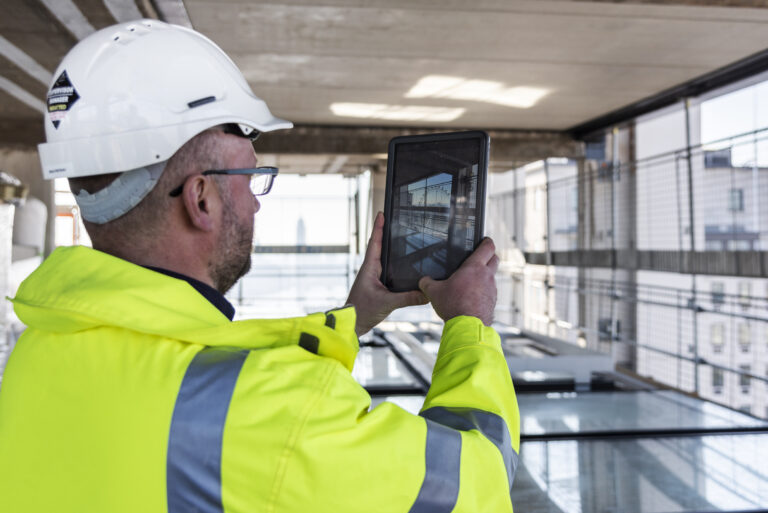
These builders capture the site once with smartphones, 360° cameras, and drones, then use that visual record for progress verification and owner updates that used to take repeat site walks.
Capital for AI infrastructure keeps flowing, and AI companies want capacity online faster than the last campus delivered it. Owners have the money to build. The constraint is people with enough field experience to run a complex job, and that talent takes years to develop. Builders getting ahead of the data center boom treat every hour of skilled supervision as part of their workforce strategy.
Why is the data center construction labor shortage worse than the wider labor shortage?
Data center construction competes for the same skilled trades as other construction projects, at a larger scale and on tighter project timelines.
What the 2026 survey numbers show for data center projects
The AGC and NCCER 2026 workforce survey found that 28% of contractors worked on data center projects in the past year. Among those firms:
| Finding from contractors on data center work | Share |
| Data center projects increased competition for skilled workers | 58% |
| Data center projects increased wage pressure | 49% |
| Worker or subcontractor availability was the biggest challenge | 37% |
Across all respondents, worker shortages were the most common cause of project delays, cited by 42%.
The broader pipeline is tight too. Associated Builders and Contractors estimates the construction industry must attract 349,000 net new workers in 2026. Its chief economist ties rising demand for qualified electricians to the growth in data center construction.
Why is the labor shortage harder to close on data center construction?
The labor shortage is harder to close on data center construction because demand concentrates in a few markets and peaks all at once, while the trades it needs take years to train.
- Regional labor conditions tighten fast. Hyperscale facilities tend to cluster, so a few projects breaking ground in the same market can leave contractors there without enough skilled tradespeople.
- Peak demand stacks trades. Electricians, pipefitters, and controls technicians are all needed on site during the same phases, so a gap in one trade holds up the others.
- Workforce development runs on a longer clock. Apprenticeship programs and community colleges are training the next generation, but an electrician needs years of hands-on experience before leading a crew on a critical power install.
- Flexible staffing models fill gaps with traveling crews and agency labor. Those workers arrive without the project history, and rapid crew turnover raises the risk of safety incidents and rework.
Long-term workforce planning matters for the business. On the current job, with little room in the schedule, builders have to get more out of the people already on site.
The critical roles the data center boom can’t spare
Supervision is the most expensive part of the skilled worker shortage. One superintendent or MEP coordinator keeps several trade crews productive. If that person spends a morning on a walkdown and an afternoon on a progress report, construction workers keep building from yesterday’s information, and slow progress compounds across the campus.
These critical roles are also the hardest to fill. Retirements in the skilled trades shrink the pool of experienced people who can step into them, and each one carries technical knowledge a new hire can’t absorb in a few weeks:
- Superintendents hold the sequencing plan and direct crews day to day.
- MEP coordinators keep trades aligned across dense power and cooling systems.
- QA/QC leads verify installed work before it gets covered up.
Every hour these people spend on documentation or travel is an hour away from directing the work.
“The superintendent’s morning goes to the walk. The owner wants an update, the PM needs percent complete for the pay app, and the electrical foreman wants to know if the room is ready for pull. That’s the same walk three times. Every hour on it is an hour he isn’t looking two weeks ahead, and the crews feel it the next morning when they show up to a room that isn’t ready.”
—Wesley DuBose, Product Manager, OpenSpace
Where do skilled trades & site leaders lose hours on AI data centers?
Most of the lost time on data center projects falls into five predictable leaks. Project teams can use this table as a quick audit of their own sites.
| Hour leak | What it looks like on site | What it costs | The fix |
| Repeat walkdowns | Site leaders walk the same floors to answer different questions for owners and trades | Hours away from directing crews | Capture the site once and review it remotely |
| Manual progress reporting | Percent-complete estimates typed up from notes and scattered photos | Days of lag and disputed pay applications | Visual progress verification against the schedule |
| Chasing updates | Calls and texts to foremen to confirm what’s installed | Interrupted crews and slow progress | A shared visual record every trade can see |
| Travel between sites | Leaders drive or fly between campuses to verify work in place | Days per trip and delayed decisions | Remote site review from any device |
| Rework and disputes | MEP installs redone, or arguments over what was in place and when | Skilled labor paid twice, plus claims costs | Reality-to-model comparison and a time-stamped record |
Each leak traces back to one problem. The site exists in one place, so someone skilled has to go there to see it.
How are builders handling schedule pressure on AI infrastructure projects?
Builders handling schedule pressure on AI infrastructure projects move verification off their scarcest people. Teams capture the site as part of normal work, and anyone who needs an answer gets it from that visual record instead of from another walk.
Capture once & stop re-walking the data center campus
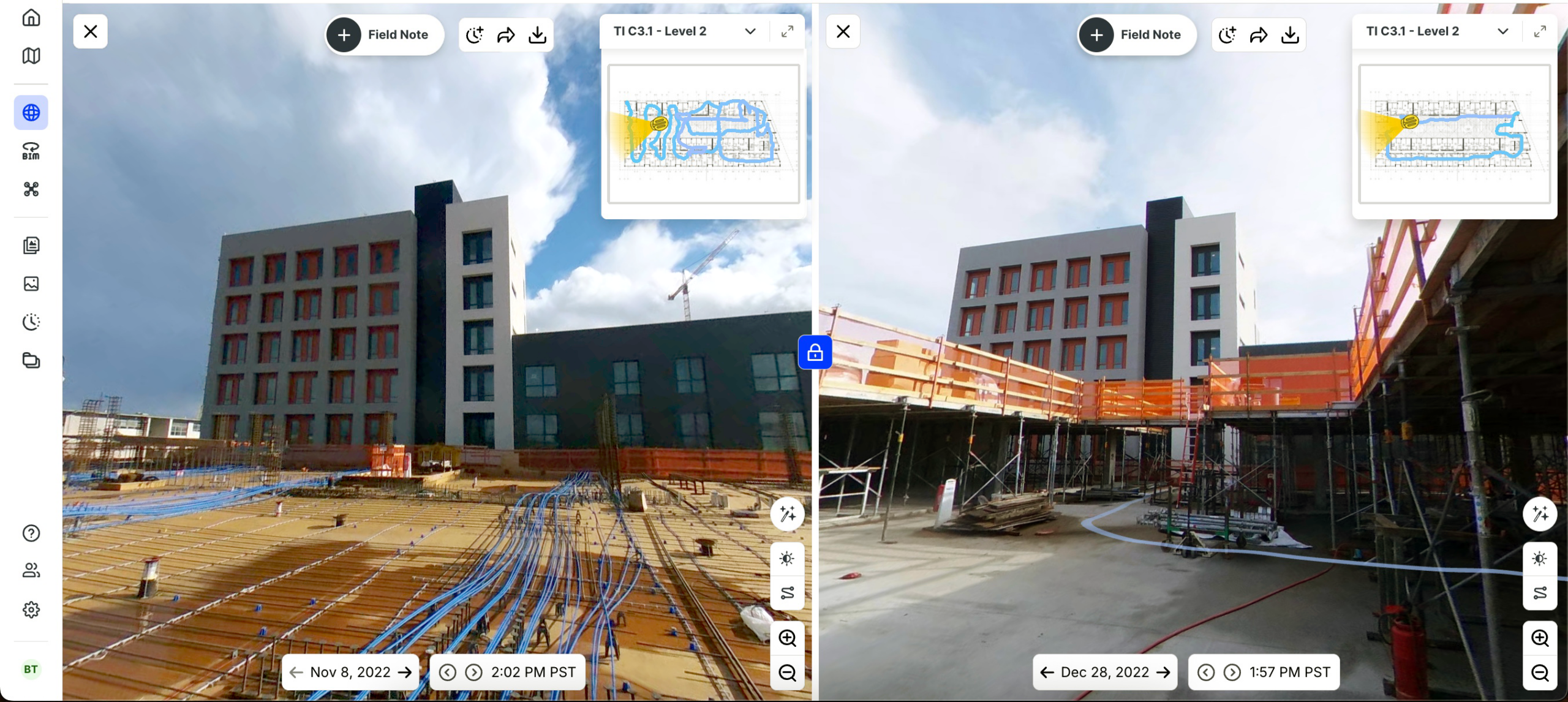
With OpenSpace Capture, anyone on the job can walk the site with a smartphone or 360° camera. Spatial AI pins each image to the floor plan. OpenSpace Air adds drone imagery for a full view of the data center campus, from site work to building envelopes. Owners and project executives then review the site from their desks instead of booking another trip.
At Suffolk, the time savings show up in superintendent hours. Senior Superintendent Javier Varela says reviewing historical conditions in OpenSpace “easily saves us 5-8 hours every week,” according to the Suffolk case study.
Distributed teams see a similar effect on travel. Linxon builds critical power infrastructure across several continents, and its managers reported spending 10% to 15% less time on site. Remote planners now track progress without weekly update calls. “They no longer have to run after people for progress updates,” says Manikandan Rangasamy, Head of Planning AMEA.
Swap the percent-complete walk for verified progress
Manual progress reporting eats a large share of a project controls team’s week. OpenSpace Track, the construction progress tracking software on the Visual Intelligence Platform, replaces that walk with verified visual progress:
- Planned vs. actual progress by phase, trade, or task
- AI tracking with human review, so reports hold up for pay applications and schedule sign-off
- About 10 minutes to capture 25,000 square feet, with progress reports in 24 to 48 hours
- Spotlights that flag unfinished work and blockers
Site leaders stay focused on the areas that need attention and skip re-checking the ones that don’t.
“The first thing teams notice is how optimistic the old numbers were. A manual percent-complete walk tends to round up, because the person walking knows the crew was in that room last week and assumes the work moved along with them. Once the schedule gets checked against what’s installed, the gaps show up in the areas nobody walked recently. On a data center, those are often the electrical rooms and containment runs, which is exactly where the schedule has the least room to absorb a surprise.”
—Michaela Rhile, Product Manager, OpenSpace
Catch MEP conflicts in data centers before construction workers redo the work
Rework costs the most of any hour because the job pays for skilled labor twice. Dense MEP systems in data centers leave little room for error. A conflict found after ceilings close means pulling qualified electricians and pipefitters back from other work.
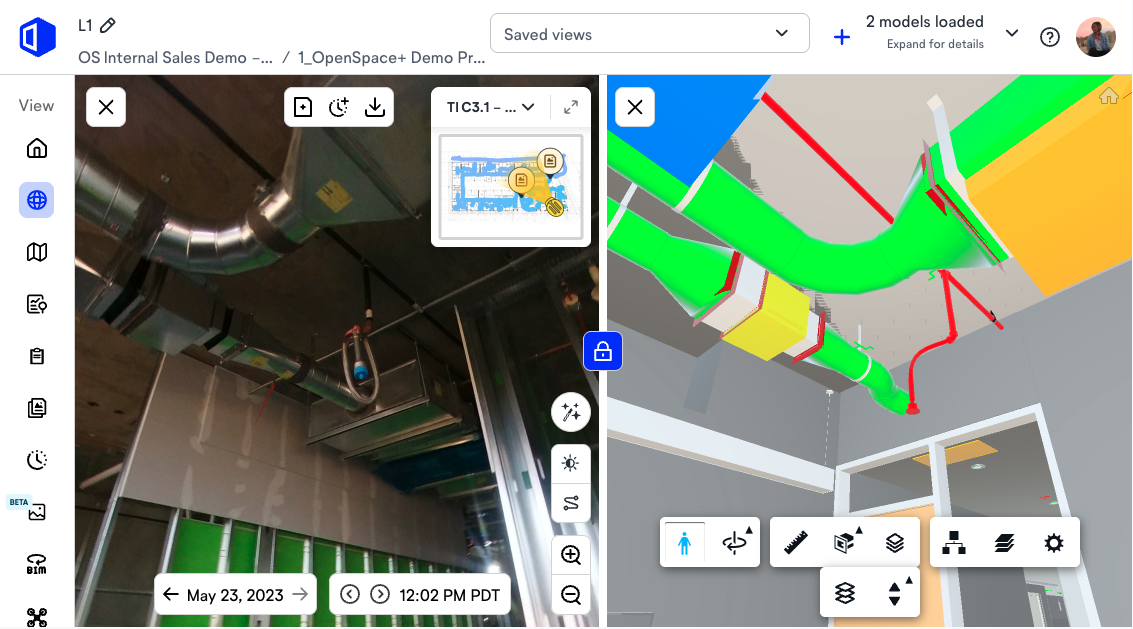
OpenSpace BIM+ lets VDC teams and field engineers verify installed work before close-in. A typical check runs like this:
- Capture the area during a normal site walk.
- Compare the built site against the design model with BIM Compare or Sheet Overlay.
- Log any conflict in OpenSpace Field with AI Voice Notes, which takes about 30 seconds.
- Let AI Autolocation pin the issue to the right spot on the plan for the responsible trade.
See how OpenSpace gives data center teams verified progress and fewer rework surprises without the manual walk. Request a demo.
What should teams measure to prove they’re doing more with less?
Teams prove they’re doing more with less by tracking where skilled hours go before and after a change. Five measures map to the hour leaks above:
| Measure | What to track | Hour leak it targets |
| Supervisor documentation time | Weekly hours superintendents and coordinators spend on walkdowns and reports | Repeat walkdowns |
| Report cycle time | Days from work in place to a verified progress report | Manual progress reporting |
| Site visits avoided | Trips by executives, owners, and remote planners replaced by remote review | Travel between sites |
| Issues caught before close-in | MEP conflicts found while they’re still cheap to fix | Rework |
| Time to settle a dispute | Days to resolve a disagreement over installed work | Disputes |
The guide to construction progress monitoring covers reporting methods and milestone documentation for teams setting up these measures.
Why site history matters when crews turn over
Dispute time matters more as crews turn over. A foreman or superintendent who leaves mid-project takes the site’s history with them unless someone captured it.
On the Longcross, U.K. data center project, Sweet Projects Project Director Andrew Moss says OpenSpace gave the team “a clear, tamper-proof record of what was happening on-site at every stage.” He credits that record with keeping the job on schedule and helping the team defend a position without a dispute, according to the OpenSpace press release.
“Start with report cycle time: the days between work going in and a progress report someone trusts. A lot of teams don’t track it, because the report shows up eventually and nobody asks how stale it was. That gap is usually where a superintendent’s week is going. Owners and lenders feel it too, because a pay application is only as current as the report behind it. If the cycle time shrinks, the people producing the report got their time back.”
—Michaela Rhile, Product Manager, OpenSpace
Delivering for AI companies with the crews already on site
The massive shortage of skilled tradespeople won’t ease before the next wave of AI data centers breaks ground. Builders who plan for it at the bid stage build visual documentation into operations from day one. That protects their critical roles and gives owners the visibility and speed they expect.
OpenSpace has supported more than 1,000 data center projects worldwide. See how data center construction software from OpenSpace helps teams build faster with the crews they have.
Always visible. Never in doubt. Talk to the OpenSpace team about your next data center campus.
Frequently asked questions
How long does it take to set up OpenSpace on an active data center project?
Teams can start capturing on day one with the smartphones they already carry. OpenSpace works on any smartphone, and site teams need no special training to start.
Does OpenSpace Track require a BIM model?
No, OpenSpace Track works without a BIM model. Teams can add a model later to compare installed work against the design.
Which scheduling platforms does OpenSpace Track connect to?
OpenSpace Track integrates with Primavera P6, Asta Powerproject, Microsoft Project, and Excel. Progress updates flow back to the schedule the project team already uses.
Is OpenSpace used on data center projects outside the United States?
Yes, OpenSpace supports data center projects in the U.S., Canada, the U.K., Europe, the Middle East, Australia, and Singapore. Teams in each of these markets use the same platform to capture and review their sites.