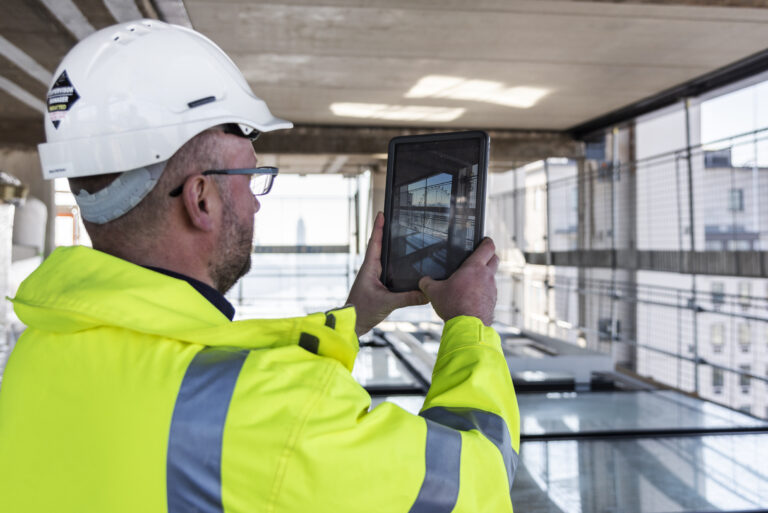
The data center construction process looks, on paper, like any other commercial build: plan, design, pour, build, commission, hand over. In practice, a data center is one of the most unforgiving projects in construction. Schedules are compressed, penalties for late delivery are steep, and the mechanical and electrical work in every hall leaves little room for error.
What separates a data center build that lands on time from one that slips is rarely the plan—it comes down to how clearly the team sees what has actually been built, phase by phase, before the next trade covers it up. Data centers are critical infrastructure now, the data processing backbone of the AI economy, raising the stakes on every construction phase.
The phases of a data center build & where schedule pressure builds
Every data center begins with decisions made long before the first excavator arrives. The eight phases below run across the data center construction process, though hyperscale, colocation, and edge projects compress or stretch each stage differently. Walking them in order shows where schedule pressure quietly builds.
Site selection, power availability & regulatory compliance
A data center site lives or dies on power. Power availability, not land cost, usually decides where a project lands, because grid capacity nearby sets the ceiling on power capacity for the whole build.
Key considerations here include proximity to fiber connectivity, distance from flood zones and other natural disasters, water for cooling, and the willingness of local governments to approve a large load. Regulatory compliance runs in parallel, and early talks with utilities and local regulations can save months. Site selection also weighs a greenfield build against reusing an existing facility.
Data center design & engineering
Data center design is where the building’s real complexity is set. Engineers size the power systems, backup systems, and cooling systems that keep servers alive, then build in redundancy so a single failure never takes the site down. This phase resolves an unusually long list at once:
- Power: uninterruptible power supplies, battery energy storage systems, generators, and power distribution units.
- Cooling: advanced HVAC systems and liquid cooling for dense AI racks.
- Network and compute: network infrastructure and the compute and storage systems the facility will host.
- Security and controls: physical security, security infrastructure, and the building management system.
ASHRAE’s TC 9.9 thermal guidelines remain the recognized reference for thermal decisions. Energy efficiency and renewable energy sources shape the design too, as owners target lower costs and cleaner power.
Preconstruction & procurement
This is the phase that breaks the most timelines. Long-lead data center equipment, especially transformers and switchgear, now carries delivery windows measured in years. Industry trackers report substation transformer lead times stretching past 160 weeks, with switchgear backlogged well beyond historical norms. Supply chain management moves to the critical path, and a single supply chain disruption can idle a site for months.
Site preparation & earthworks
This stage turns raw land into a buildable pad: clearing, grading, drainage, and foundations that carry enormous mechanical loads. Drone capture is common here to measure cut and fill across a large footprint and confirm earthworks before concrete follows.
Shell construction & building structure
Shell construction erects the structure, roof, and envelope that everything else depends on. Teams building data centers often run tilt-up or precast concrete to move fast, and the pace of shell construction sets the rhythm for every trade that follows. Falling behind here cascades.
MEP rough-in & fit-out
This is the densest, riskiest stretch of the build. Mechanical, electrical, and plumbing trades work on top of each other, and data center construction involves far more parallel activity than a typical project. Conduit, cable tray, busway, and piping get installed, then covered by walls, ceilings, and the next system. Once that work is buried, verifying it means destructive investigation. This is where a missed detail becomes a claim.
Commissioning & system integration
Commissioning proves the facility works before it supports critical operations. It moves from factory testing through integration and integrated systems testing, where power, cooling systems, and controls run together under load. It is thorough by design, and often, where hidden defects from earlier phases surface, at the worst moment for the schedule.
Handover & ongoing expansion
Handover transfers a verified, documented facility to the owner. On a hyperscale campus, construction rarely stops here. Programs can stay in construction and expansion for over a decade, leaving room for future expansion as demand grows.
Data center construction timeline: what’s realistic
A realistic timeline for data center construction depends on project scale and type more than anything else. As a rough guide:
| Facility type | Typical construction duration |
| Edge data centers | 6 to 12 months |
| Enterprise / colocation build | 12 to 18 months |
| Hyperscale data centers | 12 to 24 months, phased |
| Modular data centers | Compressed, with off-site fabrication overlapping site work |
These are directional. What moves the number is procurement of long-lead gear, the pace of shell construction, and how commissioning goes. A slip in one phase compresses the phases that follow, which is why early visibility matters more than an optimistic bar chart.
Where data center construction projects slip behind schedule
Most data center construction projects slip for reasons that were visible early and acted on late. Three patterns repeat:
- Procurement: When switchgear arrives a year after the slab is poured, no amount of field productivity recovers the gap.
- Coordination: With trades stacked in a data hall, one clash between a cooling line and a cable tray can stall a whole zone.
- The verification gap: On a fast-track build, work gets covered faster than anyone can document it, and by the time a discrepancy surfaces the evidence is sealed behind drywall.
Who owns the schedule when this happens? Accountability splits across data center owners, the general contractor, the MEP trades, and the commissioning agent—no one person holds the true state of the job. An objective, shared record of what was built, and when, changes the conversation from memory to evidence.
Most of the recurring data center construction challenges, from trade stacking to pay disputes across multiple GCs, come back to that same question of who can see the true state of the job, and how soon.
“The moment a wall or ceiling closes up, your only record of what is behind it is whatever got captured before it did. On a fast-track data center that comes faster than teams expect, usually once MEP rough-in is running ahead of anyone’s ability to document it, and a handful of phone photos stops holding up. The first real problem is rarely the rework itself. The expensive part is the argument about who owns it, weeks later, when the schedule can least afford it.”
—Michaela Rhile, Product Manager, OpenSpace
How visual documentation keeps hyperscale data centers on schedule
Keeping a hyperscale build on schedule is, at its core, an information problem. On a project this size, the field moves faster than any written report, and teams cannot manage what they cannot see. Visual documentation closes that gap by turning the site into a record.
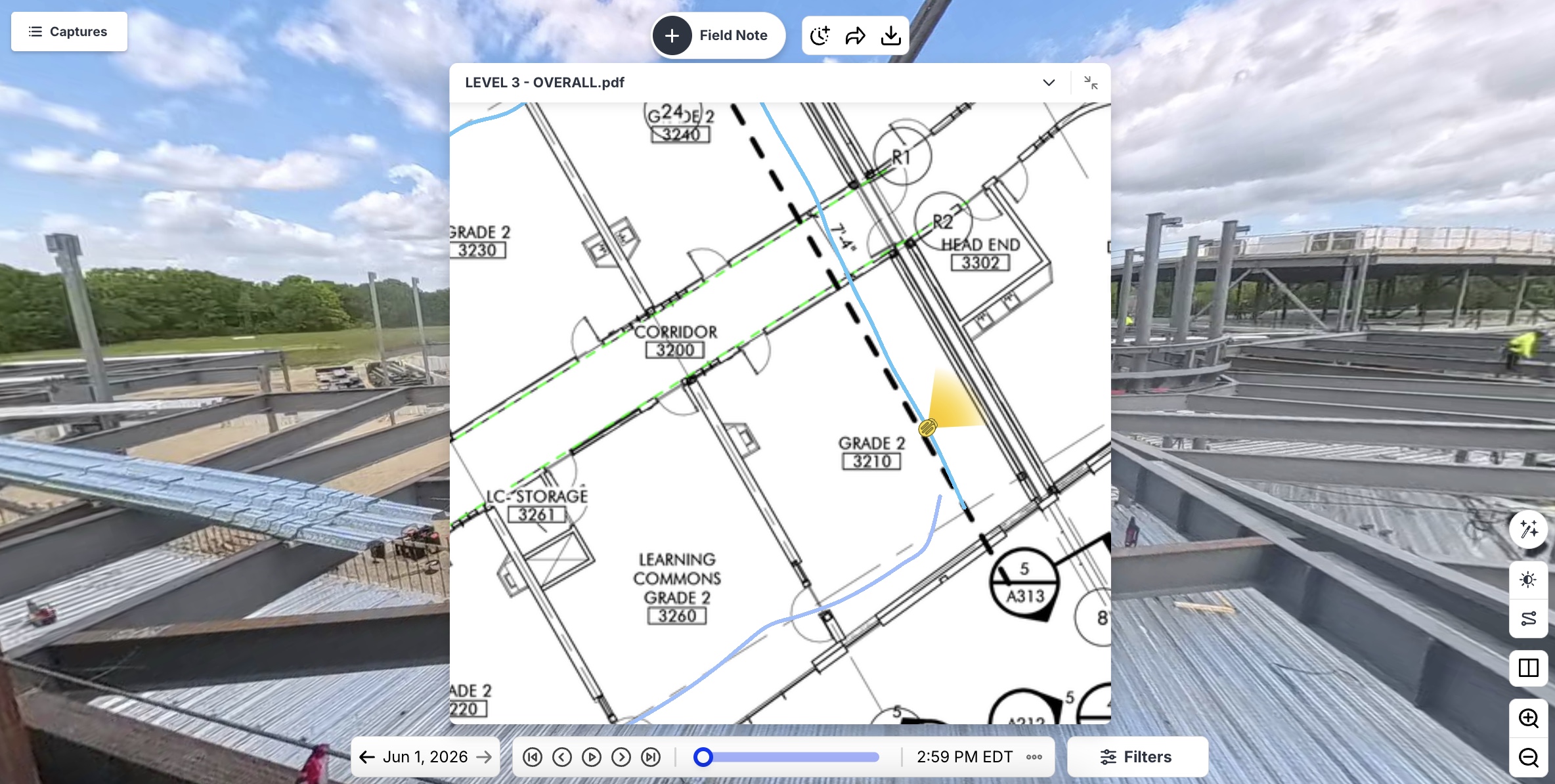
With OpenSpace, a superintendent walks the site with a 360° camera or smartphone, and Spatial AI maps every image to the floor plan automatically. The result is a complete visual record of the jobsite, time-stamped and location-pinned, that anyone can revisit. When a question comes up about MEP rough-in closed weeks ago, the team scrolls back in time instead of opening a wall.
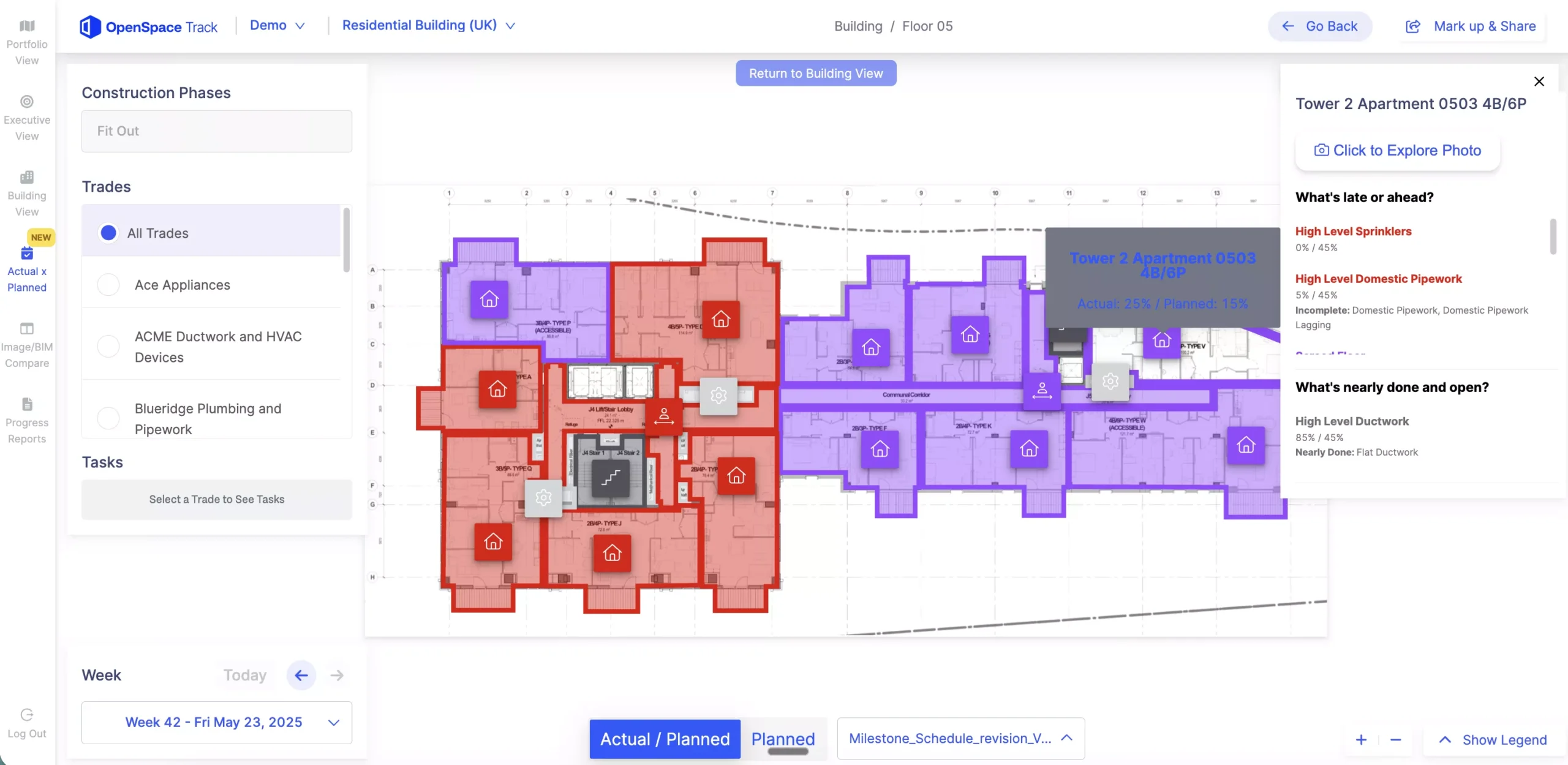
Paired with AI-powered progress tracking, the same captures feed a planned-versus-actual view, using artificial intelligence and human review to compare installed work against the schedule across hundreds of components. Delays show up as they form, so teams can act before the next monthly review. That evidence also validates work-in-place for pay applications, turning billing disputes into a quick look at the record.
The results show up on real jobs:
- OpenSpace surpassed 1,000 data center projects worldwide in 2026, and BOLDT reported a 20% reduction in scheduling delays after adopting the platform.
- On Sweet Projects’ Longcross data centre in the UK, a fast-track build with dense mechanical and electrical work, Project Director Andrew Moss credited a tamper-proof site record with helping his team stay on schedule and avoid a potential dispute.
- On one $1.2B+ hyperscale campus, OpenSpace Track runs live on foundation works, replacing manual check-ins with owner-ready reporting.
See how OpenSpace keeps data center builds on schedule.
“A daily report says the work got done. A time-stamped capture shows it, in place, on the date you billed for it. When an owner or GC questions a pay application, that is the whole difference. Instead of defending your word against theirs, you pull up the actual condition of that room on that day and let it settle the question. The teams that keep their billing clean are the ones who can answer ‘prove it’ on the spot instead of after three days of emails.”
—Michaela Rhile, Product Manager, OpenSpace
Best practices to keep a data center build on schedule
Effective project management on a data center build depends on seeing reality clearly and early. A few practices separate teams that hold their dates from teams that chase them:
- Order long-lead equipment first, and treat procurement as a design input rather than a downstream step.
- Set a consistent capture cadence so every space is documented before it is closed up, making buried work verifiable without demolition.
- Give owners and remote stakeholders a live view of the site, so reviews run on evidence.
- Tie progress evidence directly to pay applications and schedule updates, so billing and reporting draw from one source.
- Where the design allows, prefabricated modular systems and modular data centers move work off the critical path and into a controlled factory, shortening time deployed on site.
One of the clearest data center construction trends is the shift from reporting the past to catching problems in the present. Teams that pair disciplined project management with objective visual evidence and data analytics spot slippage while there is still time to recover, protecting schedule and operational efficiency.
“The failure I see most rarely comes from a bad model. It comes from three trades working off three different pictures of what is actually installed today. The mechanical contractor sequences around where they think the electrical got to last week, and by the time everyone meets in the same corridor, someone has to move. A shared visual view of the site does not prevent every clash, but it changes what the meeting is about. When the foremen are looking at the same corridor as it actually stands, the conversation shifts from who was there first to how to fix it. And because it is just a walk of the site, the trades actually use it.”
—Jess Lam, Staff Product Manager, OpenSpace
Frequently asked questions
What are the main types of data center construction?
There are four main types of data center construction:
- Hyperscale data centers are massive facilities built for cloud service providers and cloud computing at enormous scale.
- Enterprise data centers serve a single organization.
- Edge data centers are smaller sites placed close to users for low-latency processing.
- Colocation data centers host multiple tenants in one facility.
Modular data centers cut across these categories, using factory-built modules to speed delivery. Each type shapes the timeline, the digital infrastructure inside, and how a data center facility is coordinated during the data center construction process.
What is commissioning in data center construction & why is it a schedule risk?
Commissioning is the structured testing that proves every system works together before a data center goes live, and it is a schedule risk because it is where earlier mistakes surface last. It moves through levels, from factory acceptance testing to full integrated systems testing under simulated load, confirming that power, cooling systems, and controls perform as designed. Because most data centers rely on redundant systems to guarantee continuous operation, commissioning is exhaustive, and a defect traced to an earlier phase can force rework at the very end of the job. Clean documentation from every construction phase makes commissioning faster and less likely to uncover surprises.
What are the long-lead items in a data center project?
The long-lead items are the specialized components with delivery times of months or years, and they drive the procurement schedule. The most critical include:
- Large power transformers and medium-voltage switchgear
- Generators, UPS units, and chillers
- Increasingly, the equipment for liquid cooling
Because data center construction requires this gear before a facility can energize, teams order it early, sometimes before design is final, and track it closely so one late component does not stall the whole build.
Building a data center and need visibility across every phase? Talk to an OpenSpace expert to see how the Visual Intelligence Platform keeps complex, MEP-intensive projects on schedule.