Construction ROI is a familiar metric across the construction industry, but the number alone doesn’t tell the whole story. The basic formula for return on investment is simple. Understanding all the costs that affect that return can be harder. Some costs become obvious only after the money has already been spent—whether from rework, delays, disputes, or time lost searching for information.
This guide breaks down how to measure ROI in construction, what can put returns at risk, and where contractors see the biggest returns. Maximizing construction ROI depends less on the formula than on understanding the costs that affect it—and seeing potential problems early.
How is construction ROI calculated?
Return on investment in construction is measured by comparing a project’s net profit to its total cost:
ROI (%) = (net profit ÷ total cost) × 100
If a project returns $1.2 million in net profit on $10 million in total cost, the ROI is 12 percent. That basic ROI calculation can help inform investment decisions, from evaluating a project opportunity to assessing the value of new construction management software.
Different stakeholders also define returns differently, and a single percentage doesn’t capture every measure of value:
- Owners and clients weigh long-term operations and the real value a finished asset keeps creating
- Contractors track immediate returns, tight timelines, and monthly cash flow
- Sustainability-focused firms weigh progress toward sustainability goals and benefits that reach beyond the balance sheet
Construction runs on long timelines, tight budgets, and indirect costs that may surface months after a decision is made, so a useful measure can account for both the direct financial return and the indirect costs that move the number. Builders who calculate ROI successfully treat it as a running signal across the entire construction process, not a figure they compute once at closeout.
Why do construction projects fall short of ROI targets?
Construction projects can fall short of ROI targets when problems are identified after the easiest and least expensive opportunity to address them has passed. A missed detail in the field, a coordination issue between trades, or an unanswered question about installed work might cost little to address when it first appears. Weeks later, it can turn into rework, a change order, or a dispute that eats directly into net profit.
That’s one reason ROI calculations based only on budget and schedule may not tell the full story. The budget tracks what teams spend, but it may immediately show the downstream cost of an issue that went unnoticed. Problems can also originate in the planning phase, when assumptions about scope and sequencing later surface as project risk.
Rework alone is a heavy drag on profitability: research published through the American Society of Civil Engineers notes that combined change-order and quality-related rework has been estimated as high as 12.4 percent of contract value. The research also points to challenges in consistently identifying and tracking rework costs.
When information about the jobsite is slow to reach the people who need it—or depends on one person’s memory—teams may not see risk early enough to respond. When owners, project managers, and subcontractors work from different information about what happened on-site, small disagreements can grow into claims. Better, more immediate visibility into site conditions can help project teams address questions and potential issues sooner.
“The leak that surprises people is rework, because it almost never shows up on a job-cost report as rework. It hides inside labor and material lines that already look normal, so by the time the numbers move, the money is gone and no one can point to the decision that spent it. A cost report tells you where the money went. It rarely tells you why. The deviation is usually visible on site weeks before it becomes a cost, and what changes with a reliable visual record is that builders can catch the cause while it is still cheap to fix, instead of reading about the effect at closeout.”
—Michaela Rhile, Product Manager, OpenSpace
Where builders see the biggest returns on construction ROI
The biggest returns in construction rarely come from a single dramatic saving. They come from closing small gaps that repeat on every project, which is where construction ROI is won or lost. These returns fall into four categories, each mapping to a cost that is easy to miss and expensive to ignore.
| Return | Where the cost hides | OpenSpace proof point |
| Technology adoption | Software that goes unused returns nothing | Consistent field use turns scattered photos into a reliable visual record |
| Risk reduction | Disputes and rework surface weeks late | Vinci resolved a project dispute and expedited billing with its visual record; Valley Interior Systems cut rework and punch list damage costs |
| Labor productivity | Crews re-walk sites, search for drawings, and redo work | Suffolk sped punch, observations, and RFIs by up to 5x |
| Project efficiency | Travel, waiting, and manual reporting pile up | JLL cut travel costs by 50 percent |
Technology adoption & construction management software
Construction technology can only deliver real value when field teams use it. That’s why adoption matters when construction firms calculate ROI on construction management software or project management software. A tool that fits naturally into existing workflows is more likely to become part of the team’s day-to-day work.
Digital platforms can also give project managers and field teams more immediate visibility into project progress, helping them find information and make decisions without waiting for the next report or site visit.
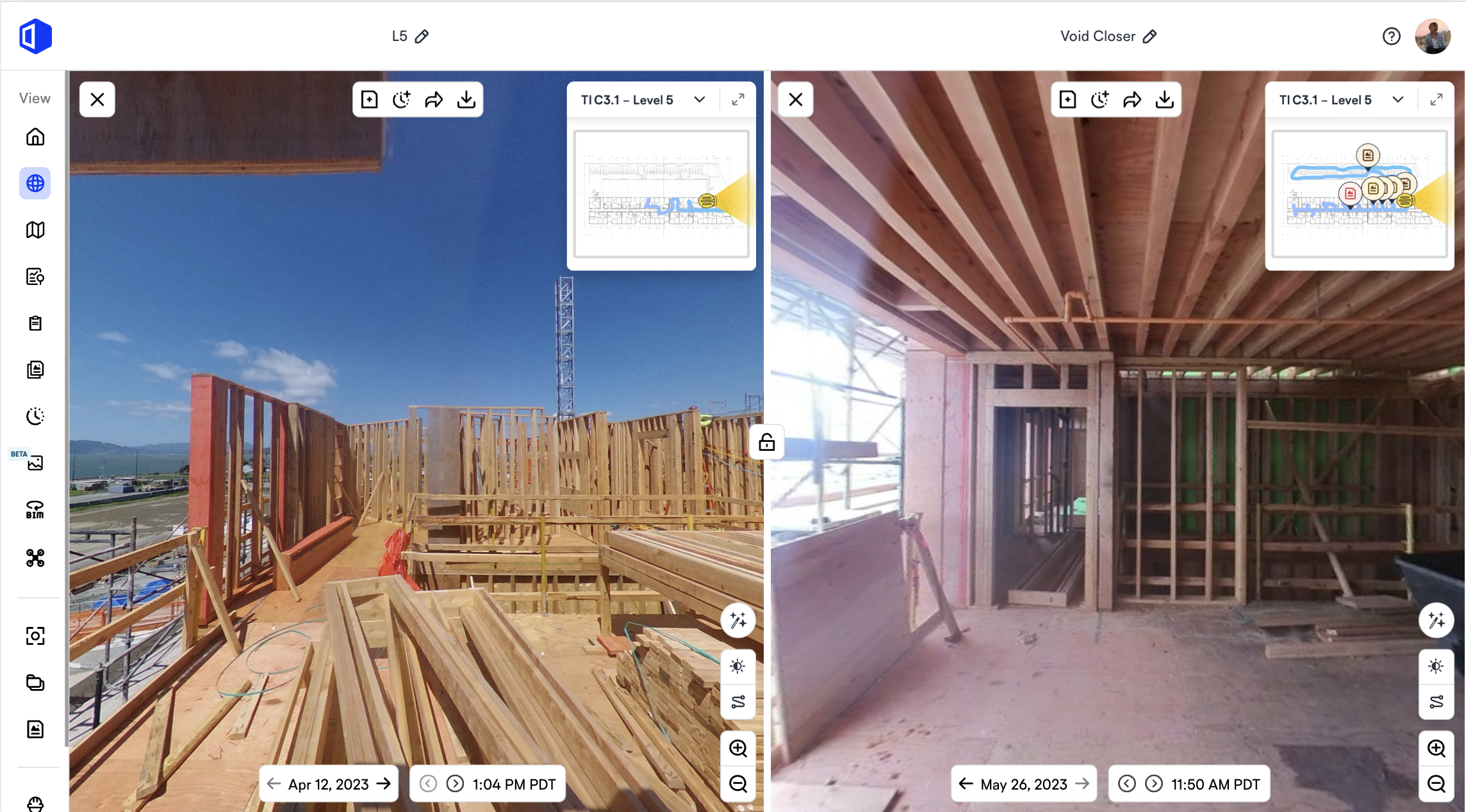
OpenSpace Capture is designed to make that documentation fast and easy. With a 360° camera, a builder can walk the site at a normal pace while OpenSpace automatically time-stamps and maps the imagery to the floor plan using Spatial AI. Teams can also capture photos with the smartphone already in their pocket, with OpenSpace automatically organizing imagery by time and location. The more consistently a team captures, the more complete its visual record becomes—making it easier to go back and see what happened, where, and when.
“I try to move builders off the idea of one hero number, because the real return comes from the whole team using it consistently, not one lucky catch. But if someone wants a single figure to take to their CFO, I point to travel and site visits, because that saving is easy to attribute on one project. JLL cut travel costs in half with OpenSpace, and once you price out what a superintendent’s windshield time actually costs over a job, that line alone can cover the platform. It is the return a skeptic can check without taking my word for it.”
—Michaela Rhile, Product Manager, OpenSpace
Risk reduction & cost control
The second return comes from cutting risk exposure, which is really a form of cost discipline. An objective visual record of the jobsite gives builders defensible evidence for the disputes that drain profit. When a payment application is questioned or a subcontractor disputes installed work, dated imagery settles the question in minutes instead of weeks.
Vinci Construction UK used that evidence to resolve a project dispute quickly and to verify completed work before releasing payment, and Valley Interior Systems used the same record to cut rework and the punch list damage costs that erode margins. A documented site record also supports safety reporting, insurance reviews, and quality checks on the same factual basis every stakeholder can trust, and faster dispute resolution steadies cash flow because progress billing rests on verified work rather than contested estimates.
Labor productivity
The third return shows up in labor—the single largest cost on most projects. Every hour a crew spends re-walking a site, hunting for the right drawing, or redoing work is money spent with no return. Faster field issue management recovers those hours directly, and that recovered time flows straight back into productive labor and a stronger return on investment.
Project efficiency & cost savings
The fourth return is efficiency, the savings that come from removing travel, waiting, and manual reporting. Remote site visibility means owners and project managers review real conditions without driving to site. JLL cut travel costs by 50 percent this way. Automated reporting adds more: OpenSpace customers using AI powered and human verified progress tracking have cut manual reporting time by up to 60 percent, freeing project teams for higher-value work.
To see where these returns show up on your projects, request a demo with one of our experts.
How do construction delays impact project ROI?
Construction delays hit ROI on two fronts at once: they raise costs and they push back revenue. Extended timelines mean more weeks of project overhead and site operationg costs, equipment rental, and financing, while revenue from the finished asset arrives later. On projects where an owner counts on the building to generate income, every week of slip carries a real price, and delays remain common. KPMG’s Global Construction Survey found that only about half of construction projects are completed on time.
Delays can become especially expensive when teams don’t see them developing early. A schedule may look fine until a monthly review reveals a section of work that fell behind weeks ago, and by then the recovery options are expensive. This is where visual progress insights change the economics.
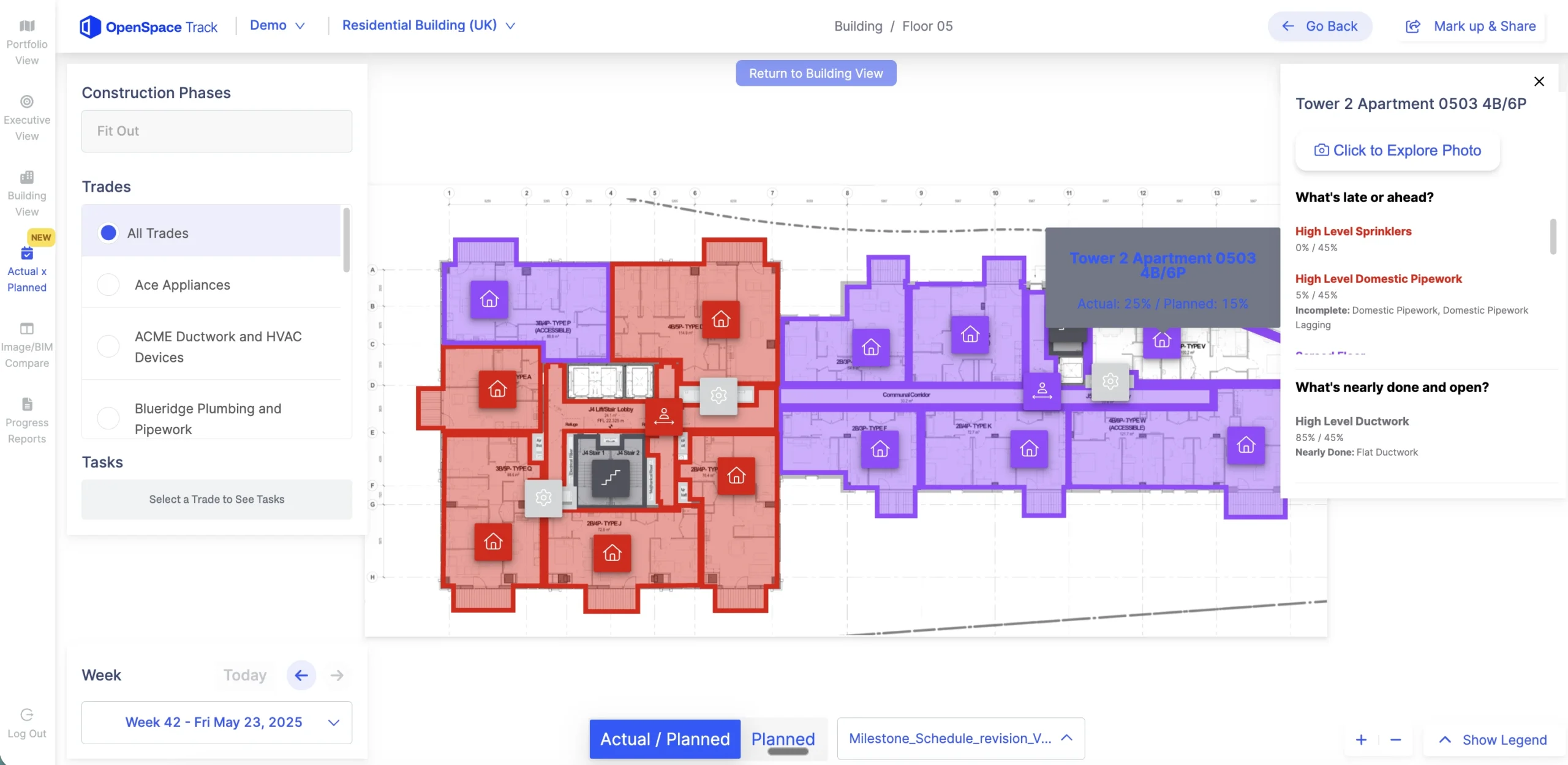
Construction progress tracking that compares planned versus actual work against the schedule gives teams an early warning while there’s still time to adjust crews or sequencing. BOLDT used that visibility to reduce scheduling delays by 20 percent. Early warning is risk management in practice—the difference between a small correction and an expensive one.
How can contractors improve labor productivity to increase ROI?
Contractors can improve labor productivity by reducing the time spen d on work that doesn’t move construction forward: re-walking sites, searching for information, and redoing installed work. Reducing that time can help project teams put more hours toward productive work and improve construction ROI.
When a superintendent spends less time hunting for information or revisiting the site just to answer a question, there’s more time available to manage the work itself. Better access to current and historical site conditions can make that possible.
Rework is an especially important cost to address because teams spend additional labor and materials correcting work that has already been installed. Identifying a deviation earlier can make it easier to address before more work goes in around it. Standardized capture can also reduce time spent reconstructing site conditions or coordinating from scattered photos, since project teams can refer back to a consistent visual record of the site.
That record can also provide useful context for job costing, cost control, and project management by helping teams verify what was built and when. Combined with other project data, better documentation can help construction firms investigate costly surprises, make more informed resource allocation decisions, and identify opportunities for cost savings across construction projects.
“If teams only capture imagery when there’s already a problem, they’re left without a complete record of what happened in between. The teams that get more value from their imagery capture the site consistently, whether or not anything looks off that week, and make the capture walk part of their regular routine. That week-by-week record can help answer questions later—whether they’re resolving a dispute, verifying a pay application, or looking back to see when a deviation appeared. The real value comes from having a visual record complete enough to answer questions the team didn’t know it would need to ask.”
—Michaela Rhile, Product Manager, OpenSpace
Maximizing construction ROI over the long term
Maximizing construction ROI over the long term depends on treating jobsite documentation as an asset rather than an afterthought. The builders who see the strongest returns capture consistently, tie that record to their schedule and coordination, and use it to settle questions before they become costs. Across a portfolio, this steadies cash flow, sharpens job costing, guides resource allocation toward the work that returns most, and protects margins from the disputes and rework that erode them.
The long term value goes beyond any single project. A complete visual record of every jobsite becomes a body of evidence for claims, a reference for closeout, and a source of insight for planning the next build. That is the shift from reality capture to a Visual Intelligence Platform: the imagery a team captures today keeps paying returns long after the crew moves on. Unlike heavy plant and specialized tools, this approach scales across projects without new capital, which makes the documentation layer one of the few investments that improves every workflow it touches.
Talk to an OpenSpace expert about building ROI into every project: Request a demo.
Frequently asked questions about ROI in construction
What’s considered a good ROI for a construction project?
A good ROI for a construction project typically falls between 5 and 20 percent, depending on project type, risk, and market. Complex or high-risk work is expected to return more, while lower-risk projects run thinner. The more useful benchmark is a firm’s own portfolio: knowing the real return on past projects, including indirect costs like rework, tells a builder far more than any construction industry average.
How do you measure the ROI of construction technology?
Measure the ROI of construction technology by comparing its total cost against the specific costs it removes, such as reduced rework, fewer site visits, faster reporting, and shorter dispute resolution. Assign a dollar figure to each saving and weigh it against subscription and rollout costs. Because much of the value lands in avoided cost rather than new revenue, tracking that cost data, much of it hard to see, is essential to an honest calculation.
How long does it take to see ROI on construction technology?
Most builders see measurable return on investment from field technology within the first project or two, because the largest savings, avoided rework and faster issue resolution, appear as soon as the platform is in daily use. Full value builds over time as adoption spreads across teams and documentation accumulates into a portfolio-wide record.
What is the difference between ROI and profit margin in construction?
Profit margin measures the profit earned on a single project as a share of revenue, while ROI measures the return generated relative to what was invested to earn it. A project can post a healthy margin yet a weak ROI if it tied up disproportionate capital, equipment, or labor. Tracking both gives a construction business a clearer picture of which work actually delivers value.