AI construction progress tracking and the traditional superintendent walkthrough are often treated as versions of the same thing. Both involve someone reviewing a construction site and reporting on what is happening. Both feed into project management decisions. Both produce documentation that shows up in OAC meetings and daily logs. The actual difference between them is not obvious until something goes wrong, and by then it is usually expensive.
Research by PlanGrid and FMI found that 48 percent of rework on US construction sites traces back to poor project documentation and miscommunication. The Construction Industry Institute puts the direct cost of rework at four to nine percent of total project cost. On a $200 million construction project, that is up to $18 million in direct exposure driven largely by the gap between reported and actual progress.
This piece breaks down that gap across five dimensions: accuracy, frequency, scalability, documentation quality, and cost of delay detection. The comparison is not a verdict on manual processes. Experienced professionals bring judgment AI systems cannot replicate.
What changes at scale is coverage, cadence, and what happens to progress information after the walkthrough ends.
How manual progress verification works today
Manual progress verification is not a single process. It is a collection of traditional methods that vary by superintendent, project size, and firm. At its core, it involves site walks, photo capture, verbal status updates, daily logs, and periodic percent complete reports assembled for project management review and owner meetings.
The mechanics are familiar to anyone who has run a construction project. A superintendent or project engineer walks each floor, notes what is in place, flags anything out-of-sequence, and records observations in a site report or field notes application.
That information feeds into a weekly progress summary, which project managers reconcile against the schedule before presenting to the project team.
| What manual verification does well | Where it structurally falls short |
| Experienced professionals bring contextual knowledge no AI system replicates. A superintendent recognizes when a subcontractor’s confidence does not match what they saw on the third floor. | A project manager covering a large commercial build can realistically walk a fraction of the total site per visit. Field conditions change between visits. |
| Sequencing problems surface through pattern recognition built over years on the job. Those judgment calls matter, and no automated system makes them independently. | Manual documentation introduces errors. Documentation depends on individual diligence, and diligence varies. The project reality reaching leadership often reflects what someone believed was true, not what the site actually showed. |
Beyond the walkthrough: what AI-powered verification adds
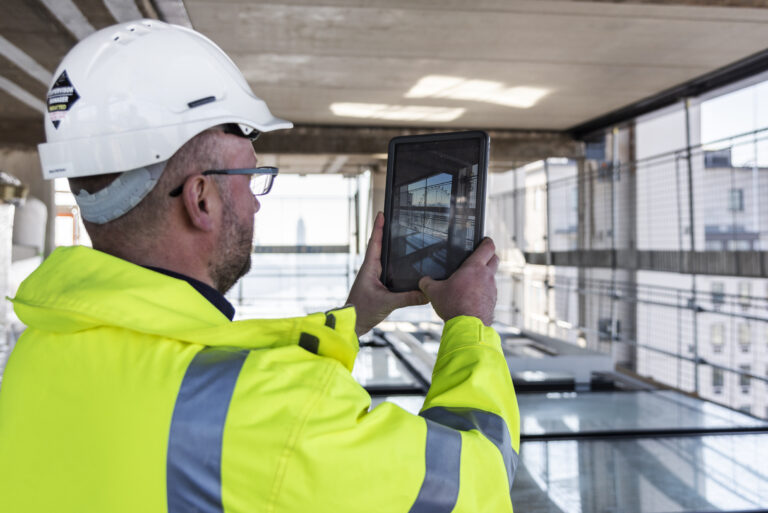
Automated progress tracking starts from the same site walks builders are already doing. A project engineer walks the construction site with a smartphone or 360-degree camera.
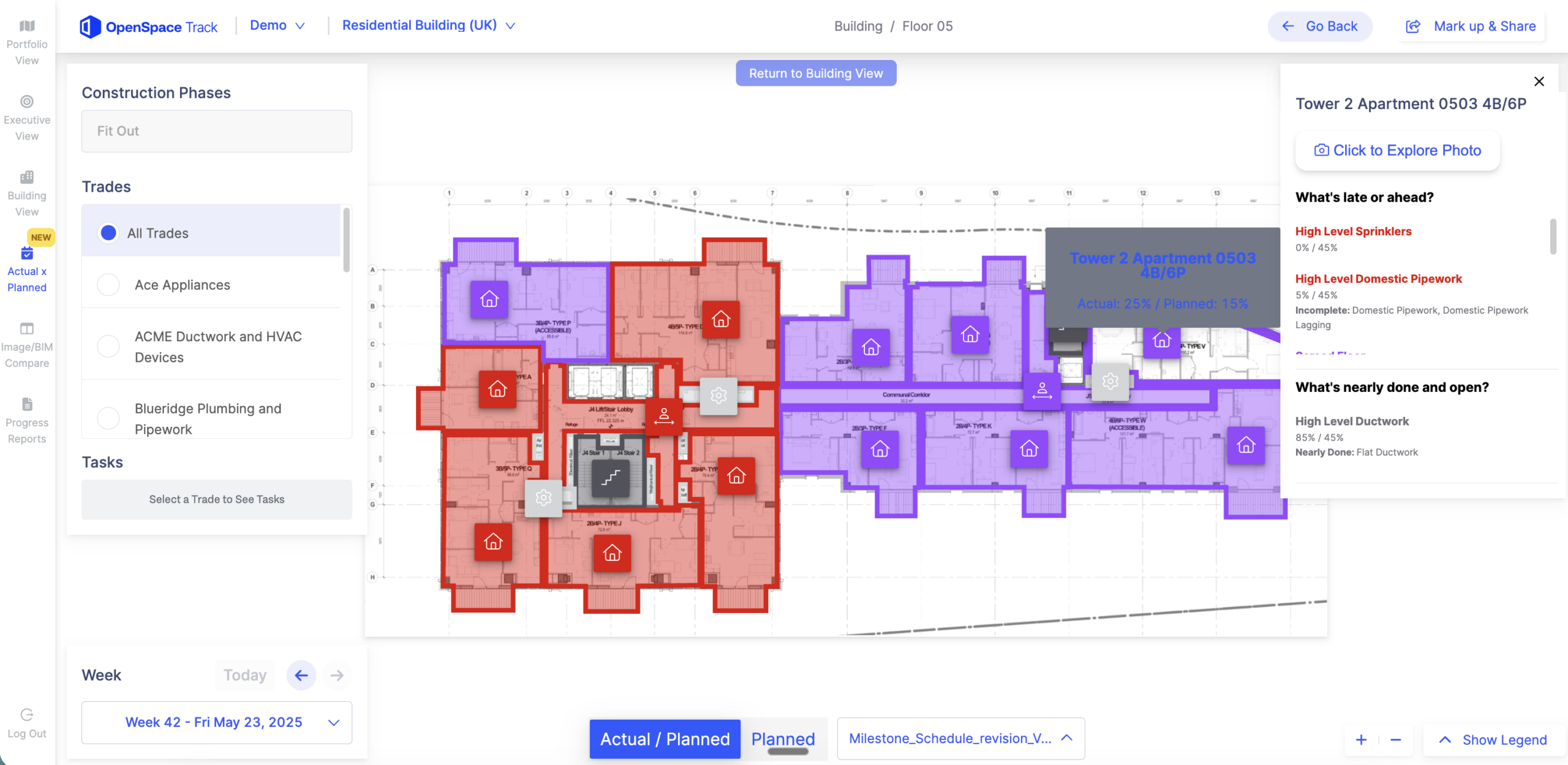
That walkthrough generates captured images that feed into an AI system using computer vision to identify installed components, map them against the project schedule, and compare actual progress against planned milestones. The result is a different kind of output across three dimensions: how fast insights arrive, what the system catches, and how much of the project it covers.
| Speed | Detection | Reach |
| Automated visual documentation produces trade-by-trade, floor-by-floor progress insights within 24 to 48 hours of capture. OpenSpace Track identifies over 700 visual components across 200 or more schedule tasks, from framing and drywall to MEP and finishes, without requiring BIM models. | AI flags out-of-sequence work automatically. If framing goes in where insulation was already logged, the system surfaces that anomaly rather than waiting for the next walkthrough. Spotlights in OpenSpace Track deliver these early warning alerts, allowing teams to act on schedule risks before delays compound into cost overruns. | A site walk covering 25,000 square feet takes around 10 minutes. AI then processes that visual information automatically, surfacing progress insights across the entire project, not just the subset of floors the superintendent reached before the end of the day. |
AI vs. manual construction progress verification: the five-dimension comparison
| Dimension | Manual walkthrough | AI-powered progress tracking |
| Accuracy | Varies by observer—subject to missed areas, fatigue, and reporting subjectivity | Consistent reading from site imagery across 700+ tracked visual components—verified by human experts before delivery |
| Frequency | Weekly or bi-weekly at best—cadence tied to superintendent availability and site access | Tied to capture cadence—weekly standard with 24-48 hour turnaround on verified progress reports |
| Scalability | Effort scales with project size— difficult to standardize across a portfolio without adding headcount | Same process regardless of project size—consistent across the entire portfolio without additional reporting overhead |
| Documentation quality | Dependent on individual diligence—captured images often undated, unlocated, or missing location context | Time-stamped, location-mapped, searchable visual record tied to schedule and BIM models where available |
| Cost of delay detection | Significant delays typically surface at 40-50% completion when schedule slippage becomes visible on-site | Productivity issues detectable as early as 10% completion, enabling cost control before overruns compound |
The comparison reflects a consistent pattern. Manual verification performs best when concentrated expertise meets a specific area of the construction site at the right time.
AI-powered progress tracking performs best at scale, frequency, and documentation quality, particularly on large projects where manual methods cannot scale AI-level coverage without proportionally increasing headcount.
That gap is widest on data center campuses, where labor shortages and compressed schedules are among the core challenges in modern data center construction.
The most consequential row in the table is cost of delay detection. Vito Antuofermo, Vice President at Commodore Construction, described the practical difference after deploying OpenSpace Track: his team had previously been unaware of significant delays and cost overruns until reaching 50 percent completion.
With AI-powered automated progress tracking in place, productivity issues became visible as early as 10 percent completion, enabling faster decision making and course-correction before the financial impact locked in.
That gap, 10 percent versus 50 percent, is a coverage and frequency story. Manual reporting simply cannot keep pace with the rate at which project reality diverges from the schedule on complex projects without automated systems running in parallel.
Why AI-powered verification still needs the human layer
Purely algorithmic progress tracking delivers estimates. Computer vision AI systems identify what is visible in captured images from site imagery and classify it against known components. What these systems cannot do reliably is interpret ambiguous actual conditions, account for mid-project design changes, or confirm that what appears installed is actually installed to spec.
This is why the hybrid model matters. OpenSpace Track combines AI-powered analysis with expert human review. Progress insights go through experienced professionals before delivery as a verified report. The output is reliable information the project team can take into payment applications and schedule reviews without flagging it as an estimate.
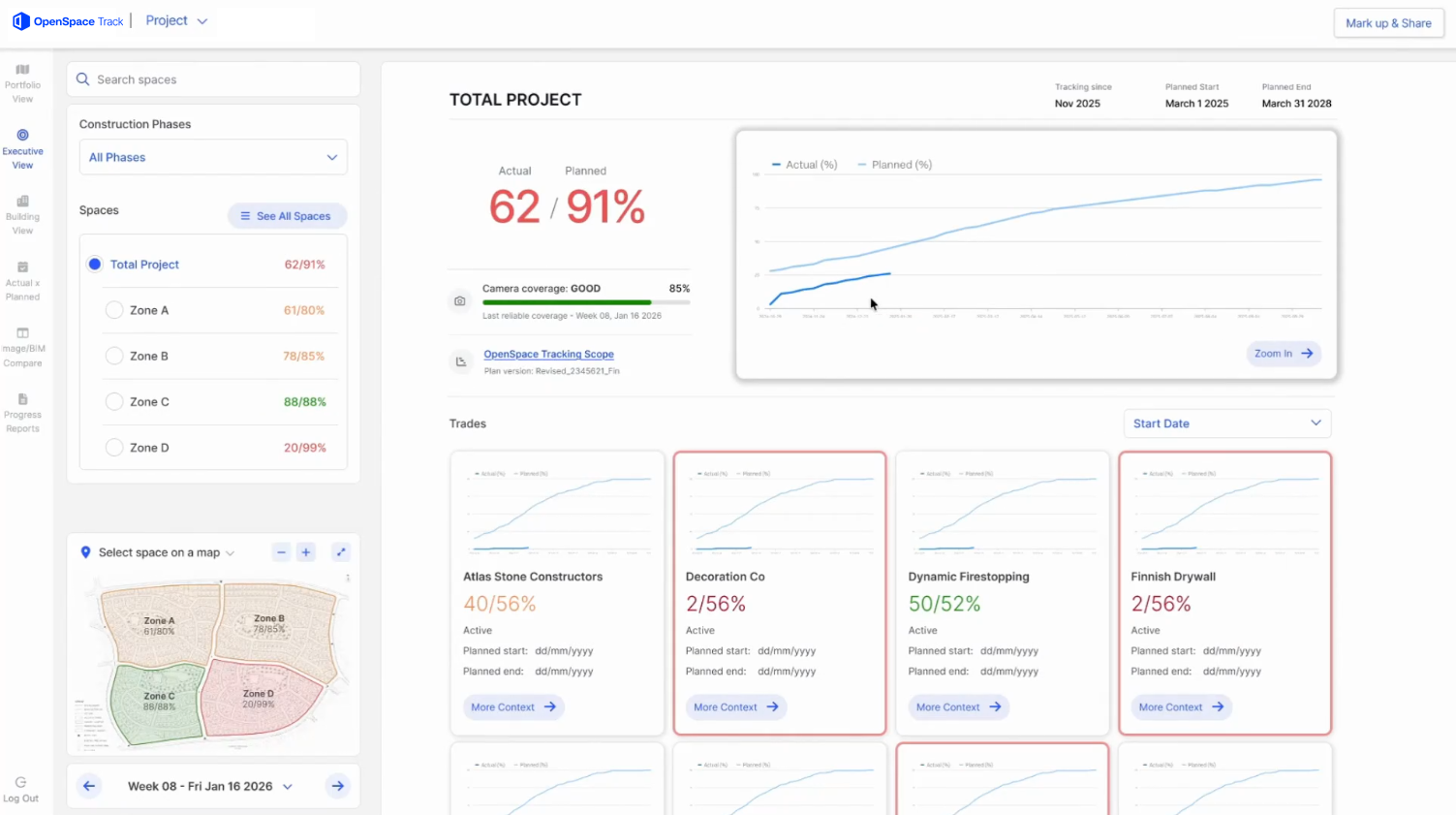
A verified reading matters where an estimate does not hold up: in payment disputes, schedule recovery conversations, and owner reporting. In each case, the difference between documented progress and reported progress determines who has the stronger position.
AI systems also integrate with the project management software builders already use. OpenSpace Track connects with P6, Asta Powerproject, Microsoft Project, and Excel, so progress documentation surfaces through project management dashboards rather than as a separate reporting layer requiring manual documentation to reconcile.
What gets missed without automated progress tracking
The categories of risk that manual documentation consistently underreports are the most expensive ones:
- Out-of-sequence installs go undetected for two weeks and become rework.
- Slow trades obscured by busier adjacent areas do not appear in project management reports until the floor is already behind schedule.
- Payment application claims that do not reflect actual progress create disputes that delay funding and strain subcontractor relationships.
None of these surface reliably through traditional methods. Daily logs record activity, not verified progress. Site walks cover a fraction of the construction site at a fixed point in time. Site conditions between visits go unobserved and undocumented, allowing teams to carry a false picture of progress into OAC meetings and cost control conversations.
On complex projects spanning multiple sites or dozens of floors, the gap between reported and actual progress compounds faster than traditional methods can track. Verified construction progress insights across the entire portfolio give project managers an early warning system that manual reporting structurally cannot provide. Without it, schedule risks accumulate undetected until they become schedule failures.
Common objections to AI construction progress tracking
| The objection | What is actually true |
| “We already take photos” | Captured images create a visual archive. AI-powered progress tracking compares those images against the schedule, classifies installed components, and generates verified percent complete values tied to specific tasks. Photo documentation records site conditions. Automated progress tracking produces progress insights. |
| “Will field teams actually adopt it?” | The capture workflow requires nothing beyond the site walks builders are already doing. A project engineer documents 25,000 square feet in around 10 minutes with no additional setup. AI systems handle the analysis. The team continues with other tasks while the walkthrough generates automated visual documentation. |
| “How accurate is it, really?” | Computer vision AI systems identify visual components from site imagery with strong consistency. The expert review layer in OpenSpace Track catches cases where actual conditions or design changes require experienced professionals to interpret before reliable information reaches the project team. This is why the hybrid model exists. |
Assessing your current approach: where does your process stand?
For project managers who want to evaluate their current construction progress verification approach against the five dimensions, the 5-Dimension Evaluation Framework for Construction Progress Tracking provides a simple scoring process. Each dimension scores from Ad Hoc (no repeatable process, verbal updates only) to Optimized (AI-powered, human-verified progress insights delivered on a fixed cadence with full schedule integration).
The five tiers are:
- Ad Hoc: no repeatable process; progress verification depends on individual memory and verbal reporting
- Inconsistent: some documentation exists but cadence, coverage, and format vary by project or superintendent
- Developing: a recognizable process is in place but degrades under schedule pressure
- Systematic: structured, repeatable verification with consistent output across the project team
- Optimized: AI-powered, human-verified progress insights on a fixed cadence with full schedule integration and automated out-of-sequence detection
Most construction projects sit between Inconsistent and Developing. The process exists, the site walks happen, and the reports go out. The problem is that the process degrades under schedule pressure exactly when accurate information matters most, and no one sees it happening until the schedule already reflects the damage.
Frequently asked questions
How does AI construction progress tracking connect to payment applications?
Verified percent complete values per trade and scope area, tied directly to the project schedule, give project managers accurate information to validate work in place before submitting payment applications. A system that tracks construction progress at component level reduces the manual review cycle that traditionally creates disputes over what was actually completed, shortening approval timelines and reducing payment delays.
Does AI-powered progress tracking require BIM models to work?
No. OpenSpace Track works from PDF drawings alone. It is among the modern software for automated progress tracking that do not require BIM to deploy, making it accessible to the full range of construction projects regardless of BIM maturity. BIM models integrate at Level 4 and above to enhance documentation quality and enable component-level comparison against design intent, but they are not a prerequisite for automated progress tracking.
Does AI-powered progress tracking replace the superintendent?
No. AI systems handle the systematic, repeatable work of classifying installed components and comparing actual progress against plan at scale across construction projects. Superintendents handle what AI systems cannot: contextual judgment, trade relationship management, and real-time decisions that require reading site conditions rather than captured images. The two functions are complementary. What changes is that the superintendent spends less time on manual report compilation and more time acting on the early warning signals the AI system surfaces.
How does the accuracy of AI-powered verification compare to a superintendent walkthrough?
They measure different things. A superintendent walkthrough captures expert judgment about actual conditions at a specific place and time. AI-powered progress tracking captures systematic, consistent readings across the entire construction site on a fixed cadence, verified by experienced professionals before delivery. The strongest construction progress verification system uses both: AI for coverage and consistency, human review for accuracy and interpretation. Neither approach alone reaches the Optimized tier on the 5-Dimension Framework.
The coverage gap is where schedule risk lives
Manual verification is not going away. The judgment, relationships, and contextual knowledge that experienced field professionals bring to a construction project cannot be encoded in a progress report. That expertise is irreplaceable on complex projects where actual site conditions diverge from design intent in ways that only someone who knows the project can interpret.
What AI-powered progress tracking adds is coverage, frequency, and documentation quality that traditional methods structurally cannot deliver at scale.
The construction progress verification system that earns the most trust from owners, survives payment disputes, and catches schedule risks before they become cost overruns is the one that combines both: systematic AI-powered automated progress tracking for consistency and scale, with experienced professionals verifying what the progress insights mean before they drive decisions.
That combination is what the Visual Intelligence Platform is built to deliver.
Ready to see what verified progress insights looks like on your projects? Request a demo of OpenSpace Track.