
Mission critical construction management is the work of delivering a facility that has to run without interruption from the day the owner accepts it. Data centers and hospitals are the clearest examples. The finish line on these projects is operator acceptance, and every system has to arrive there with proof attached. On both building types, crews also end up working beside live operations, and that changes how a project team plans and reports progress.
Below is a step-by-step approach to managing backward from acceptance, with reality capture keeping the record intact along the way.
What is mission critical construction management?
Mission critical construction management is the planning and verification work that carries a zero-downtime facility from preconstruction to operator acceptance. The general contractor or construction manager runs the project, but it works alongside other parties who all have a say in acceptance:
- Commissioning authority: tests systems and signs off each commissioning level
- Owner’s operations team: inherits the building and its record at turnover
- Infection preventionist (healthcare): sets containment rules for work in occupied areas
- Authority having jurisdiction: inspects and approves life safety work
What do mission critical construction management services include?
These services include commissioning support and phased turnover, which reach well past the punch list:
- Commissioning support, from site acceptance through integrated systems testing
- Phased turnover to an operations organization that will rely on the project record for years
On these jobs, the builder has to show what was installed and when.
Why mission critical construction management looks the same in data centers & hospitals
Both building types put construction next to people or equipment that can’t stop running.
Hospitals: building inside an occupied facility
A hospital renovation happens inside an occupied building. Patients and staff stay in place while crews work above ceilings and behind temporary walls. The American Society for Health Care Engineering published its ICRA 2.0 infection control risk assessment to guide interdisciplinary infection prevention during construction and renovation work.
Data centers: building beside energized halls
A data center campus becomes occupied in a different way. Owners often accept data halls in phases, so the second and third halls get built next to a first hall carrying live IT load. Colocation sales teams may have already promised customers a ready-for-service date. Each week of delay leaves owner spending tied up in a building that hasn’t started earning yet.
What does failure cost on a mission-critical project?
A major outage at a data center often costs more than $100,000, and some cost more than $1 million. Uptime Institute’s Annual Outage Analysis 2026 reports that 57 percent of respondents said their most recent major outage cost more than $100,000, and one in five put the cost above $1 million.
| Data centers | Hospitals | |
| What failure means | Lost uptime and broken service commitments | Risk to patients and clinical operations |
| Live operations nearby | Energized halls on a phased campus | Occupied floors and departments |
| Controlling process | Commissioning levels, through integrated systems testing | Infection control risk assessment and life safety measures |
| Where work gets hidden | Cable trays, raised floors, and containment | Above-ceiling MEP and in-wall utilities |
| Who accepts the building | Owner operations and the commissioning authority | Facilities team and clinical leadership, with inspector sign-off |
How do you manage a mission critical project backward from acceptance?
Start with the acceptance gate, list the proof each earlier gate has to produce, and schedule capture before that proof disappears. Documentation then sits on the schedule like any other activity, with a person responsible and a date.
On data centers, commissioning sets the sequence. JLL lays out seven stages of data center commissioning, from programming and design at level 0 to integrated systems testing at level 5 and transition to operations at level 6. Hospitals follow a different rulebook, though each gate there also needs evidence that stops being easy to collect once the work moves on.
Before work is concealed
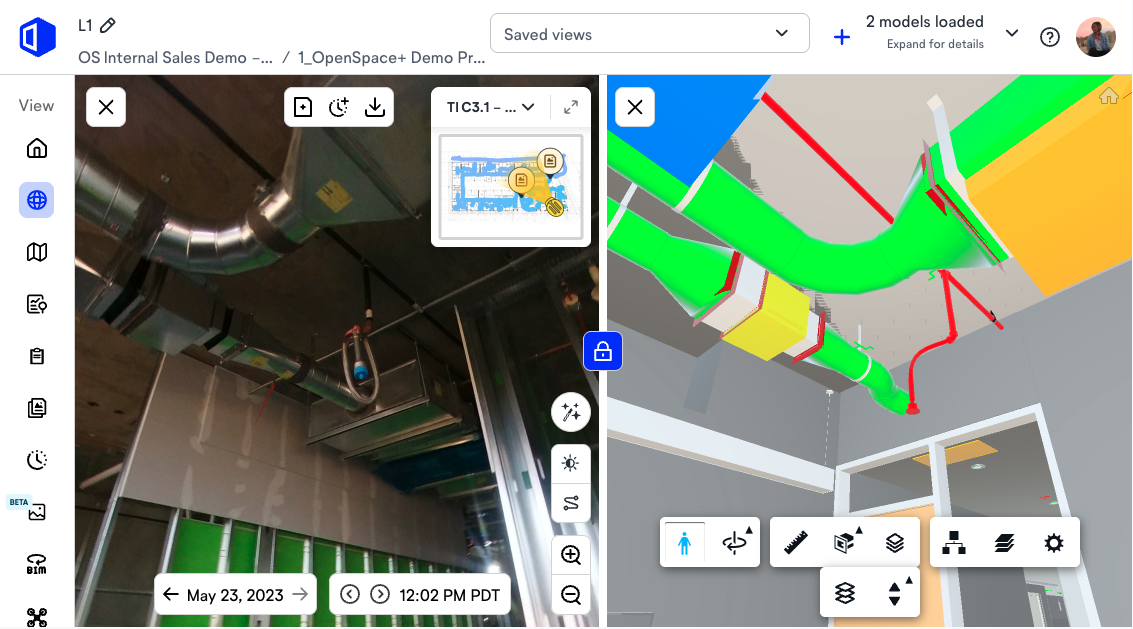
The first gate is concealment. Once a ceiling is closed or a slab is poured, checking what sits inside costs demolition and time. Teams that capture the full floor in 360° the day before closure keep a time-stamped view of conduit routing, sleeves, supports, and labels. OpenSpace BIM Compare places that capture next to the model, so a coordinator can spot a missing run before the drywall crew arrives.
“The gap I see is timing. Teams walk the area for the above-ceiling inspection, the inspector signs off, and then three more trades go up there before the grid gets tiled. The capture that matters is the one after the last trade is out and before the first tile goes in. Get every run, every hanger, every label, and the firestopping at each penetration. Then the superintendent and the MEP coordinator review it together. The super knows what changed this week, and the coordinator knows what the drawings say should be up there. On a data hall or a hospital corridor, that 30-minute review costs a lot less than opening the ceiling later.”
—Wesley DuBose, Product Manager, OpenSpace
Before systems are energized
Energization changes who can walk a space. In a data center, a powered room comes under tighter access control. On a hospital floor, tie-ins to live systems happen in short shutdown windows. If the team captures terminations and equipment tags right before energization, the commissioning authority can check that work from the record without waiting for an escort into a live room.
Before the operator signs off
At turnover, the operations team inherits the building and every question about what’s behind the finishes. Phone photos in shared folders are the usual tools for this, and they seldom hold up at turnover. A complete, location-pinned capture history answers those questions in minutes. It also gives the commissioning issues log a visual reference for each deficiency and its fix.
Turning site captures into schedule decisions
How often should mission-critical sites capture progress?
Mission-critical sites should capture more often than a typical commercial job, and more often still in dense MEP areas. Two real cadences show the range:
- Baseline: Suffolk expects a site capture at least every two weeks on every project.
- Mission-critical pace: on its Longcross data center project in the UK, Sweet Projects moved from weekly 360° walks to daily captures, sometimes twice a day.
The faster pace matches how fast conditions change once MEP trades stack up in the same rooms. For a broader look at methods and cadence, see this guide to construction progress monitoring.
How OpenSpace Track turns captures into schedule updates
Captures help the schedule once someone turns them into progress information. OpenSpace Track converts 360° captures, plus drone imagery where available, into weekly progress updates, with AI processing reviewed by trained specialists. For a mission-critical team, that means:
- More than 700 visual components tracked across more than 200 schedule tasks
- Planned versus actual progress by floor, zone, trade, and task
- Spotlights that flag rework and trailing trades
- Updates within about 48 hours of capture, pushed to P6, Asta Powerproject, Microsoft Project, and Excel
Teams evaluating progress tracking software for mission-critical programs can start with that planned-versus-actual view.
The Boldt Company has built healthcare facilities for more than 50 years. After adopting OpenSpace on its healthcare projects, Boldt reported 20 percent fewer scheduling delays.
“On a mission-critical job, the owner’s team is watching the same date the GC is, because a ready-for-service date or a clinical opening is tied to it. When the weekly meeting runs on self-reported percent complete, a lot of the hour goes to debating whether a zone is really at 80 percent. Verified progress takes that debate out of the room. Both sides look at the same installed quantities, so the conversation moves to what’s trailing and what it will take to recover. From my time in commercial real estate at a bank, I know a number you can trust early is worth more than a better number you get late.”
—Michaela Rhile, Product Manager, OpenSpace
See verified progress on your next data center or hospital project. Request a demo
Keeping the record consistent from first hall to handover
Standardize capture across the program
Many mission-critical programs run past one building. Hyperscale owners repeat a design across halls and campuses, and health systems run renovation programs across many sites. The organization that standardizes its capture routine early can compare like for like and grow its program without starting over at each site.
Linxon, a joint venture of AtkinsRéalis and Hitachi Energy, works on substations and data centers, among other power projects. It piloted OpenSpace on a major project in Saudi Arabia, then rolled it out across all active AMEA projects and extended it to Europe and North America. “Our planners collect site progress information they need quickly and effortlessly with OpenSpace,” said Manikandan Rangasamy, Head of Planning AMEA.
Use the record to defend claims & support operations
A consistent record also protects the builder. Andrew Moss, Project Director at Sweet Projects, used 360° captures to dismiss a claim on the Longcross build. “If I didn’t have OpenSpace, it would have been them against us,” he said. After handover, the operations team can use that same capture history as its reference.
Build adoption into the field routine
Both stories depend on crews capturing the site week after week, and that only happens when the routine is easy. Construction technology innovation pays off on these projects when field people adopt it. A capture that takes one walk with a 360° camera fits into the time crews already spend on site. OpenSpace builds on that capture as a Visual Intelligence Platform: one visual record supports progress tracking and field workflows on one platform, in place of separate point solutions.
Talk to the OpenSpace team about mission-critical delivery.
Frequently asked questions
Which delivery methods suit mission critical construction?
Design-build and construction manager at risk are common on mission-critical projects because they bring the builder in early. Early involvement helps the team plan around phasing and commissioning from the start. The right choice depends on the owner’s goals and appetite for risk.
How do teams verify N+1 redundancy during construction?
Teams verify N+1 redundancy, meaning one more component than the load requires, through functional and integrated systems testing that shows a backup unit taking over when one fails. The builder’s part is to install every redundant power and cooling path to design so those tests can run on schedule. A capture of each path before it is concealed gives the commissioning authority a reference if a test fails.
How do long-lead equipment delays affect mission-critical schedules?
Late switchgear or generators push back energization and every commissioning level that follows it. Teams protect the date by locking equipment orders during design and tracking installed progress against each delivery window.
What does Uptime Institute Tier certification mean for a construction team?
Tier certification rates a data center’s design and constructed facility against Uptime Institute’s Tier I to Tier IV topology standards. Commissioning levels and Tier ratings are separate systems, so a team can complete integrated systems testing without the facility holding a Tier certification. Owners who pursue certification of the constructed facility need the as-built conditions to match the certified design.
Build the acceptance record from day one
Mission critical construction management works best when capture sits on the schedule ahead of each gate. Plan it against concealment, energization, and turnover today, and the operations team gets a record it can use on day one and for years after.
Request a demo to see how OpenSpace supports data center and healthcare builds.