The biggest data center construction challenges are schedules with no float, cooling requirements that change as artificial intelligence pushes rack density up, and a shortage of electricians.
Builders also face mechanical, electrical, and plumbing (MEP) trades stacked on top of each other in dense halls, quality issues hidden behind closed walls, weak owner visibility across multiple general contractors, and security measures that limit site documentation.
Most of these problems start early and surface late, when fixing them costs the most. Builders overcome them by shortening the gap between the moment a problem starts and the moment someone sees it, backed by a verified visual record of the site.
Why are data center construction challenges harder to recover from on mission-critical projects?
Data center construction challenges are harder to recover from because owners usually lease the building before it exists. Once a hyperscaler or cloud services tenant signs for that capacity, the delivery date becomes a contract commitment, and the float is gone. CBRE’s H1 2026 North American data center report shows how tight the market is:
- More than 80% of capacity under construction in the primary markets was already preleased.
- About six months of available supply remained.
- Vacancy in Northern Virginia, the largest market, sat at 0.2%.
- Power constraints were extending completion timelines.
Land acquisition now follows grid infrastructure, because power grids set the ceiling on campus capacity. Even the right parcel can stall at zoning: Faegre Drinker’s review of data center real estate and construction challenges lists land-use approvals among the most common hurdles, with many communities pushing back on new facilities.
Projects that add renewable energy, such as wind power, solar panels, or battery storage, take on extra interconnection work and long lead times for critical equipment, supply chain constraints that sit on the critical path.
Rising material and labor costs add pressure, since a preleased building can’t absorb overruns by moving its date. With no float left, the essential protection is knowing where the job stands every week.
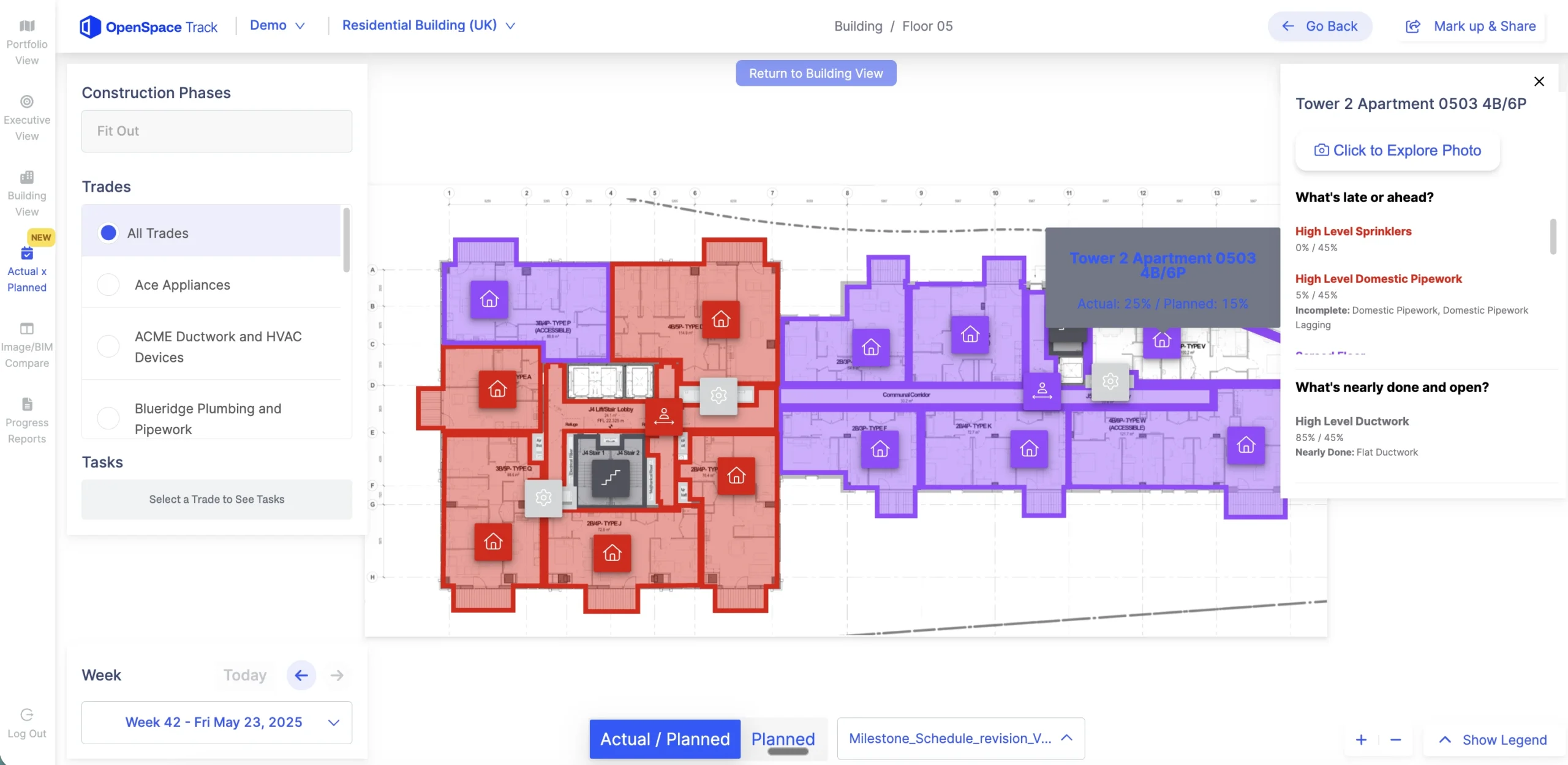
AI-powered construction progress tracking with OpenSpace Track compares captured site conditions against the schedule, with human review, so slipping areas show up in the next weekly report instead of the next monthly meeting.
Discovery lag: ranking supply chain, design & field risk on data center projects
Discovery lag is the time between the moment a problem starts and the moment someone on the project sees it. On data center projects, the challenges with the longest lag cost the most. A clash spotted the day it happens costs a conversation. Found during commissioning, the same clash means rework and significant delays to a date a tenant is waiting on.
That makes construction progress monitoring more consequential on a data center than almost anywhere else in the construction industry.
| Challenge | Where the problem starts | Where teams usually find it | What shortens discovery lag |
| Shifting cooling requirements | Design changes after rack density or tenant specs move | Change orders during MEP fit-out | A dated record of what crews installed before the change |
| Electrician shortages | Crew planning and regional hiring | Missed milestones in electrical rough-in | Fewer site trips for scarce specialists |
| Trade stacking and hidden quality issues | Out-of-sequence work in crowded halls | Commissioning and integrated testing | Captures before every close-in |
| Owner visibility across GCs | Inconsistent reporting between contractors | Pay application disputes and missed milestones | One visual record every party can check |
| Security restrictions | Access and photography rules set late | Documentation gaps in restricted rooms | Capture scope agreed before mobilization |
See how OpenSpace shortens discovery lag on data center builds. Get a demo.
What are the biggest challenges in modern data center construction & how do builders solve them?
The biggest challenges in modern data center construction are shifting cooling requirements, electrician shortages, trade stacking that hides quality issues, weak owner visibility across multiple GCs, and security limits on documentation. Builders solve each one by finding the problem while it is still cheap to fix.
Cooling requirements that shift as artificial intelligence raises rack density
Cooling requirements keep moving because the servers going into data centers keep getting denser. Uptime Institute’s 2026 Global Data Center Survey reports a growing number of data center operators with peak rack densities of 30 kW or higher.
High-performance computing equipment for machine learning often depends on new technologies such as liquid cooling, which changes piping routes and mechanical systems while the build is under way.
Each late change to cooling systems or backup systems, including added redundancy, becomes a change order against work already in place. Owner targets for energy efficiency, renewable energy, and lower carbon emissions add reviews of their own. Builders who can show what crews installed, where, and when the change arrived keep that cost conversation short.
Electrician shortages as data center growth outpaces the labor supply
Data center growth pulls hardest on the trades these buildings need most. Associated Builders and Contractors’ 2026 workforce analysis estimates the construction industry must attract 349,000 net new workers in 2026, and it ties surging demand for precision-wiring electricians to data center construction. Local governments court data center projects for job creation, but the crews still come from other regions and other jobs.
With crews that thin, every hour matters. Remote walkthroughs let engineers and owner’s reps review site conditions without a trip for every question, so electricians and supervisors stay on installation. With OpenSpace Capture, documentation happens during a normal site walk with a smartphone or 360° camera.
Trade stacking and quality that disappears at close-in
Trade stacking happens once electrical, mechanical, fire protection, and controls crews share the same data hall. Busway, cable tray, piping, and ductwork go in fast, with walls and ceilings close behind. Any error gets buried, and on complex facilities it tends to resurface during commissioning, the worst moment for the schedule.
Captures taken before each close-in turn buried work into something anyone can check later. On Sweet Projects’ Longcross data centre in the UK, Project Director Andrew Moss uses OpenSpace to confirm what sits inside a wall long after it closes. “If someone asks if a wall has insulation in it, I can say, let’s go back in time and look,” he says.
“You usually see it in the progress record before anyone says it out loud. One trade reports a zone as nearly done, and the next trade still can’t start there. Walk that zone the same day and capture it.”
—Michaela Rhile, Product Manager, OpenSpace
Owner visibility & pay disputes across multiple GCs on data centers
Owners building data centers often run several general contractors across one campus, each with its own reporting habits. Those reports agree until a milestone slips, and then nobody can say where the problem started. The same gap turns pay applications into negotiations.
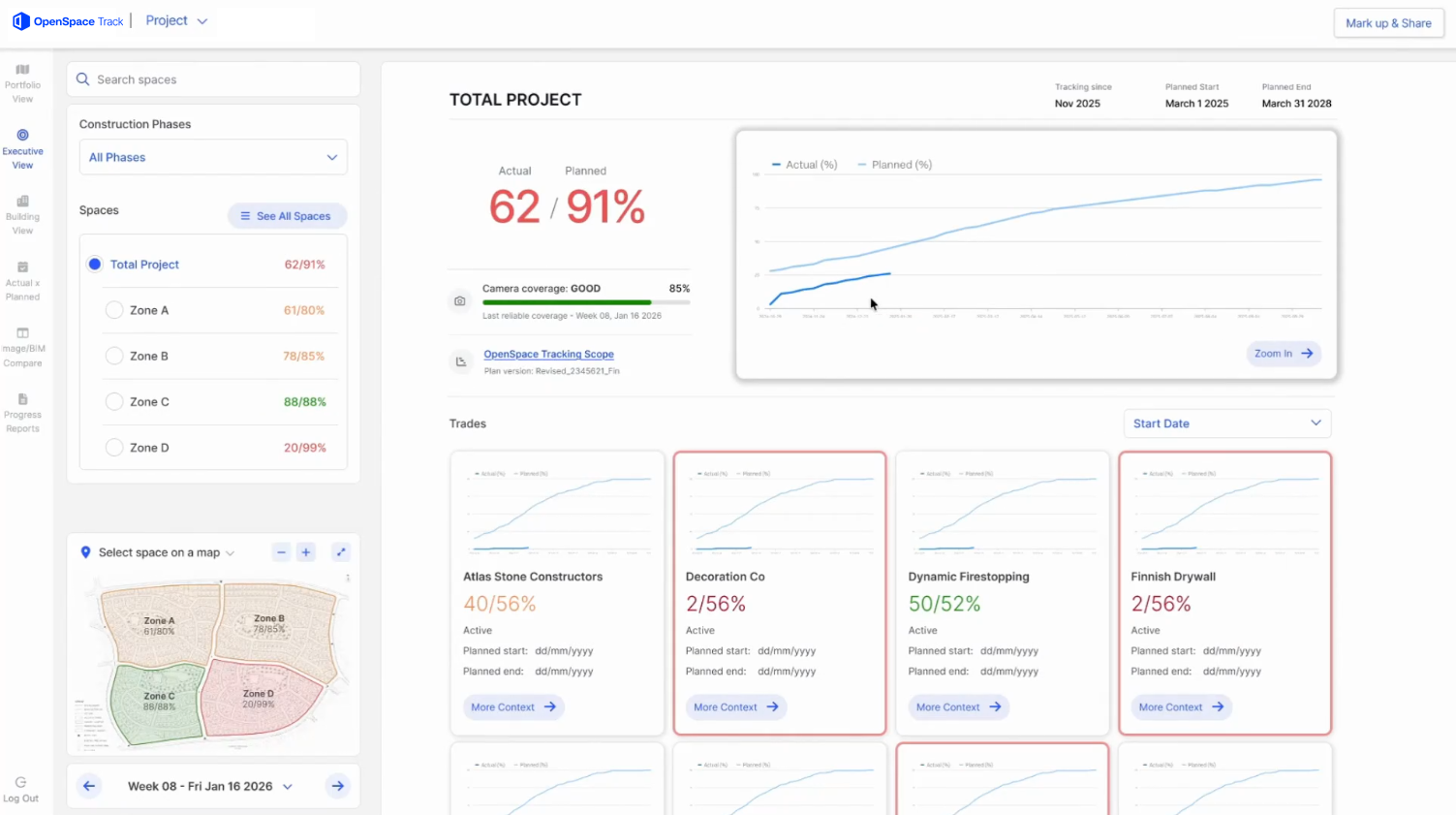
On one $1.2B+ hyperscale campus, OpenSpace Track runs on foundation works, replacing time-consuming manual check-ins with owner-level reporting. OpenSpace’s data center construction software gives owners, GCs, and program teams the same view of verified progress across buildings, so a disagreement can be checked against the record. After a claim at Longcross, Moss said: “If I didn’t have OpenSpace, it would have been them against us. Instead, I was able to unequivocally defend my position.”
Running a multi-building data center program? Talk to an OpenSpace expert about portfolio-wide visibility.
Security measures that restrict site documentation
Security measures on data center sites limit where cameras go and who sees the images. Operators protect access points, network rooms, and IT infrastructure layouts, and those rules often arrive after the documentation plan is set, leaving blind spots around the most critical equipment.
The fix is sequencing. Before mobilization, agree on four points with the owner’s security team:
- Capture scope, meaning which rooms and systems crews can document
- Restricted zones where cameras stay off
- Who can view and share site imagery
- Where the imagery is hosted
What changes in the data center industry when a program repeats across buildings?
When a program repeats across buildings, what building one documents becomes the baseline for every building after it. Each challenge above gets harder once a campus repeats it, and many owners plan the next five years of expansion on the same site with the same designs.
Programs that set a few standards on the first building give every later GC the same starting point:
- One capture cadence for every building and contractor
- The same capture zones across phases
- One reporting format, so owners can compare phases like for like
- Documented installs from each modular hall, used as the reference for the next one
With modular designs, that last point helps teams build faster without giving up reliability. Operators later inherit a visual record of what sits behind every wall, a long-term impact on data center operations.
Reality capture starts that record, and the OpenSpace Visual Intelligence Platform turns it into verified progress and owner reporting that carry across buildings. More than 1,000 data center projects worldwide have used OpenSpace to capture jobsite conditions.
Frequently asked questions
What are liquidated damages in data center construction?
Liquidated damages are a pre-agreed amount, usually charged per day, that a contractor owes the owner when a project finishes after the contract completion date. On data center projects, the daily rate often reflects the tenant revenue a late facility puts at risk. Dated, location-specific site records help contractors support time-extension claims when a delay originates outside their scope.
Is retrofitting an existing data center harder than building a new one?
Retrofitting an operating data center is often harder than building new, because crews work around live IT loads that cannot go down. Every tie-in to power or cooling needs careful sequencing, planned shutdown windows, and accurate records of existing conditions. Capturing those conditions before work starts reduces surprises once crews open walls and ceilings.
What is a site logistics plan on a data center campus?
A site logistics plan maps how people, equipment, and deliveries move around the jobsite, including laydown areas, crane positions, access roads, and security checkpoints. On a data center campus, it has to account for oversized equipment deliveries and phased work next to buildings that may already be operating. Updating the plan as each phase advances keeps deliveries from blocking active work zones.
Closing the gap on data center construction challenges
Global data center demand is absorbing capacity faster than builders can deliver it, even with construction at a record high. That gap, and the factors behind it, will set the pace for future programs across the data center industry. The teams that hold their dates find problems within days and deliver modern infrastructure on the date the tenant was promised.
Building a data center and need a clear view of every phase? Get a demo of the OpenSpace Visual Intelligence Platform.