Construction disputes are among the most expensive problems builders face. According to the Arcadis 2024 Global Construction Disputes Report, the average dispute value in North America reached $43 million, with resolution taking over 14 months on average.
For general contractors, owners, and project teams already managing tight deadlines and complex scopes, that timeline is project-ending.
Yet most construction disputes do not start with bad intent. They start with a documentation gap: the distance between what builders think happened on site and what they can actually prove.
Why construction disputes keep rising: what the numbers tell us
The scale of construction disputes is not a niche problem. Construction is one of the most litigation-heavy industries in the United States. Construction projects bring together multiple parties, including general contractors, subcontractors, owners, designers, and construction lawyers, each operating under different assumptions about scope of work, contract language, and project timelines. When disagreements arise, the party with better documentation wins.
The Arcadis 2023 Construction Disputes Report identified errors and omissions in contract documents as the number one cause of disputes in North America for multiple consecutive years. The second most common cause: parties involved failing to understand or comply with their contractual obligations. Both causes have documentation at their core. When construction documents are incomplete, ambiguous, or inconsistently applied in the field, disputes arise before the first backcharge is ever filed.
The documentation problem builders overlook in construction projects
Ask builders about their documentation practices and many will tell you they take photos. The problem is what happens to those photos. Image folders, scattered camera rolls, and disconnected daily reports create a system that no one can search, sequence, or rely on under pressure.
When construction issues arise, whether a disputed scope, a damaged installation, or a missed coordination detail, the question is never whether images exist. It’s whether the right image, from the right location, at the right date, can be found and trusted.
The volume of imagery on construction projects is enormous. What’s missing is structure: time-stamped captures tied to floor plans, organized by location, and accessible to all parties involved.
Construction lawyers and project managers who have navigated disputes know that the side with organized, verifiable records resolves faster and settles better. The side without them is left negotiating from memory.
What construction documentation & construction drawings need to do
Construction documents serve a purpose beyond record-keeping. They’re the evidentiary foundation for every contractual right a builder holds.
| Document type | What it establishes |
| Construction drawings | Design intent and the visual baseline for what is to be built |
| Detailed drawings | Scope definition at the component level: dimensions, materials, installation sequences |
| Full drawing set | The complete record against which field conditions are measured at every phase |
| Title blocks and sheet revisions | Which version of the drawings governed at each point in the construction process |
When construction projects enter dispute, construction lawyers on both sides return to these documents to reconstruct what was agreed, what was built, and where the two diverged.
A common misconception is that disputes are always about contract interpretation. Many are simpler: one party claims work was done, another claims it was not, and neither can produce a visual record that resolves the question objectively.
That gap is where disputes form. Design errors caught late, unforeseen site conditions, and out-of-sequence installs all generate claims at higher rates when the site record is incomplete. On projects involving MEP coordination or concealed structural work, the window to document before close-in is narrow. Once that window closes, verifying what’s behind the wall requires destructive investigation, at significant cost to all parties involved.
“The disputes that become expensive are the ones that surface after work gets covered. By the time someone files a backcharge or brings legal counsel into a conversation, both sides are reconstructing what happened from daily reports and camera rolls—and nobody’s camera roll is organized by location and date. The issue that causes the most damage isn’t missing documentation. It’s documentation that exists but can’t be used.”
—Wesley DuBose, Product Manager, OpenSpace
How visual intelligence changes the accountability picture in construction
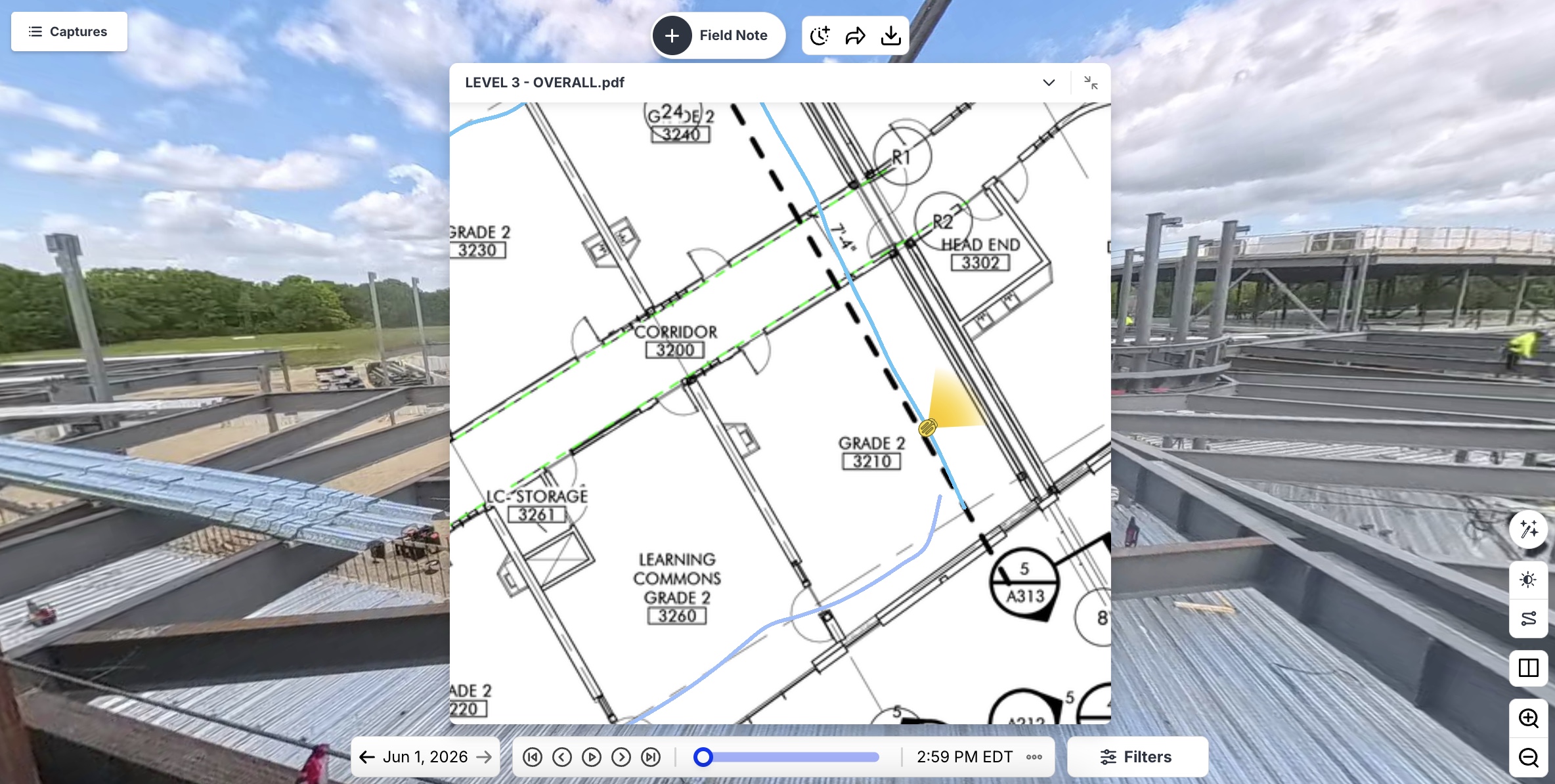
OpenSpace is the Visual Intelligence Platform for the built world. Powered by the Spatial AI Engine, it turns routine site walks into a structured, searchable, time-stamped visual record that maps every capture to a floor plan location. That turns construction documentation from a collection of images into a living record of the construction process—one that every party can access and that no one can credibly dispute.
When questions arise about site conditions, scope completion, or work-in-place, teams go to the captures—a visual record that shows exactly what was present, where, and when. Not to a spreadsheet. Not to a chain of emails. This is how preventing disputes should work: clear communication built on objective evidence, not recollection.
![[Capture] Split View](https://www.openspace.ai/wp-content/uploads/2026/06/Capture-Split-View-scaled.png)
To see how OpenSpace supports dispute prevention across your projects, request a demo.
U.S. Engineering: catching design errors before close-in
U.S. Engineering, an MEP contractor operating across the Rocky Mountain region and Midwest, adopted OpenSpace to build a more defensible construction documentation practice across their jobsites. On a hospital project in North Dakota, Quality Control Manager Chad Lucks used BIM Compare to spot missing pipe installations before ceiling closeout.
The team was able to identify the issue before the ceiling was sealed. Catching that discrepancy between design intent and field conditions at that stage, rather than after close-in, meant no destructive investigation, no change order dispute, and no impact to the completed project schedule.
The detailed drawings showed what should have been there. The visual record showed what was actually there. BIM Compare surfaced the difference. That is the architectural process of construction verification applied in real time.
“The coordination meeting is when conflicts are identified. It’s rarely when they’re resolved. When field teams can pull up a capture and compare it directly against the model, you’re no longer asking someone to describe what they saw last Tuesday—you have a shared reference point for what was actually there. That changes the conversation from ‘who’s right’ to ‘here’s what we’re looking at.’ Alignment happens faster because both sides are working from the same visual record, not two separate accounts of the same space.”
—Molly Taylor, Senior Product Manager, OpenSpace
From dispute resolution to dispute prevention: the documentation shift
Most builders think about construction documentation reactively: something to produce when a claim lands. The builders with the strongest dispute resolution outcomes think about it differently. Documentation is a daily workflow, and its value compounds over the life of a project.
Disruption claims, payment terms disputes, and questions of contractual obligations all share a common pattern: they are easier to defend when the visual record is continuous, not assembled after the fact. On projects with multiple parties, frequent subcontractor handoffs, and tight deadlines, a consistent capture cadence means every phase of work has a verifiable baseline. Future disputes over scope, site conditions, or sequencing have fewer open questions.
For small business owners in the trades, this matters as much as it does for large general contractors. Backcharges and billing disputes disproportionately affect smaller contractors who lack the legal resources to fight prolonged claims. A clear, accessible visual record is the most cost-effective form of legal counsel a contractor can maintain. It keeps disputes from forming in the first place.
OpenSpace supports construction documentation workflows for builders of every size, from specialty trades to enterprise general contractors managing multi-phase portfolios.
Documentation, insurance & the financial case for visual intelligence
Construction law treats documentation as evidence. Insurers treat it as a risk. When builders maintain consistent, time-stamped visual records across construction projects, insurers can assess exposure more accurately, and that assessment tends to work in the builder’s favor.
The types of construction claims that generate the highest exposure, including disputes about concealed work, damage attribution, safety regulations compliance, and building codes verification, are also the claims that visual records resolve most directly.
Builders can reduce legal counsel costs, shorten arbitration provisions proceedings, and demonstrate contractual rights with evidence. Learn more about how consistent documentation supports reducing insurance costs through construction documentation.
Frequently asked questions
How long should builders retain site documentation after a project is complete?
Retention requirements vary by jurisdiction, contract type, and project scope, but most construction lawyers recommend keeping site documentation for a minimum of 10 years after substantial completion to cover standard statutes of limitations for construction defect claims. Projects with long-tail liability exposure, including healthcare, infrastructure, or public works, commonly require retention periods of 15 to 20 years. A time-stamped, searchable visual record stored on a platform like OpenSpace is significantly easier to retrieve and present years after project closeout than folders of unstructured photos
How can construction documentation help resolve disputes faster?
Time-stamped, location-tagged site captures create a verifiable record that both parties can reference. When visual records are organized by floor plan location and date, as they are in OpenSpace, project teams spend less time arguing about what happened and more time resolving the actual disagreement. Many builders find that thorough documentation prevents formal disputes from forming at all, particularly in billing and backcharge situations common across construction projects in different countries and project types.
When should builders consult construction lawyers about documentation practices?
Construction lawyers are a valuable resource when structuring contract terms and identifying which types of construction documentation carry legal weight in your jurisdiction. Many construction lawyers recommend establishing a documentation protocol before a project begins, covering capture cadence, naming conventions, and access rights as part of the project kickoff. For construction projects with complex scope of work, multiple parties, or significant contract value, legal counsel involved early in documentation planning reduces exposure across the full construction process.
Build a record that holds up
Construction disputes cost builders time, money, and relationships. The industry’s exposure to disputes is growing, driven by project complexity, tight deadlines, and the volume of parties involved across modern construction projects. What builders can control is the quality of their documentation.
A time-stamped, location-mapped visual record is more than a risk management strategy. It’s how builders maintain accountability, support clear communication across project teams, and resolve issues before they become claims. That’s what the Visual Intelligence Platform delivers: not just more images, but more confidence in every decision made from the field.
Ready to reduce disputes on your next project? Request a demo to speak with an OpenSpace expert.