Artificial intelligence is changing what construction jobs contain rather than removing the people who do them, whatever the chatbots and the headlines suggest.
The more useful model comes from OpenSpace co-founder and CTO Michael Fleischman, who describes the technology as more Iron Man than Terminator: an exoskeleton giving workers total recall and the ability to be in two places at once. That framing matters now because the construction workforce is losing experienced workers to retirement faster than new workers arrive.
What does AI actually change about construction jobs?
AI will not replace construction workers, because the hard part of construction work is judgment applied to conditions that change hourly, and judgment is what the technology struggles most to produce on its own. A superintendent walking a floor filters forty possible problems down to the three that will delay projects if nobody acts today. That filtering draws on trade skills, decades of pattern recognition, and knowledge of how a crew works.
Artificial intelligence handles the surrounding load, which eats a significant portion of a project management week without needing twenty years in the skilled trades.
| Work AI absorbs | Work the person keeps |
| Data entry and photo sorting | Deciding which issue gets attention |
| Assembling the weekly owner report | Judging whether a subcontractor is behind |
| Checking installed work against the schedule | Calling the sequencing change on the floor |
| Surfacing a plan-to-site discrepancy | Approving pay applications and schedule sign-off |
Fleischman puts the dependency plainly: AI is only as good as what you give it to see.
Will AI replace construction workers in every trade?
No. Exposure tracks with how repeatable the work is. IMF analysis of AI exposure across the global workforce found construction more likely to be complemented by the technology than displaced by it. Inside the sector the same logic holds: takeoff, quantity checks, and report assembly sit closer to automation than a crane operator reading a lift or a construction manager sequencing trades.
What does AI augmentation look like on a construction site?
Augmentation shows up as two abilities a person working alone does not have.
Total recall across every construction project
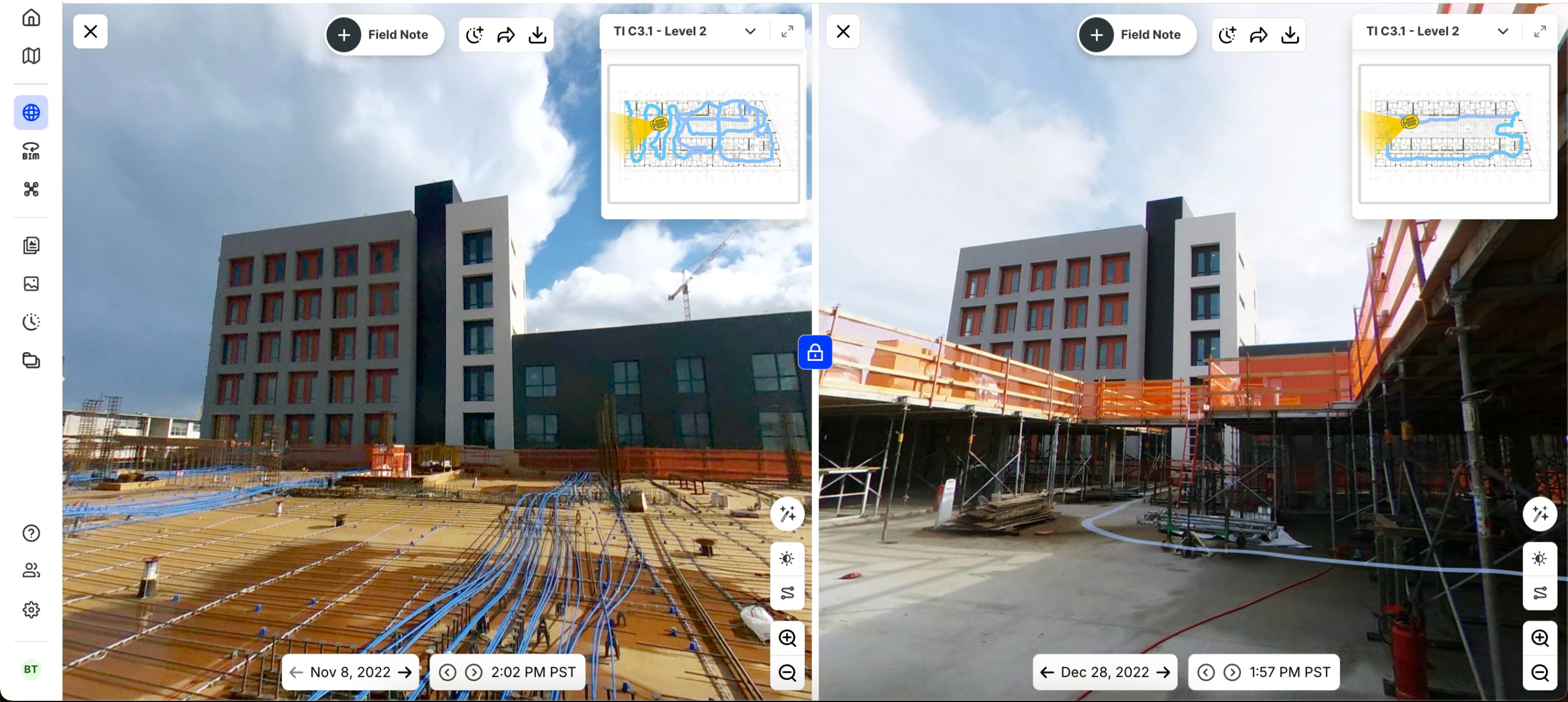
A located visual record makes every square foot of a project retrievable months later. On the Digital Builder podcast, CEO Jeevan Kalanithi described a superintendent who called early on to say OpenSpace saved him in a conflict with a trade partner. The team pulled up the image and the argument ended. Construction disputes over installed work usually cost days, and photographic recall closes them in minutes, answering project delays that start as disagreements.
Being in two places at once
The second ability is presence without travel, which is what remote construction site monitoring makes possible. A project executive covering four construction projects across two states can review all of them before lunch. General contractors use it to keep senior judgment on more jobs when there are not enough skilled workers to put a veteran on every site.
“When a superintendent tells me the platform saved them time, they are almost never talking about the walk. They are talking about the hour after the walk. Sorting photos, labeling them, and hunting for the one that shows the sleeve before the wall closed. That work used to happen at night. What it does not save you from is the walk itself. You still have to go look at the work, and any super who stops doing that is going to miss something a camera was never going to catch.”
—Wesley DuBose, Product Manager, OpenSpace
Labor shortages & the construction workforce math behind the urgency
The construction industry needs to attract an estimated 349,000 net new workers in 2026, according to Associated Builders and Contractors, a model built on Census construction spending and Bureau of Labor Statistics employment data.
| Year | Net new workers the construction industry must attract |
| 2025 | 439,000 |
| 2026 | 349,000 |
| 2027 | 456,000 |
Most coverage stops there. The composition matters more. The 2026 figure is the smallest projected shortfall since 2021, and ABC chief economist Anirban Basu noted that a majority of new worker demand in 2026 comes from retirement rather than increased spending on construction services.
The construction labor shortage is now a story about departure rather than growth, which makes retention of institutional knowledge a critical challenge for construction firms, not just a recruiting problem.
Contractors are having a hard time finding workers across the construction trades and in project management roles.
The retirement split changes what a solution looks like. Recruiting efforts, technical education programs in high schools, competitive pay, and clearer career paths address the count of qualified workers, and a sustainable construction workforce needs all of them.
None replicates what a superintendent learned over thirty years. When that person retires, the count of skilled labor can be restored while the judgment is not.
“A system can capture what a superintendent did. It can hold every sequence they ran, every issue they flagged, and what the job looked like the week they made each call. A new PM can study that. What a system cannot capture is the part that happens before the decision, walking onto a floor and knowing something is off before anyone can tell you what. That is pattern recognition built from 25 years of consequences, and nothing records consequences. The goal worth aiming at is shortening how long it takes the next person to build that instinct.”
—Gabriel Denis-Arrue Munes, Product Manager, OpenSpace
Can AI capture what experienced workers know before they leave?
AI can capture part of what experienced workers know: the part that shows up as a repeatable pattern across projects. Fleischman has pointed out how rarely this happens: lessons from one building transfer to the next only when the same person works both jobs.
Encoding changes that. When weekly capture, schedule comparison, and field observations sit in one place, machine learning has a portfolio to learn from. Fleischman puts OpenSpace’s own footprint at roughly 80,000 projects across 125 countries and 52 billion square feet captured. A firm can ask why three buildings took longer than four others and get an answer grounded in what was visible on site.
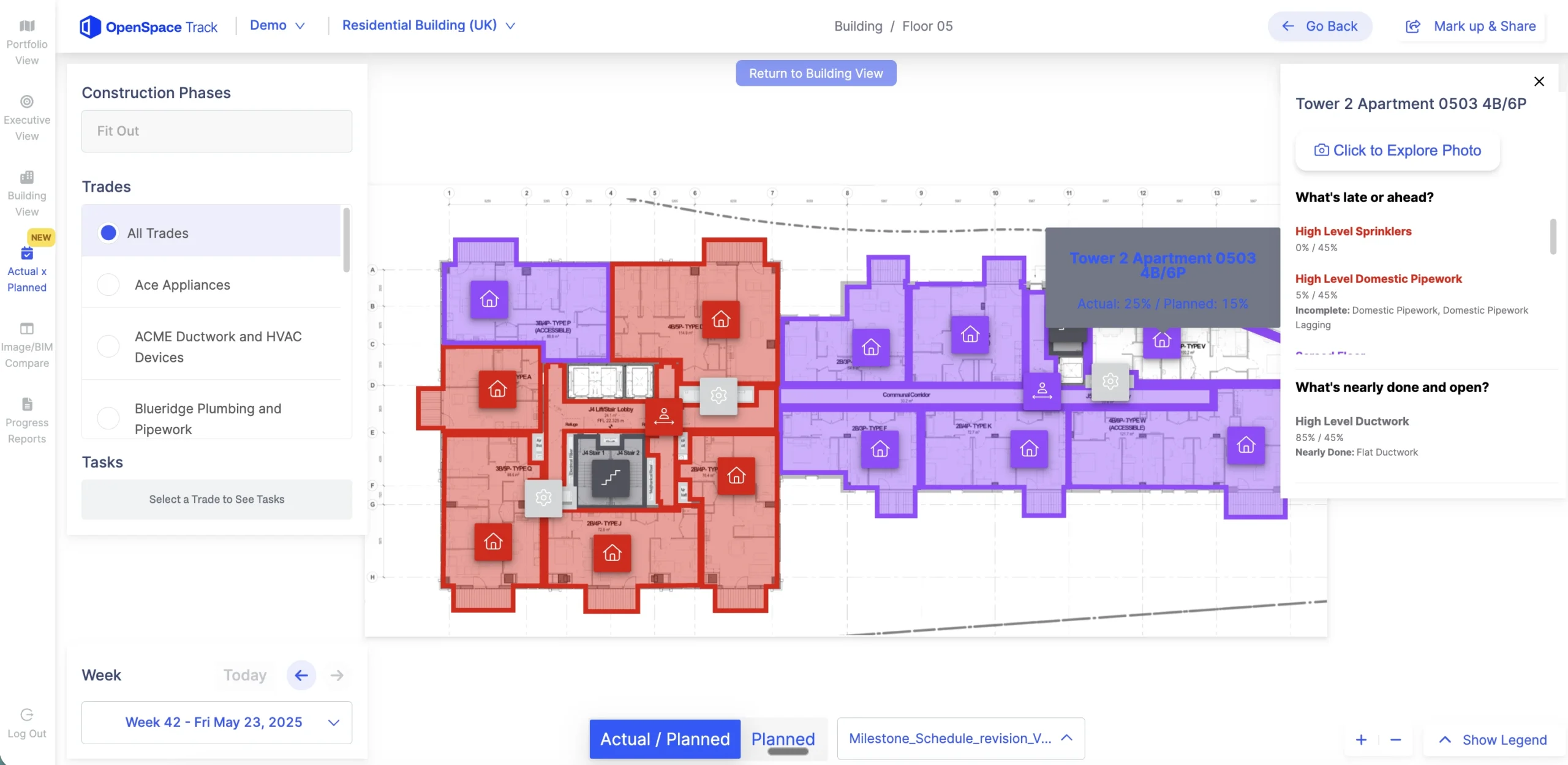
Construction progress tracking is where this becomes practical. Planned versus actual comparison runs week over week, Spotlights flag conditions the system suspects are wrong, and a younger project engineer sees the discrepancy a veteran would have caught on a walk. The engineer still decides what to do, and the ramp gets shorter.
Where does the human stay in charge?
The human stays in charge because the human carries the responsibility. Fleischman is direct about this: whatever an agent does on a project, accountability sits with the person who deployed it.
That principle has a practical consequence. A person signs off on OpenSpace progress output rather than letting it publish on its own, which makes it defensible when a decision carries money or liability:
- Approving a pay application against percent complete
- Signing off on a schedule update an owner will rely on
- Deciding a safety condition warrants stopping work
- Accepting or rejecting installed work before it gets covered
In the field, AI autolocation pins an observation to the right spot on the plan and voice notes route a spoken comment, but field notes and issue tracking still depend on someone noticing that something is wrong. That human touch is the input.
See what this looks like on your project, request a demo.
What does augmentation actually return to a team?
It returns hours, and published customer accounts put numbers on them:
| Team | Documented result |
| NOVO Construction | An AI agent drafts 85 to 90 percent of the weekly owner report |
| BESIX Watpac | Site documentation time down 90 percent |
| Joeris | A project engineer walks the site in 4 hours a week, about a tenth of the manual equivalent |
| Linxon | Managers report 10 to 15 percent less time on site, plus fewer admin hours |
Nobody at NOVO lost a job. The report used to eat most of a workday; teams now spend a few minutes refining it and put the hours into RFIs, submittals, and field problems. CIO Colin Stoner describes AI as augmenting his experienced builders and freeing them for higher value work.
Linxon shows the other half of the pattern. Safety engineers there review each other’s captures across projects, so instead of one HSE team per job, several specialists look at the same site. Reporting effort fell and the number of experienced people examining each project rose. That is augmentation working: more expert attention per project.
NOVO had captured projects the same way since 2017, giving the agent nine years of organized visual history. Firms that start capturing now will have that history in a few years.
“The first thing that breaks is review. When a person builds the report by hand, they read every line as they write it, so mistakes get caught by accident. Automate it and that accidental review disappears. The teams that handle this well replace it on purpose. Someone owns the read before it goes out, and they know which sections tend to drift, usually percent complete on work that is partially installed. The report gets faster and someone still signs their name to it.”
—Michaela Rhile, Product Manager, OpenSpace
What does this mean for construction careers & younger workers?
Construction jobs are becoming more supervisory and less clerical, a better pitch to young people than the one the industry has made for years. Manual labor and data entry are shrinking shares of the week, while job stability, growing demand, and specialized roles pairing trade skills with technology hold up well against other industries chasing the same talent.
The people who do well will be the ones who can direct these systems and check the work, which is worth teaching in technical education.
Augmentation is easiest to judge on a project you know. See where the hours go now, what a system takes off a superintendent’s plate, and which calls stay with your team. Request a demo.
Frequently asked question
Are construction robots replacing workers on jobsites?
Physical robots handle a narrow set of repetitive tasks such as layout marking and rebar tying, under supervision. Most AI in construction today is software analyzing what already happened on site. Robotics adoption remains limited by cost and by the variability of the work.
Do field crews need training to work with AI on a project?
Most crews need very little. Capture takes minutes to learn and the AI runs after the fact, so a foreman’s workflow hardly changes. The heavier training sits with construction managers who interpret the output and decide what to act on.
What should a contractor adopt first to improve productivity with AI?
Start with consistent capture on active projects, because every AI capability downstream depends on a visual history. Then pick one recurring task that eats hours, such as the weekly owner report, and automate it before expanding.