The largest data centers in the US are campuses built for artificial intelligence and measured in gigawatts, and Meta’s Hyperion campus in Richland Parish, Louisiana, leads the list. Meta plans up to 5 GW of power capacity and about 10 million square feet there at full build-out, with Turner, DPR Construction, and Mortenson building it on a timeline that runs to 2036.
Measured by power running today, the title of largest data center in the US is contested. Epoch AI estimates about 1 GW of IT capacity each at the AWS campus in New Carlisle, Indiana, and xAI’s Colossus 2 in Memphis, while Cleanview, which counts grid power, puts Colossus 2 first at 1,820 MW.
A data center campus is a group of data halls that share land, a substation, and backup systems. This ranking covers 15 U.S. data center campuses where construction has started or finished. Each row names the general contractor (GC), the build phase, and the time from groundbreaking to first power. Figures come from operator releases and county filings, current as of November 2nd, 2026, with updates every year.
The largest data centers in the US, ranked by power capacity (2026)
The table ranks campuses by planned power capacity in megawatts (MW), the measure that best answers which campus is the largest data center in the US. Few operators publish energized capacity for a single campus, so “est.” marks an independent estimate from Epoch AI or Cleanview, which track data centers through satellite imagery, permits, and grid filings.
| # | Data center campus | Operator | Location | Planned power capacity | Energized, late 2026 | Size | General contractor | Timeline | Build phase |
| 1 | Hyperion | Meta | Richland Parish, LA | Up to 5,000 MW at full build-out | 0 MW (est.) | ~10M sq ft; 3,200+ acres | Turner, DPR Construction, Mortenson | Groundbreaking Dec. 2024; build-out 2036 | Under construction; interior buildout under way |
| 2 | Colossus 2 | xAI (SpaceX) | Memphis, TN, and Southaven, MS | ~2,555 MW grid power at full build-out (Cleanview est.) | ~946 MW IT (est., June 2026) | Not disclosed | Not disclosed | First Colossus cluster online Sept. 2024; Colossus 2 online Jan. 2026 | Operating; expanding |
| 3 | New Carlisle (Project Rainier) | AWS | St. Joseph County, IN | 2,200+ MW | ~1,037 MW (est.) | 870 acres (2024 filing) | Not disclosed | Groundbreaking Sept. 2024; opened Oct. 2025 | Operating; expansion under construction |
| 4 | Project Jupiter (Stargate) | Oracle and OpenAI, with STACK and BorderPlex | Doña Ana County, NM | ~2,200 MW facility power (est.) | 0 MW | ~700 acres | Not disclosed | Started Q4 2025; first operations targeted Q4 2026 | Under construction |
| 5 | Richmond campus | QTS | Henrico County, VA | ~2,054 MW at full build-out (Cleanview est.) | ~921 MW (Cleanview est.) | 3M+ sq ft built; ~8M sq ft and 26 buildings planned | HITT Contracting (RIC4 expansion only) | Site bought 2010; 622-acre rezoning May 2024 | Operating; expansion site work under way |
| 6 | Fairwater | Microsoft | Mount Pleasant, WI | ~1,480 MW (grid load notice) | ~369 MW (est.) | 315 acres; ~9M sq ft more approved Jan. 2026 | Walsh Construction (phase one) | Groundbreaking 2023; first facility complete June 2026 | First facility operating; second due 2028 |
| 7 | Frontier (Stargate) | Vantage Data Centers | Shackelford County, TX | 1,400 MW critical IT | 0 MW | 3.7M+ sq ft; 1,200 acres | Kiewit | Groundbreaking Dec. 2025; first building 2H 2026 | Under construction |
| 8 | Lighthouse (Stargate) | Vantage Data Centers | Port Washington, WI | 1,300 MW initial, up to 3,500 MW | 0 MW | 672 acres; four buildings | Whiting-Turner, Weitz, Michels, Turner-McCarthy JV | Groundbreaking Dec. 2025; opens 2028 | Under construction |
| 9 | Abilene (Stargate) | Crusoe for Oracle and OpenAI | Abilene, TX | 1,200 MW | 618 MW (Sept. 2026) | ~4M sq ft; eight buildings | DPR Construction | Started mid-2024; first phase live Sept. 2025 | Final buildings coming online |
| 10 | Milam County (Stargate) | SB Energy | Milam County, TX | 1,200 MW | 0 MW | Not disclosed | SB Energy (builds and operates) | Started Q3 2025; completion Q4 2028 (est.) | Under construction |
| 11 | The Barn (Stargate) | Related Digital for Oracle and OpenAI | Saline Township, MI | 1,000+ MW | 0 MW | ~1.65M sq ft; 250 acres | Walbridge | Started Q4 2025 | First building nearly complete |
| 12 | Prometheus | Meta | New Albany, OH | 1,000 MW | ~471 MW (est.) | Not disclosed | Not disclosed | Site clearing 2022; online 2026 | Partly operating |
| 13 | Council Bluffs | Pottawattamie County, IA | ~696 MW operating (Cleanview est.) | ~696 MW (Cleanview est.) | ~3M sq ft | Not disclosed | First data center opened 2009 | Operating; expanding | |
| 14 | Citadel Campus | Switch | Storey County, NV | Up to 650 MW | Not disclosed | 7.2M sq ft planned | Not disclosed | First building opened Feb. 2017 | Operating; expanding |
| 15 | Fairwater Atlanta | Microsoft | Fayetteville, GA | ~636 MW (est.) | ~636 MW (est.) | 1M+ sq ft; 85 acres | QTS | Opened Nov. 2025 | Operating |
Two power-first campuses to watch
Two projects announce more power than anything on the list, but both start with a power plant. Both join the ranking once data hall construction is under way.
- Project Matador, Fermi America (near Amarillo, TX): up to 11 GW planned. Construction paused in February 2026 while Fermi waited on an air permit.
- Homer City campus (Indiana County, PA): a 4.5 GW gas plant paired with an AWS plan for 36 buildings, with first power targeted for 2027.
Why do data centers use megawatts instead of square footage?
Data centers use megawatts because power sets how much computing a facility can run, so the data center industry sizes campuses by power. Data Center Knowledge describes MW as a consistent proxy for the servers and computing workloads a site can support. Square footage is a looser measure, because power density per rack varies so much from one building to the next.
Compare two rows in the table. Abilene packs almost twice the power of the Citadel Campus into about half the floor area:
| Data center campus | Square footage | Planned power capacity | MW per million square feet |
| Citadel Campus (Switch) | 7.2M sq ft planned | Up to 650 MW | ~90 |
| Abilene (Crusoe) | ~4M sq ft | 1,200 MW | ~300 |
AI workloads and other large-scale data processing pack dense GPU racks into data halls, which pushes power consumption per square foot up. Older halls moved cool air through raised floors. Designers of AI halls now put cooling efficiency and energy efficiency first, since power costs climb with every megawatt.
IT capacity vs. facility power
If you compare rows, check whether a figure counts IT capacity or facility power. IT capacity is the power that reaches servers and networking equipment, and facility power adds cooling and electrical losses on top. Vantage lists Frontier at 1,400 MW of critical IT, while Epoch estimates about 2,000 MW of total facility power for the same site.
The energization gap: announced capacity vs. power delivered at each data center campus
The energization gap is the difference between the power capacity an operator announces and the power running inside commissioned data halls. That gap is the construction still to deliver, and it’s where schedule risk and data center capital sit. Each time an operator announces a data center expansion, its gap gets wider until crews catch up.
| Data center campus | Planned capacity | Energized, late 2026 | Share delivered |
| Abilene | 1,200 MW | 618 MW | ~52% |
| New Carlisle | 2,200+ MW | ~1,037 MW (est.) | ~47% |
| Prometheus | 1,000 MW | ~471 MW (est.) | ~47% |
| QTS Richmond | ~2,054 MW (est.) | ~921 MW (est.) | ~45% |
| Fairwater (WI) | ~1,480 MW | ~369 MW (est.) | ~25% |
| Hyperion | Up to 5,000 MW | 0 MW | 0% |
Crusoe started construction at Abilene in mid-2024, and Oracle reported 618 MW delivered there in September 2026. That’s about half the planned capacity online in two years, the highest share in the group. Hyperion has thousands of workers on site and no energized capacity yet.
On a large data center campus, the gap closes one data hall at a time, after installed work passes testing. Owners and lenders ask the GC the same question each week: how much work is in place in each building, and is it on schedule?
Construction progress tracking with OpenSpace Track compares planned vs. actual installed quantities by zone and trade from 360° captures, with AI processing and review by trained specialists. Teams then push those results into schedules in P6, Asta Powerproject, Microsoft Project, or Excel.
“On a data center campus, a single percent-complete number hides the part that matters. A hall can have every rack and busway set and still be weeks from carrying load. I’d ask the GC to report three states for each building: installed, energized, and through integrated testing, each tied to dated imagery of the actual space. That gives the owner and the lender a number they can check. If the 600 MW figure lines up with the first column and nothing else, the owner is paying for megawatts it can’t lease yet.”
—Michaela Rhile, Product Manager, OpenSpace
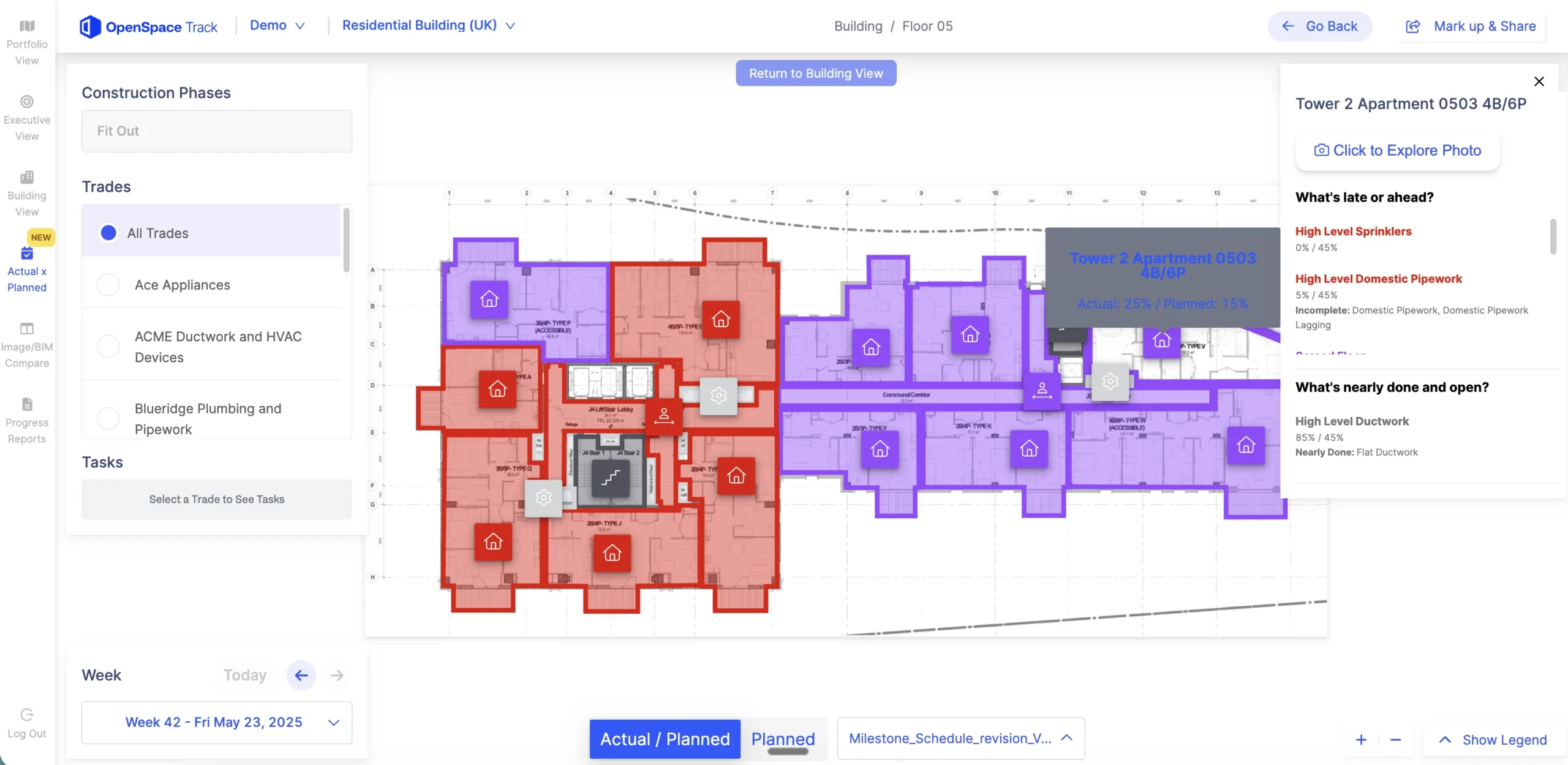
See how OpenSpace Track measures work-in-place across every building on a data center campus.
Who builds the largest AI data centers? The general contractors behind the list
DPR Construction, Turner, and Kiewit build more of the largest AI data centers than any other general contractors, and each appears on more than one campus in or near the ranking.
| General contractor | Data center campus |
| DPR Construction | Hyperion, Abilene |
| Turner | Hyperion; Lighthouse (joint venture with McCarthy) |
| Kiewit | Frontier; Homer City power plant (engineering, procurement, and construction contractor) |
| Mortenson | Hyperion |
| Walsh Construction | Fairwater (WI), phase one |
| Walbridge | The Barn |
| Whiting-Turner, Weitz, Michels | Lighthouse |
| QTS | Fairwater Atlanta |
| HITT Contracting | QTS Richmond (RIC4 expansion) |
How owners staff a gigawatt campus
Owners split the biggest campuses across several builders to staff a highly skilled workforce of electricians and pipefitters at once. Hyperion has three GCs and a planned peak of about 7,500 workers, and Lighthouse has four contractors plus a joint venture, with state filings projecting 3,500 workers in 2026 and 5,000 in 2027. Abilene uses a multi-prime structure, with Rosendin on electrical systems and Southland on mechanical working alongside DPR.
Campuses that don’t name a builder
Seven of the 15 campuses don’t name a general contractor for their main build in any public record found for this ranking: Colossus 2, AWS New Carlisle, Project Jupiter, QTS Richmond, Prometheus, Google Council Bluffs, and the Switch Citadel Campus. QTS names HITT Contracting for one Richmond expansion phase. Developers that build for tenants, such as Vantage, Crusoe, and Related Digital, tend to name their builders in public announcements.
How long does it take to build a hyperscale data center campus?
A hyperscale data center is a campus built for one company’s cloud or AI workloads, often at hundreds of megawatts or more. The first building of a hyperscale data center can reach power in as little as four months or as long as three years. Full build-out takes anywhere from about two and a half years to 12.
| Data center campus | Start of construction | First power | Time to first power | Full build-out |
| Colossus 1 (xAI) | Not disclosed | Sept. 2024 | 122 days | Expanded with Colossus 2 |
| New Carlisle (AWS) | Sept. 2024 | Oct. 2025 | ~13 months | Expansion under construction |
| Abilene (Crusoe) | Mid-2024 | Sept. 2025 | ~15 months | End of 2026 |
| Fairwater (Microsoft, WI) | 2023 | June 2026 | ~3 years | Second facility 2028 |
| Hyperion (Meta) | Dec. 2024 | First phase ~2028 (est.) | ~3+ years (est.) | 2036 |
The Colossus figure comes from the SpaceX registration statement filed in May 2026. Growing demand from cloud providers and AI labs pushes builders to energize new facilities in phases. In any given week, one data center campus can have site work on an empty pad while a finished hall next door goes through commissioning.
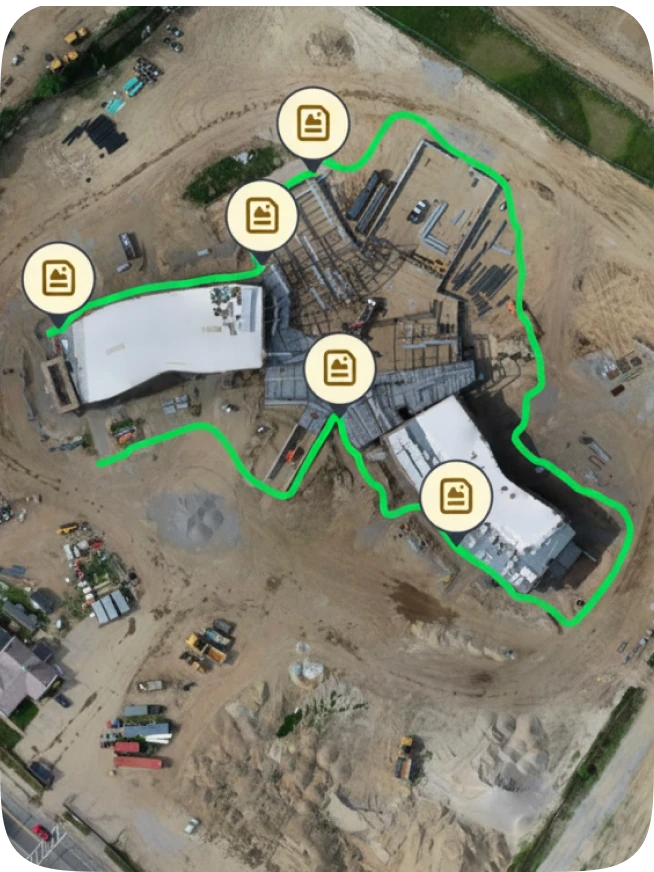
“On a 1,000-acre campus, the owner’s biggest blind spot is the ground between buildings. Ground capture tells you what’s happening inside one hall. A flight shows you whether the duct bank to the substation is in and whether the next pad is graded to elevation, and those are the items that decide when the next building can start. Aerial earns its keep through site work and steel erection. Once a building dries in, the questions for that building move inside and ground capture takes over, while the drone keeps flying the rest of the campus.”
—Jess Lam, Product Manager, OpenSpace
Where are the largest data center markets in the US?
Northern Virginia is the largest major data center market in the U.S. by inventory, and none of the 15 campuses in this ranking sits there. The closest is QTS Richmond, south of the market in Henrico County. CBRE’s North America Data Center Trends H1 2026 reports these figures for the largest data center markets:
- Northern Virginia: 4,496.5 MW of inventory, 2,420.2 MW under construction, and 0.2 percent vacancy
- Atlanta: 2,882 MW under construction, now ahead of Northern Virginia on new supply
Why AI data centers choose other locations
The two maps differ because they serve different buyers. Northern Virginia and Silicon Valley grew over the past decade on fiber networks, and cloud services and cloud computing still pay for that strong fiber connectivity. Developers of gigawatt AI data centers make site selection decisions on other grounds.
| Site selection factor | Established markets (Northern Virginia, Silicon Valley) | Gigawatt AI data centers |
| What they need most | Fiber networks and direct access to cloud providers | Land and substation capacity |
| Who they serve | Cloud providers, financial institutions, and internet traffic | AI workloads for a single tenant |
| Power | Grid capacity in a constrained market | Competitive energy costs, renewable energy sources, and on-site generation |
| Approvals | Existing zoning for data center facilities | Local governments willing to approve grid upgrades and tax incentives |
| Location priority | Proximity to users and networks | Low exposure to natural disasters |
That mix pushes most new data center development into other markets. Texas holds three ranked campuses and Wisconsin holds two, and no other state holds more than one.
Digital Realty & the colocation space in Northern Virginia
Colocation providers run data center facilities and lease space and power to many tenants, from cloud infrastructure teams to companies moving out of their own enterprise data centers for better network connectivity. QTS Richmond, the only Virginia campus in the ranking, follows the same model. Digital Realty is widely recognized as the largest colocation provider in Northern Virginia.
A 2020 county filing for its Digital Dulles campus described 11 two-story buildings on 424 acres, about 7.5 million square feet, and more than 1 GW at full build-out. That plan would rank alongside The Barn and Prometheus. Public records don’t confirm its 2026 status, so it stays outside the ranking for now.
What do the biggest builds in the data center industry have in common?
The largest data center builds all carry dense mechanical, electrical, and plumbing (MEP) work and long commissioning sequences, and most of them lean on prefabrication to keep pace.
Dense MEP work & prefabrication
Electrical systems and cooling systems set the critical path. Rosendin’s prefabrication arm built about 60 percent of Abilene’s electrical infrastructure off-site, and Walbridge uses prefabricated mechanical and electrical skids at The Barn. Meta went further at Prometheus and put part of the campus in tent structures to get capacity online sooner.
Five levels of data center commissioning
Commissioning runs in five levels, each one building on the last:
- Level 1, factory testing: manufacturers test equipment before it ships.
- Level 2, pre-installation check: teams inspect equipment on arrival at the site.
- Level 3, pre-functional testing: crews start up and check each installed system.
- Level 4, functional testing: each system runs through its full operating range.
- Level 5, integrated systems test: power and cooling run together under load.
Commissioning agents prove out diesel generators and switchgear at Level 5, and that’s often where they find defects from earlier phases, sitting behind finished walls.
Substations & power delivery
Getting power to the site is its own construction project. Linxon builds substations and grid solutions for markets that include data centers, and its managers reported 10 to 15 percent less time on site after adopting OpenSpace Capture and Field Notes, as the Linxon substation construction case study details.
“The model and the data hall start drifting in the overhead. Coordination settles the routing for cable tray and chilled water piping, but crews resolve the last few inches in the field, and those decisions don’t always travel back to the model. By the time Level 3 testing starts, the commissioning team is checking installed systems against a model that still shows design intent. Comparing reality to the model while the work is still open turns each reroute into a recorded decision instead of a surprise behind a finished wall.”
—Molly Taylor, Product Manager, OpenSpace
More than 1,000 data center projects have used OpenSpace as of June 2026. With visual documentation for data center construction, field teams capture every building with smartphones, 360° cameras, and drones, so owners and GCs work from the same work-in-place record across the campus.
Methodology & sources
Counts of how many data centers operate in the U.S. vary by tracker and definition, so this list ranks campuses by power. JLL expects the global data center market to almost double, from 103 GW to 200 GW by 2030, and the list adds more data centers as they break ground. The ranking follows these rules:
- Inclusion: U.S. campuses with data hall construction started or complete and a planned capacity near or above 650 MW
- Capacity figure: the operator’s latest public figure, or a grid filing or an Epoch AI or Cleanview estimate (labeled) when the operator publishes none
- Exclusions: Prince William Digital Gateway, which QTS ended in July 2026; Riot Platforms’ 700 MW Rockdale site in Texas, a bitcoin mine now converting to data center tenants; and AWS’s Lewis & Clark campus in Boardman, Oregon, which trackers estimate near 690 MW but no operator or public filing confirms
- Update cadence: once a year, with the year in the URL
Sources by campus
- Hyperion: Meta, Turner, WWNO
- New Carlisle: SiliconANGLE, Inside Indiana Business, Epoch AI
- Project Jupiter: Doña Ana County, KVIA
- Fairwater (WI): Microsoft, CommercialSearch, Epoch AI
- Frontier: Vantage, Tradeline
- Lighthouse: BizTimes
- Abilene: Crusoe, Crusoe and DPR, ACP, Epoch AI
- Milam County: SB Energy, Epoch AI
- The Barn: Walbridge, Oracle
- Colossus 2: Epoch AI, Cleanview, Teslarati
- QTS Richmond: Richmond BizSense, Data Center Dynamics
- Google Council Bluffs: Data Center Frontier, Data Center Knowledge
- Prometheus: TechCrunch, Epoch AI
- Colossus 1: SpaceX S-1, Tom’s Hardware
- Citadel Campus: Switch
- Fairwater Atlanta: SiliconANGLE, Epoch AI
- Power-first campuses: KCBD, GE Vernova, Baxtel
- Digital Dulles: Data Center Frontier
- Commissioning levels: IPS
- Global market forecast: JLL
- World’s largest data center: SlashGear
- Exclusions: Riot Platforms, Cleanview on AWS Boardman
- State rankings: Baxtel
- Prince William Digital Gateway: WTOP
Frequently asked questions
What is the biggest data center in the world?
China Telecom’s Inner Mongolia Information Park is the campus most often named the biggest data center in the world, at a reported 10.7 million square feet. Satellite measurements from Data Center Dynamics put its built area closer to 1 million square feet. By power capacity, several U.S. AI campuses in this ranking plan more.
Who are the largest data center operators in the US?
By campus power capacity, Meta, xAI, Amazon, Microsoft, and the Oracle and OpenAI Stargate program operate the largest U.S. campuses, with QTS and Google close behind. Developers such as Vantage, Crusoe, and Related Digital build and run several of those sites. In colocation, Digital Realty is the largest operator in Northern Virginia.
Which state has the most data centers?
Virginia has the most data centers of any state, with 845 operating, under construction, or planned, ahead of Texas at 768, according to Cleanview. Virginia also leads on operating capacity, at 12.3 GW to 11.1 GW for Texas, per Baxtel. Texas leads on planned capacity, at 63.6 GW to 20.3 GW, which helps explain why three of the campuses in this ranking sit there.
How much electricity will AI data centers need?
U.S. data center electricity consumption reached 4.4 percent of the country’s total in 2023, and that share could reach 6.7 to 12 percent by 2028. Those figures come from Lawrence Berkeley National Laboratory’s 2024 report, which ties the rapid growth to servers built for AI infrastructure. Electricity demand at that scale is one reason several campuses on this list pair with their own power generation.
Track every data hall from foundations to commissioning with the Visual Intelligence Platform for builders. Get a demo.