
Construction risk management now carries a price signal. At least one insurer reads jobsite documentation as underwriting input and discounts premiums for builders who capture their construction projects on a fixed rhythm, which means the visual record a project team keeps for its own purposes can return as a line item on a casualty proposal.
The mechanism is public, the arithmetic is checkable, and on one $260 million project the credit covered the entire cost of the software that produced the record.
Why construction risk management now carries a price signal
Underwriters price two things: how often a claim occurs, and what it costs when it does. Jobsite documentation sat outside that calculation for decades. Every contractor took photos, so photos carried no signal, and nothing credibly connected a filing habit to a loss outcome.
Two pressures changed that. Casualty lines are absorbing severe legal cost inflation, a trend the National Association of Insurance Commissioners describes as social inflation, where insured claim costs climb faster than general economic inflation, driven substantially by outsized jury awards. Carriers under that pressure hunt for any variable that separates a better risk from an average one.
At the same time, jobsite capture generated what photos never had: verifiable usage records. Whether a project was documented, how often, and across how much of the site became measurable at portfolio scale. That is raw material an actuary can test against the historical data in a claims book.
What Shepherd’s analysis found about construction risks & insurance claims
Shepherd, a technology-enabled insurer writing casualty coverage for the commercial construction industry, analyzed OpenSpace usage across more than 1,000 contractors against non-users. Users showed a stronger ability to reduce claim frequency, with the gap wider than Shepherd expected. It also found a correlation with claim severity, meaning smaller average losses when a claim did occur.
Shepherd published its findings qualitatively. The percentages come from OpenSpace’s reporting of the partnership.
| Finding | What it measures | Published by |
| Lower claim frequency, gap wider than expected | Casualty claims, users vs. non-users | Shepherd |
| Correlation with lower claim severity | Average loss size when a claim occurs | Shepherd |
| Up to 50% loss frequency vs. industry average | Loss frequency benchmark | OpenSpace |
| 26% loss rate reduction after adoption | Loss rate change post-adoption | OpenSpace |
| Up to 25% premium savings | Credit for qualified customers | Shepherd Savings program |
What the analysis does & does not prove
Both parties describe the analysis as observational rather than experimental. It establishes correlation between documentation habits and loss outcomes, not proof that captures alone caused the difference. Builders who document consistently may differ in other ways that also reduce risk. Underwriting does not require causation to price a variable, only a reliable signal.
Speaking on Autodesk’s Digital Builder podcast, OpenSpace CEO Jeevan Kalanithi described claims frequency among users as “way, way lower.”
How jobsite documentation becomes a premium credit on construction projects
The credit applies upfront, at quote, rather than as a rebate after a clean year. The sequence runs:
- Shepherd presents a savings proposal beside a traditional quote.
- The credit applies at binding, before any usage has accumulated.
- Usage is tracked through the policy term.
- Pricing adjusts at renewal once real activity is on record.
Why do wrap-ups, OCIPs & CCIPs carry the biggest credits?
Wrap-ups carry the biggest credits because a single policy covers all parties involved in the project, so the owner controls both the insurance spend and the decision about what technology gets deployed. Those two budgets sit with the same person, which puts the risk conversation and the software conversation on the same page.
On a practice program spread across a contractor’s whole book, the connection between one project’s documentation habits and the renewal is far looser. This is why reality capture insurance credits show up most often on project-specific placements rather than annual programs.
Shepherd is not the only carrier doing this. Its savings program spans several jobsite platforms, including Procore, Autodesk Construction Cloud, and Samsara. OpenSpace notes that AXA XL and Travelers also reward documentation practices. A thesis that broad is more durable than a single partnership.
“The first thing I hear is that somebody upstairs is now grading their walk. That fades fast, because the walk itself does not change. What changes is that it happens on a rhythm instead of whenever someone remembers. Before, a superintendent would capture heavily the week before an owner walkthrough and then go quiet for a month. Now the coverage is even, and even coverage is the part an underwriter can check.”
—Wesley DuBose, Product Manager, OpenSpace
The financial risks math: when the credit is bigger than the license
Shepherd’s published account of one OCIP placement makes the arithmetic concrete:
| Project detail | Atlanta OCIP placement |
| Project value | $260 million entertainment district, Atlanta |
| Program | Five-year OCIP |
| Credit applied | 15% upfront on Primary General Liability and Umbrella |
| Net effect | 100% of the OpenSpace purchase covered, with surplus left for further risk mitigation |
The owner was not an existing customer, and adopted the platform as part of the placement.
When does the credit exceed the cost of the software?
The credit exceeds the software cost when the eligible premium is large enough that a mid-single-digit percentage clears the documentation line in the project’s budget, which is most common on large wrap-ups and rare on small practice programs.
The arithmetic generalizes even where the numbers do not. Multiply the eligible premium by the credit percentage, then compare that figure against the annual license cost for the square footage being documented.
Two variables move the answer: which lines qualify, since credits across primary and excess layers compound, and external factors, chiefly where casualty rates sit at renewal. A percentage credit is worth more against a rising premium than a flat one.
Why earlier detection prevents insurance claims before they happen
Documentation lowers claim frequency by changing what happens before a claim exists, rather than by winning arguments afterward. Kalanithi has put the chain plainly: when you can see what is happening, you address it before it becomes a claim.
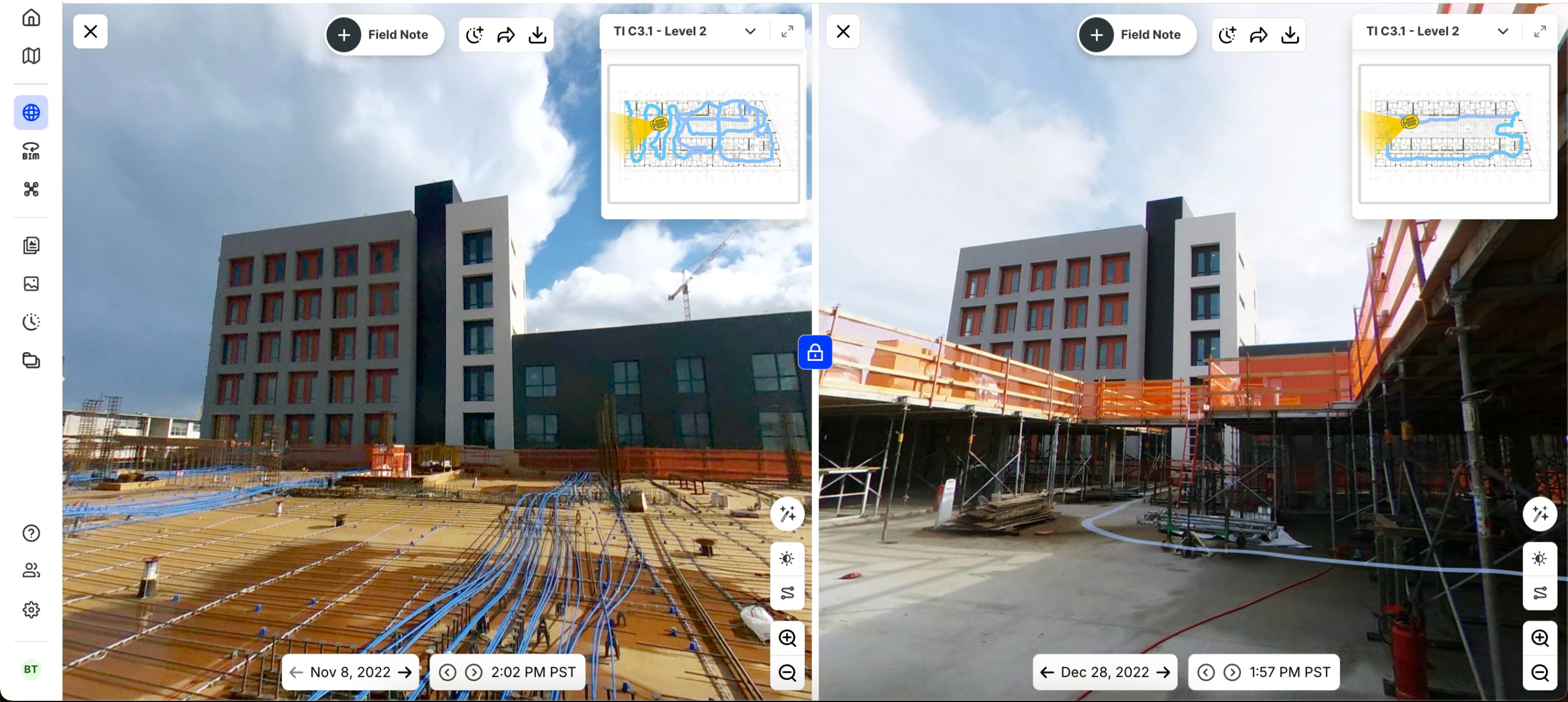
The mechanism is mundane, which is why it works. A disagreement over installed work that would otherwise escalate into a construction dispute gets settled by pulling up a located image. Kalanithi has described a superintendent whose conflict with a trade partner ended the moment the photo appeared. Nobody filed anything, so nothing entered a claims record.
The same record shortens claims that do happen. After Hurricane Ian struck Florida in 2022, DeAngelis Diamond produced captures showing an adjuster what a Fort Myers resort project looked like before and after the storm, and resumed work within a month because the adjuster was satisfied with the documentation.
OpenSpace’s account of how reality capture improves loss ratios notes that this kind of evidence can reduce inspector site visits and, in some cases, increase the amount ultimately paid out.
Nibbi Brothers General Contractors reports a comparable pattern. Capturing twice weekly across its projects, the firm avoided $15,400 in billing discrepancies on a single job and $63,000 in rework on one issue, according to its construction risk mitigation case study. Disagreements resolved at that stage never become claims.
If an underwriter will price a verified record of site conditions, it is worth asking what the formal plan is actually doing.
What belongs in a construction risk management plan?
A construction risk management plan documents intent rather than evidence. The risk management process behind effective construction risk management sets out construction risk identification, meaning how project managers will identify risks, assess the likelihood of a risk occurring alongside its potential impact, use that risk assessment to prioritize risks, concentrate mitigation strategies on the significant risks, assign owners, and hold a contingency plan against unforeseen circumstances.
That contingency is the safety net for cash flow when project risks land. Most plans cover exposures in three broad groups:
- Site and safety — safety hazards facing construction workers, hazardous materials, environmental risks
- Schedule and supply — schedule risks, project delays, supply chain disruptions, weather delays
- Financial and legal — legal risks, property damage, regulatory compliance, and the contractual obligations that allocate each exposure
The register that comes out of this process answers what might happen. It is not an accurate record of what did.
Where insurance fits: risk transfer, not risk reduction
Risk management offers four responses to any exposure: avoid it, transfer it, mitigate it, or accept it. Insurance is the transfer mechanism, moving the financial consequence to a carrier without changing how often the event happens.
Documentation credits are unusual because they sit in both columns. The capture record works by mitigating risks, surfacing problems while they are still cheap to fix, and it lowers the price of the transfer because the carrier can verify the mitigation is real. Most risk controls do one or the other.
Why Gantt charts & risk registers miss the construction process
Gantt charts and risk registers are planning artifacts. They describe the sequence work should follow and the exposures the team expects, both maintained at the pace someone updates a document. Neither captures the state of the building on a given Tuesday.
That gap is where insurance claims are decided. A dispute over whether a hanger was installed before the ceiling closed turns on evidence of actual site conditions at a specific moment. A plan naming water intrusion as a risk factor helps nobody prove what the roof looked like three days before the fire.
Consistent 360° jobsite capture produces a complete record of what existed and when, as the project progresses, turning a jobsite documentation risk profile into something an underwriter can verify.
What construction managers should ask a broker about documentation credits
Most brokers will not raise this unprompted, because jobsite documentation risk sits between the insurance conversation and the technology budget. Five questions surface whether it applies:
- Which markets you place with participate in technology-linked underwriting credits, and for which platforms.
- Whether the credit applies to primary, excess, or both, since compounding across layers changes the total materially.
- What usage threshold qualifies, how it is measured, and who reports it.
- Whether a project-specific placement, OCIP, or CCIP can carry a credit that a practice program cannot.
- What happens at renewal if documentation coverage drops mid-term.
Common challenges that stall a documentation credit
The common challenges here are procedural rather than technical. Documentation is often already running on the project, but nobody connected it to the insurance conversation, the usage reporting was never enabled, or the project stakeholders who buy software sat in operations while the premium sat with finance. Those are calendar problems, worth solving before the next renewal rather than after.
See how builders build a verifiable documentation record. Request a demo.
What this changes for builders
Documentation has always been justified on efficiency, and the reality capture ROI shows up as fewer trips and faster closeout. The underwriting evidence adds a second justification finance recognizes, because it arrives as a number on a proposal rather than a productivity estimate. That moves capture into the set of risk management strategies a builder can point to, reframing it from an operational expense into a risk control with a measurable return, and it moves the conversation from the field to the people who sign off on both budgets.
“Teams that treat it as a filing requirement capture so they have something to point to later. Teams that treat it as a risk control look at what came back. There is a real difference between a project manager who opens the capture Monday morning and one who opens it the first time a claim shows up. The second one still has the record, and the record still helps. But everything that could have been caught in between is gone.”
—Wesley DuBose, Product Manager, OpenSpace
For builders evaluating where documentation fits against total cost of risk, OpenSpace’s overview of construction insurance risk management covers how the visual record supports both premium credits and faster claims resolution.
Frequently asked questions
Can a subcontractor earn a documentation credit if the general contractor owns the capture account?
Usually not directly, because credits are tied to verified usage under the account holder’s own program. The subcontractor still benefits from reduced dispute exposure, but the credit follows whoever holds the qualifying policy. Trades capturing across their own projects can pursue a credit on their own program.
What happens to a credit if documentation stops partway through the policy term?
The upfront credit is generally not clawed back mid-term, but the lapse shows up at renewal, when the carrier reviews actual usage against what was assumed at binding. Reality capture insurance credits are priced on sustained activity, so a project that captures heavily for two months and then stops carries a weaker case into the next term and the pricing of future projects. Confirm the specific reporting thresholds with your broker before coverage gaps open.
Who owns the capture record if a claim goes into litigation?
Ownership follows the account agreement, which typically vests the imagery with the customer who captured it rather than the software provider. Once a claim is anticipated, the record generally falls under evidence preservation obligations and should be treated as discoverable. Confirm legal hold procedures with counsel before a dispute arises.
How long should jobsite captures be retained for claims purposes?
Longer than most builders assume, because defect exposure can run for years after substantial completion under statutes of repose that vary by state. Set retention against the longest applicable period for the jurisdictions the project team works in, not against the project schedule.
Talk to an expert about documenting your projects. Request a demo.