A covered loss is only half the battle. When fire, wind, theft, or water damages work in progress, the builders risk policy should make the project whole again. What decides whether it actually does is not the loss itself, but what the general contractor can prove about the site.
Construction insurance claims stall, shrink, or get denied for one recurring reason: the record of the jobsite does not hold up when an adjuster starts asking questions. This is where documentation stops being a filing chore and becomes what protects the project.
Most guidance on this topic ends at “take more photos.” That advice misses how claims are actually won. A builders risk claim turns on two things a phone camera roll rarely proves: the exact condition of the site at the moment of loss, and whether the policy’s own conditions were being met when the loss occurred.
Contractors who understand that difference recover faster and fight fewer disputes. The focus here is the builders risk claims lifecycle, from filing to final payment, rather than the broader scope and delay disputes covered elsewhere.
What builders risk insurance covers & where claims break down
Builders risk insurance covers direct physical loss or property damage to a construction project while it is being built. General contractors and project owners both face the unique risks of a live build, from on-site accidents to storm and environmental damage, which is why the construction industry treats builders risk as core project protection. It sits alongside the other coverages a construction business carries, so it helps to be clear on what the policy does and does not respond to:
| What builders risk typically covers | What it does not cover |
| The structure under construction, plus materials, fixtures, and equipment slated to be installed | Third-party bodily injury and property damage, handled by general liability |
| Covered perils such as fire, wind, theft, vandalism, and water damage | On-the-job employee injuries, handled by workers compensation |
The coverage is rarely the problem. The proof is. An adjuster reviews the circumstances of the loss, the policy terms, and the proof of loss the insured submits, then adjusts the claim accordingly.
Everything hinges on that middle document. When the proof of loss rests on a thin or disorganized set of images, the insured is asking the carrier to take their word for the pre-loss condition of the site. Carriers do not pay on trust. They pay on evidence, and the gap between “a loss happened” and “here is exactly what was there” is where construction insurance claims quietly lose value.
Why the standard photo folder fails a construction insurance claim
The typical jobsite photo record fails under scrutiny because it is undated, unlocated, and full of gaps. A folder of thousands of phone photos lacks a reliable timeline, has no fixed position on the floor plan, and offers little assurance that the area in question was ever captured before it was buried behind drywall or concrete. When a claim is challenged, those gaps become the carrier’s argument, and they let disputes between subcontractors drag on when the record cannot identify who was responsible.
Contemporaneous records tell a different story. Evidence created at the time an event occurred is consistently treated as the strongest proof in construction disputes, precisely because it cannot be reworked after the fact to fit an argument. A time-stamped, spatially located visual record meets that standard. Each image carries the date it was taken and its exact location on the plan, so the record answers when and where without anyone reconstructing events from memory months later.
“An adjuster is not impressed by volume. I have watched teams hand over a drive with ten thousand photos on it and think that is proof, when the adjuster still cannot tell what the room looked like the week before the fire. What moves a payout is a record the adjuster can navigate without you in the room. When every image is already pinned to the plan and dated, they stop asking the contractor to go find things, and the claim stops stalling on questions nobody can answer. The pile makes their job harder. The organized record makes the decision for them.”
—Wesley DuBose, Product Manager, OpenSpace
How documentation supports a builders risk claim at each stage
Strong documentation supports a construction insurance claim at every stage of the process, from the day work starts to the day the adjuster signs off. Rather than scrambling to assemble evidence after a loss, contractors who fold capture into daily operations and document on a fixed rhythm already have the record built. The claim lifecycle breaks into four points where visual proof carries weight:
- Establishing pre-loss condition: A regular capture cadence creates a running baseline of the site, so there is always a recent record of what existed and how it was installed before any damage occurred.
- Documenting the loss: Immediately after an event, new captures record the extent and nature of the damage against the same floor plan, showing precisely what changed.
- Supporting the proof of loss: Paired before-and-after imagery of the same location gives the adjuster a clear, dated view of the loss without a site visit for every question.
- Speeding resolution: When the record is complete and organized, adjusters spend less time gathering information and more time settling, which shortens the path to payment.
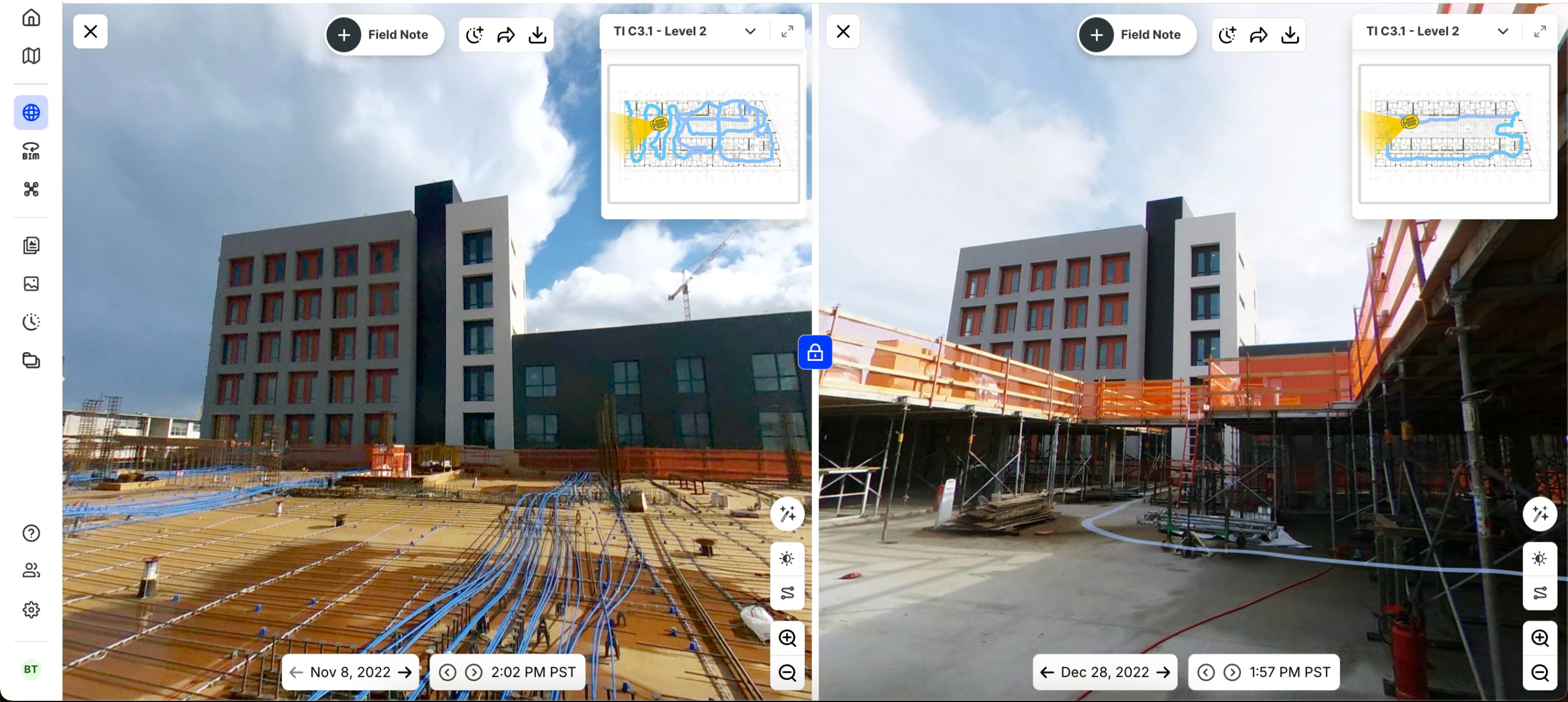
Because the imagery is captured and located automatically, the record does not depend on anyone remembering to photograph the right corner on the right day. That reliability is what makes the record usable as insurance evidence rather than a scrapbook.
Request a demo to see how OpenSpace builds a claim-ready visual record on your projects.
The denial trap most builders miss: proving policy compliance
The most avoidable builders risk denials happen when a contractor cannot prove they were meeting the policy’s own conditions at the time of loss. Insurers increasingly deny claims based on failed subjectivities: the safeguards a policy requires as a condition of coverage.
These often include site security, fencing, fire watch, and the status of sprinkler and riser systems. If a fire occurs and the carrier questions whether required protective measures were in place, the burden lands on the insured to show they were, and thin proof can lead straight to a denial.
This is a documentation problem disguised as a coverage problem, and it is where day-to-day risk management on job sites meets the fine print of the policy. A dated visual record of the perimeter, the fencing, the posted fire watch, or the active safety measures can settle the question directly, because it shows the required conditions as they existed on the relevant date. Contractors who only document finished work miss this entirely. The record that protects a claim captures the whole site, including the conditions the policy cares about.
“The thing teams forget is that the policy has conditions, and a loss is the moment those conditions get audited. Everybody documents the finished work, because that is what they are proud of. Almost nobody documents the fence line, the fire watch, or whether the riser was live that week. Then a fire happens, the carrier asks if the safeguards were in place, and the honest answer is that the crew knows they were but cannot prove it. That gap is where a real loss turns into a denied claim. The record that protects you is the boring one, the one that shows the conditions nobody thinks to photograph.”
—Wesley DuBose, Product Manager, OpenSpace
What a defensible visual record looks like on an active job site
A visual record that holds up under a claim shares four qualities:
- Consistent: The site is captured on a fixed rhythm, not whenever someone remembers, so there are no blind spots in the timeline.
- Complete: Every walk covers the whole site, including areas that seem routine, because the corner nobody thought mattered is often the one a claim later depends on.
- Automatically dated and located: Time-stamping and plan location remove the two weakest links in ordinary photos.
- Permanent: A centralized, tamper-resistant history means the evidence is still there when a claim surfaces months after the work is covered up.
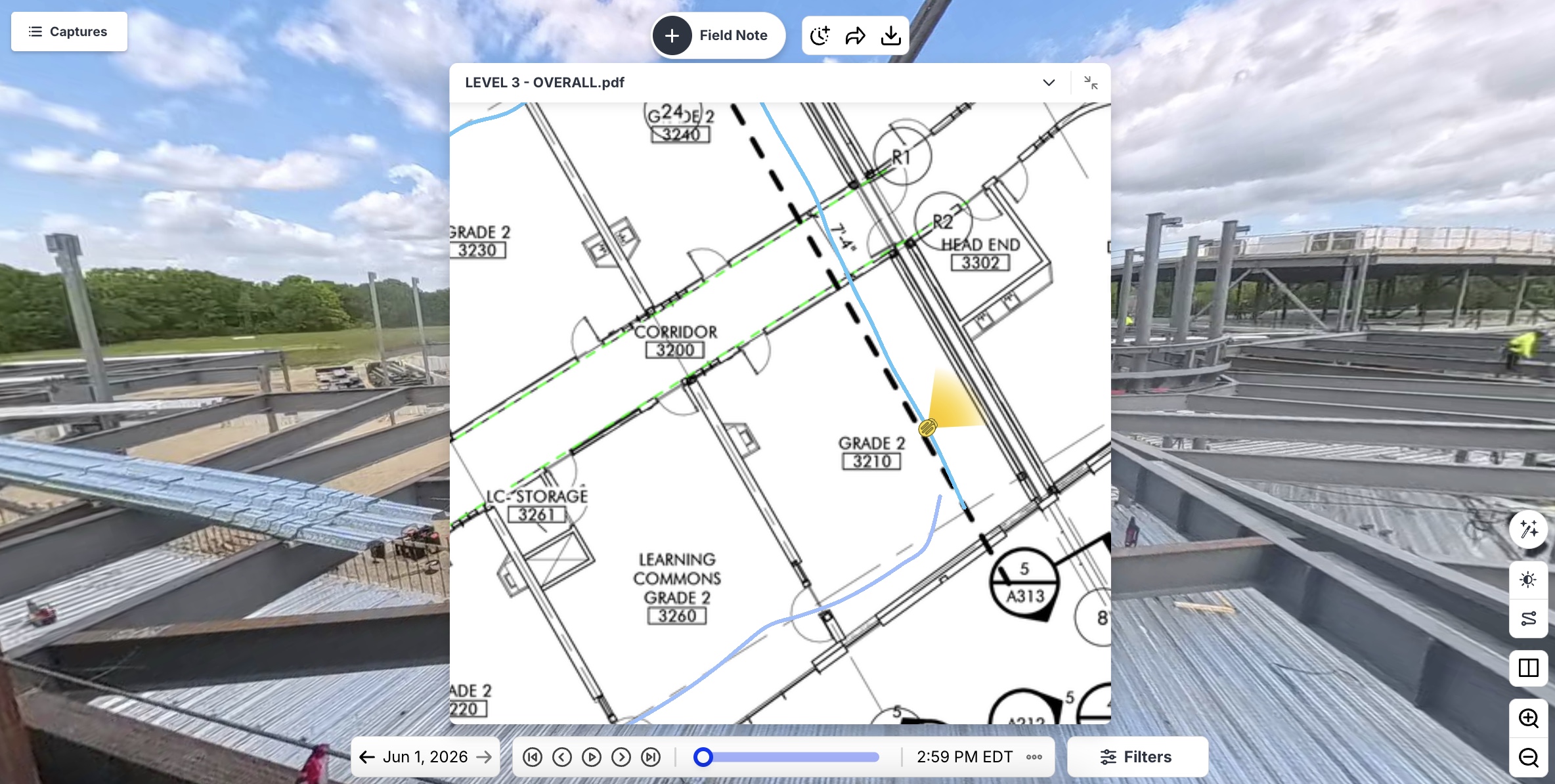
Reality capture built for this makes the discipline practical. With construction documentation from OpenSpace Capture, field teams walk the site with a 360 camera or smartphone, and images are automatically pinned to the floor plan and time-stamped.
A complete record like this also helps builders reduce insurance costs, since insurers such as Shepherd, an OpenSpace partner, recognize the lower risk profile of well-documented projects and pass on premium savings, one of the clearest financial benefits of documentation.
Real recovery: how a visual record defended a claim
Visual evidence changes claim outcomes because it removes the argument. On an advanced data center project in Longcross, U.K., project director Andrew Moss of Sweet Projects used OpenSpace captures to dismiss a claim outright. His team captured the site daily, building a tamper-proof 360 record pinned to the floor plan. When a claim came in, that record settled it. “If I didn’t have OpenSpace, it would have been them against us,” Moss said. “Instead, I was able to unequivocally defend my position.”
That is the practical value of a defensible record. The dispute never became a drawn-out contest of recollections, because the evidence spoke for itself. For a general contractor carrying real financial exposure on a complex build, an outcome like that is the difference between a fast resolution and months of cost and distraction.
As property damage and claims-related costs climb across the construction industry, a clear account of what happened on the ground is becoming a baseline expectation.
“A lot of pictures is not the same as a record. I can take five hundred photos on a Friday walk and still not be able to prove anything, because there is no rhythm to it and no way to place any single shot in time. What protects you is consistency. The same walk, the same coverage, every week, so the history is unbroken. When a claim lands, you are not hunting for the one photo that happens to show the right corner. You already have every corner, on every date, and that is what ends the argument before it starts.”
—Wesley DuBose, Product Manager, OpenSpace
Frequently asked questions
How do you document construction site damage for insurance purposes?
Document the damage against a dated record of the same location before the loss, so the change is clear. Capture the full extent of the affected area, keep every image time-stamped and tied to its position on the plan, and preserve the pre-loss baseline that shows original conditions. A consistent capture routine throughout the project makes this straightforward instead of a scramble after the fact.
What does builders risk insurance cover in a claim?
Builders risk insurance covers direct physical loss or damage to a project under construction, including the building, materials, fixtures, and equipment intended to become part of it. Common covered perils are fire, wind, theft, vandalism, and water damage. It does not cover the separate exposures handled by general liability or workers compensation.
What are the most common reasons builders risk claims are denied?
The most common denials come from failed policy subjectivities, where the insured cannot prove required safeguards such as fencing, fire watch, or security were in place at the time of loss. Claims are also weakened by incomplete or undated documentation that cannot establish pre-loss condition. Both failures are largely avoidable with a consistent, dated visual record.
How long do you have to file a builders risk insurance claim?
Most policies require prompt notice of a loss, often “as soon as practicable,” followed by a formal proof of loss within a set window defined in the policy. The exact deadlines vary by carrier and policy, so contractors should do their due diligence and review notice requirements at the start of the project rather than after a loss. Documenting the site on a fixed rhythm throughout the build means the evidence is ready whenever the clock starts.
See how OpenSpace protects your projects and your claims. Request a demo or contact the OpenSpace team today.