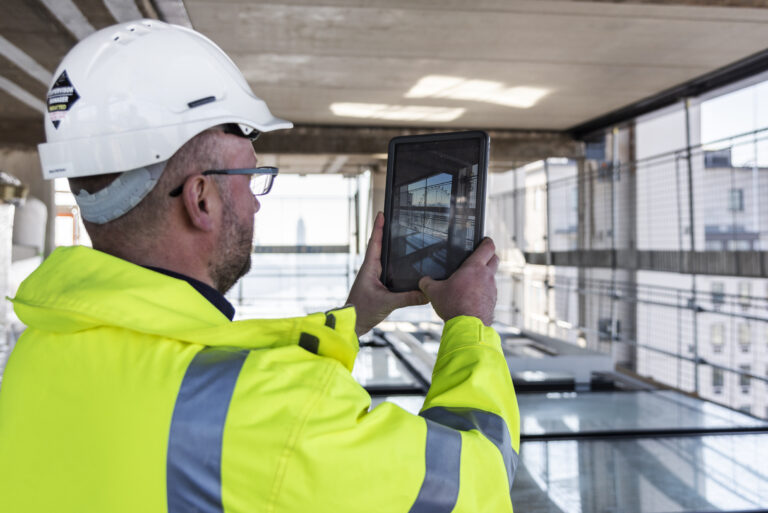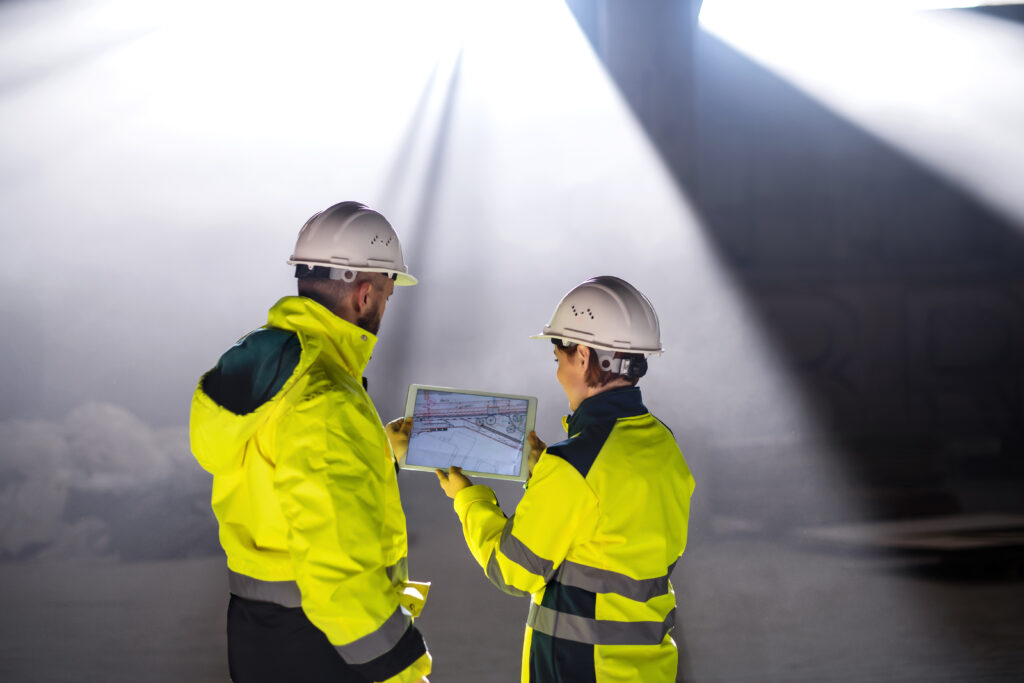
AI in construction includes the application of machine learning, computer vision, and predictive analytics to automate documentation, track progress, and surface insights across every phase of a project, from preconstruction through closeout.
Across the construction industry, artificial intelligence is reshaping construction projects of all sizes—from commercial towers to data center fit-outs—changing how builders plan, document, and deliver work. Yet for all the momentum, many builders are in the early stages of AI adoption. The field (where decisions are made, profits are won or lost, and where projects actually get built) remains the least legible part of any project. That is the problem AI is built to solve.
This guide covers how artificial intelligence works across the construction lifecycle, what barriers remain for builders moving toward adoption, and what it looks like when AI moves from a pilot program to a core part of how project teams operate.
Why the construction industry has been slow to adopt AI
Construction is one of the least digitized industries in the global economy. According to McKinsey research, global construction productivity grew by just 0.4 percent annually between 2000 and 2022, compared to roughly 2 percent economy-wide. The gap between construction output and efficiency is not for lack of scale: global construction spending is projected to rise from $13 trillion in 2023 to $22 trillion by 2040.
Fragmentation is at the root of this problem. Every construction project is a temporary organization: different subcontractors, different systems, different site conditions. That makes standardizing AI technologies across a portfolio far harder than in manufacturing or logistics. The construction sector also operates on thin margins, which limits tolerance for technology experiments that don’t deliver fast, measurable returns.
The result is a market that’s curious but cautious. The RICS AI in Construction 2025 report, drawing on more than 2,200 professionals globally, found that 45 percent of organizations report no AI use at all, and fewer than one percent have AI embedded across multiple processes. Confidence in AI’s potential is high. Actual deployment is a different story.
How is AI used in construction?
AI is used across the construction industry to surface insights from the field, automate repetitive tasks, extract intelligence from captured imagery, and support faster decision-making at every phase from preconstruction through closeout.
The clearest breakdown is by the decisions AI supports:
Documentation & site capture
Machine learning and computer vision automatically map and time-stamp imagery captured through OpenSpace via smartphones, 360-degree cameras, and drones, giving builders a reliable visual record without spending hours on manual walkthroughs.
Progress monitoring
AI algorithms trained on historical captures recognize installed materials (drywall, framing, insulation) and calculate percent complete by floor, zone, and trade. This replaces clipboard-based estimates with objective, image-verified insight.
QA/QC & issue management
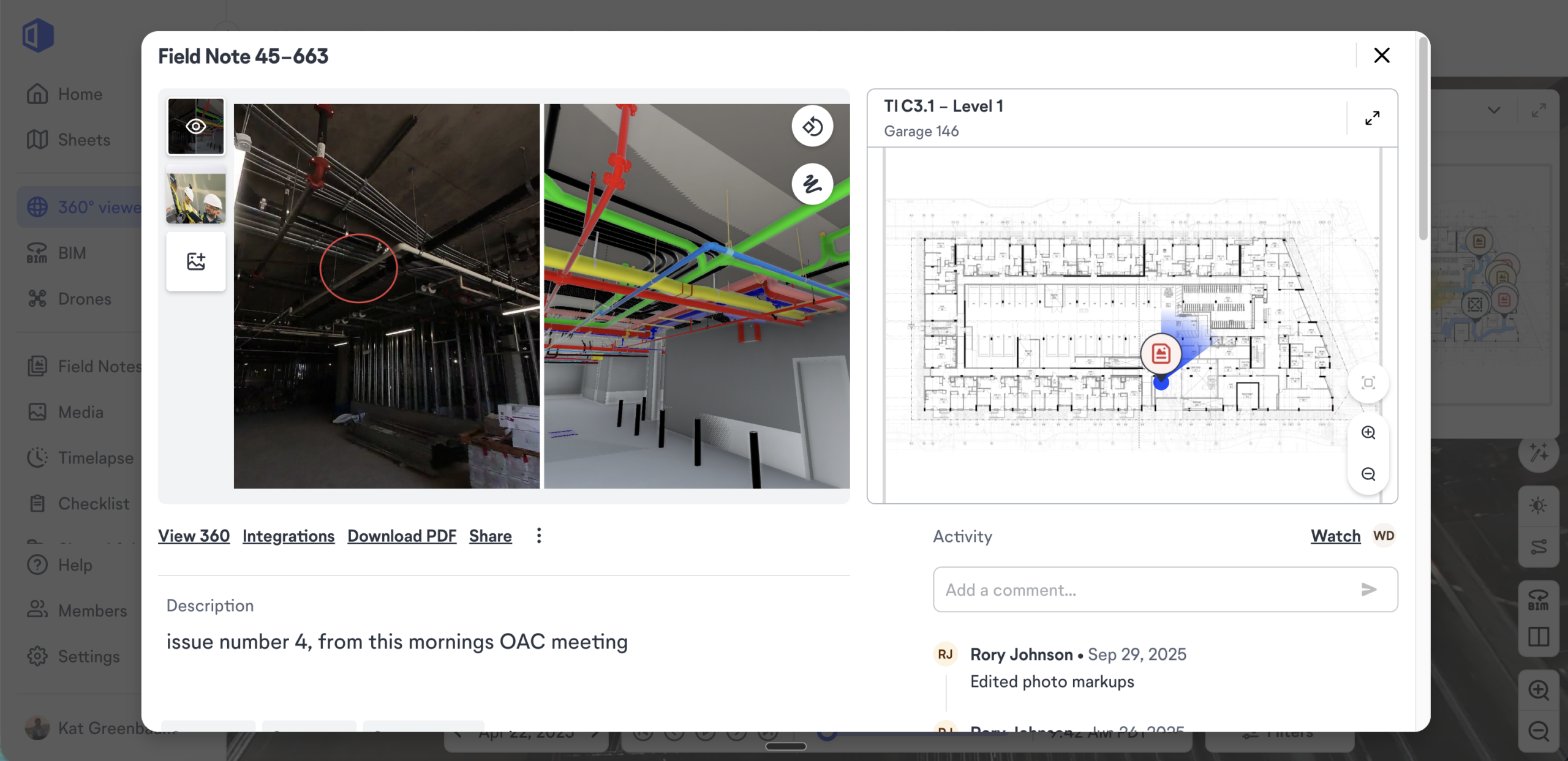
Field Notes, Punch Items, and Observations get logged up to 5-10 times faster using AI Voice Notes and AI Autolocation. AI Autolocation uses our Spatial AI engine to suggest the exact location of a Field Note on the plan, like GPS for indoors. AI Voice Notes let field teams say what they see—the platform fills in all required fields automatically, reducing repetitive tasks and improving documentation quality.
Predictive analytics & scheduling
AI-driven platforms use captured progress insights and project plans to predict potential delays, flag out-of-sequence installs, and give project managers early warning on schedule risk.
Construction estimating and cost control: AI supports more accurate cost estimates by identifying patterns across past projects and flagging risks that historically drive cost overruns. Natural language processing assists in contract review and scope analysis during the preconstruction phase.
Building systems & energy
AI applied to HVAC systems and building systems management supports predictive maintenance, identifies energy usage patterns, and improves energy efficiency across occupied assets, extending AI value beyond construction into operations.
Jobsite safety
Beyond documentation and progress tracking, AI is also applied to jobsite monitoring for risk identification. Computer vision systems connected to site cameras can detect conditions such as missing protective gear, unauthorized access to restricted zones, or equipment operating outside safe parameters, flagging them for site supervisors in real time.
AI on the jobsite: from raw imagery to intelligence
The process of converting raw documentation into intelligence matters on a jobsite where project teams are already overloaded.
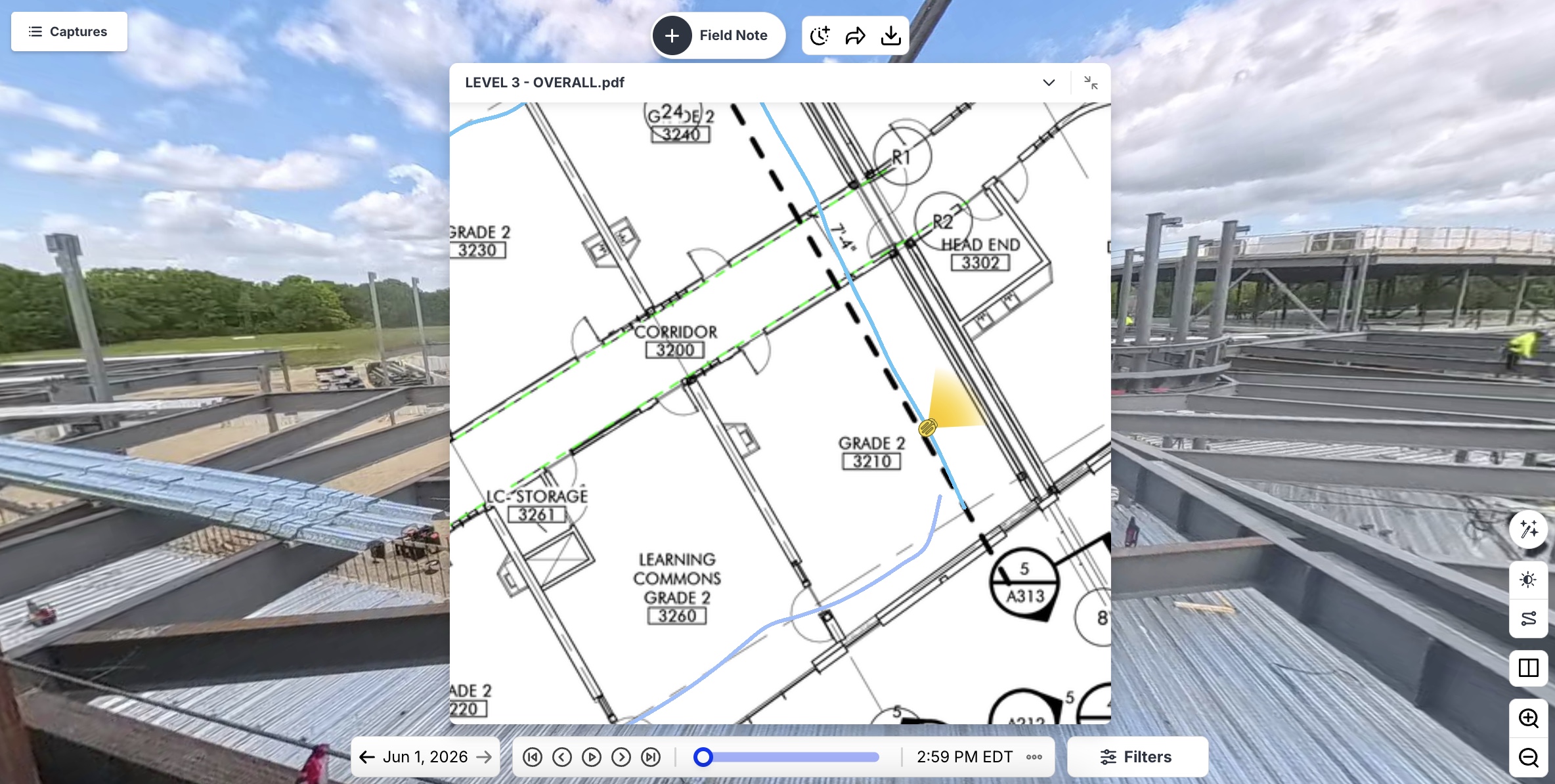
The OpenSpace Spatial AI engine sits at the center of how raw site imagery becomes actionable insight. Every image, captured by a field team member walking the site with a smartphone or 360-degree camera, is automatically pinned to the floorplan at the precise location and time it was taken.
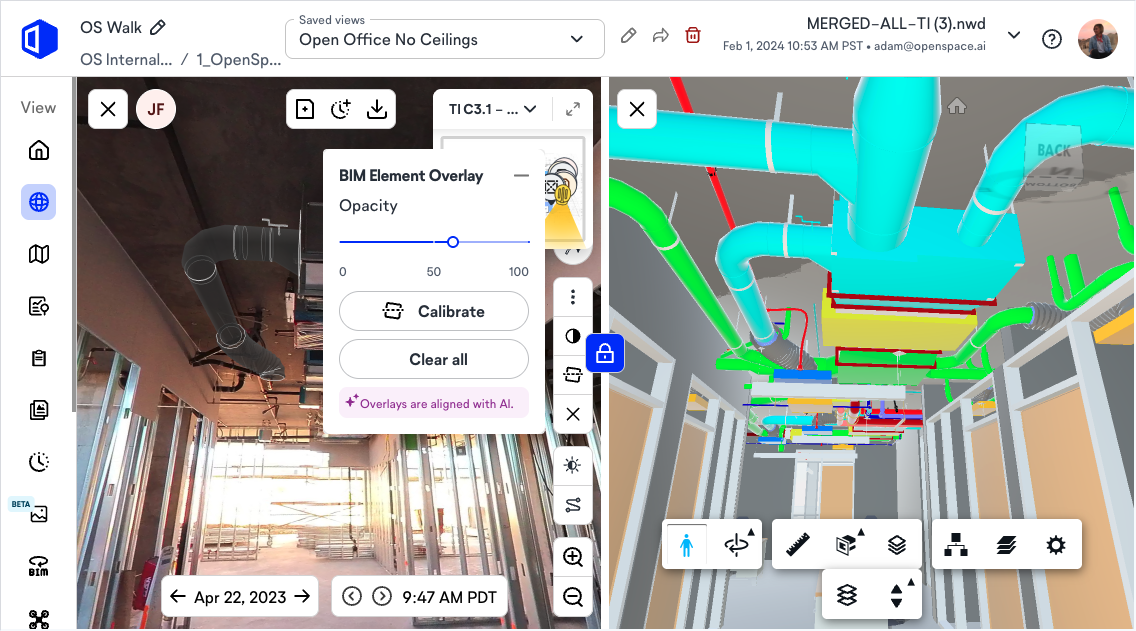
For teams working with BIM models, OpenSpace BIM+ layers reality directly against design, making field-to-model comparison immediate. The platform uses machine learning and computer vision to connect what happened, where it happened, and when, building a structured, searchable visual record of the project over time.
Visual Intelligence transforms captured images into a spatially indexed record, pinned to an exact location and time-stamp on the plan. A superintendent can navigate to any room on any floor from any date. A project executive reviewing a construction site remotely can see conditions as they were on any given day. An owner can verify work in place without a site visit. The result is intelligence, not just a record of activity.
At Suffolk Construction, the results of this approach were measurable: an 86 percent speed improvement in documenting issues using AI Autolocation and AI Voice Notes, with higher-quality Field Notes and properly assigned trades, drawings, and zones.
“The shift people notice first is speed. But the more significant change is that the documentation stops being a task and starts being a byproduct. When every image is automatically pinned to the plan with a time-stamp, the team stops managing the record and starts using it. Decisions that used to require a site visit or a phone call get made from a desk, because the information is already there and everyone trusts it.”
— Gabriel Denis-Arrue Munes, Product Manager, OpenSpace
AI for progress tracking and construction project management
Progress monitoring is where AI has the most immediate impact on project management, and where the gap between estimated and actual progress has the most financial consequences.
Traditional progress tracking on construction sites relies on a superintendent walking the site with a set of plans, estimating percent complete visually, and recording it by hand. It is time-consuming, inconsistent across superintendents, and almost always a lagging indicator. By the time a project delay is visible in the numbers, the project has already lost ground.
OpenSpace Track uses AI algorithms trained to recognize specific materials (framing, drywall, insulation), paired with human verification, to compare progress between captures. The platform maps results to plans and references them against takeoffs to generate quantities and percent complete values by trade, floor, and zone. This gives construction stakeholders objective, image-verified progress insights, not estimations.
That distinction carries the most weight on data center construction projects, where pay applications are tied to MEP rough-in that disappears behind walls within days of being installed.
For Linxon, a joint venture between AtkinsRéalis and Hitachi Energy delivering critical power infrastructure across AMEA, Europe, and the Americas, the challenge was a different dimension of the same problem. Inconsistent photo documentation across global sites made it difficult for remote planners and safety engineers to support project delivery without costly travel. OpenSpace provided a unified visual record across regions and time zones, reducing unnecessary site visits and improving transparency for leadership across every construction project in the portfolio.
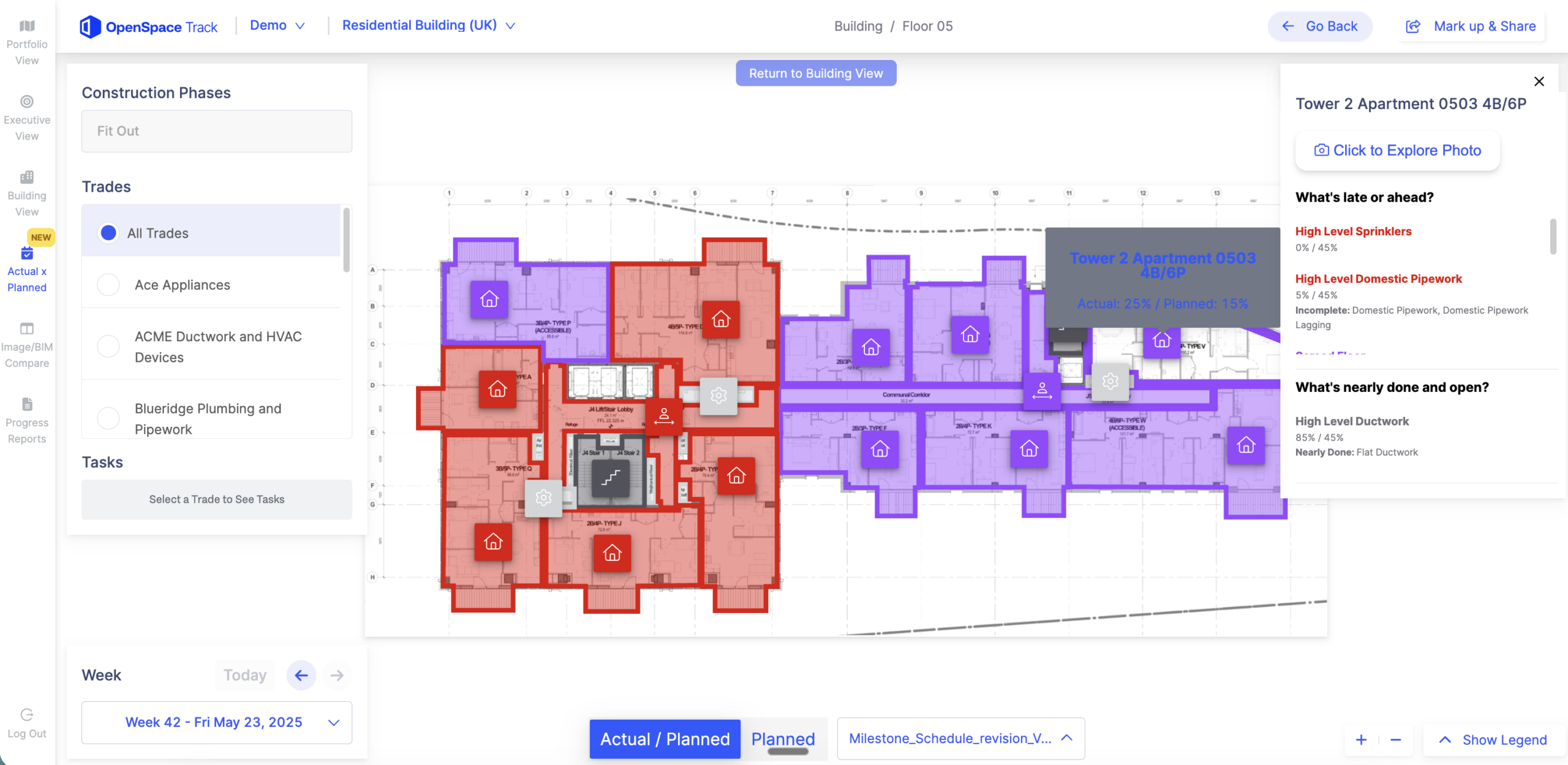
“When every project in a portfolio is documented on the same cadence, with the same structure, leadership stops having to ask ‘how confident are we in this update?’ The conversation moves from debating status to acting on it. That’s a meaningful shift — it means risk surfaces earlier, and accountability follows naturally because the record is objective.”
—Michaela Rhile, Product Manager, OpenSpace
See how AI-powered progress tracking works on real projects—Request a demo.
What are the barriers to adopting AI in the construction industry?
The main barriers to artificial intelligence adoption in construction are: a lack of skilled personnel, integration with existing systems, documentation quality and availability, and high implementation costs, in that order, according to the RICS 2025 global survey of more than 2,200 professionals.
Each barrier is real, and each is solvable with the right approach:
Integration with existing systems
Construction teams already work in Procore, Autodesk, and other platforms. AI platforms that require parallel workflows will face resistance. Deep, native integrations are the threshold requirement, not workarounds.
Data quality
AI systems are only as reliable as the inputs they process. Inconsistent capture cadence, variable image quality, and fragmented documentation practices all degrade output. The solution is not more sophisticated AI algorithms. The fix is making consistent site capture effortless for builders in the field.
Cost & complexity
For smaller builders, upfront implementation costs are a significant barrier. The Bluebeam 2026 AEC Technology Outlook found that complexity and culture are the biggest blockers, not cost alone. Regulatory uncertainty around AI is also affecting AI adoption plans at 69 percent of firms surveyed.
These are not reasons to wait. They are the criteria by which to evaluate which platforms are actually built for construction, and which are built for a different industry altogether.
How to use AI in construction
The most effective way to adopt artificial intelligence on your projects is to start with a single, high-value use case tied to a workflow your team already runs, not a wholesale overhaul of everything at once. Builders that achieve broad adoption do it incrementally, not by mandate.
Implement consistent capture
Consistent visual capture is the foundation for AI-powered Visual Intelligence on the jobsite. Without reliable, time-stamped imagery tied to project plans, AI has limited visibility into what’s happening in the field. Prioritize platforms that make capture easy for field teams using smartphones rather than specialized equipment.
Connect to existing systems
AI software should flow into platforms project teams already use. Native integrations with Procore and Autodesk Construction Cloud mean operational efficiency gains happen inside the construction process people already work in, not alongside it.
Expand from a proven use case
Progress tracking, QA/QC, and issue management are the highest-ROI entry points for most project teams—predictive analytics, resource allocation, and schedule maintenance follows naturally.
Measure what matters
AI software should improve project timelines, reduce rework, and support faster decision-making. Track those outcomes from day one. If the platform cannot demonstrate operational efficiency gains within the first few projects, it is the wrong platform.
What are the future trends of AI in construction?
AI in the construction industry is on a steep growth curve. According to Mordor Intelligence, the sector is projected to grow from $3.99 billion in 2024 to $11.85 billion by 2029, a compound annual growth rate of 24 percent. The near-term trends shaping that growth fall into a few clear directions.
Agentic AI & autonomous decision support
The next wave of machine learning in construction is moving from documentation to action. Agentic AI, meaning systems that can dynamically select actions based on context, will begin to surface not just what has been built, but what needs to happen next: flagging supply chain management gaps, identifying out-of-sequence trades, and recommending corrective action before a delay drives rising costs that erode margin.
For the latest on what OpenSpace is building with AI, including agents that can see a jobsite and take action, check out our Waypoint customer summit.
Predictive maintenance & building performance
Predictive maintenance software is moving from industrial settings into the construction and facilities space. Machine learning applied to building systems, particularly HVAC systems, electrical, and structural monitoring, can predict maintenance needs before failure, reduce energy usage, and improve energy efficiency across a building’s lifecycle. This extends the ROI of AI well beyond construction design and delivery into long-term asset management.
Beyond mechanical systems, real-time monitoring of air quality, temperature, and environmental conditions on active construction sites supports better decision-making around protective gear requirements and worker safety, a growing application as sensor costs continue to fall.
Drone autonomy & aerial intelligence
AI-powered robots and robotic systems, including autonomous drones, are removing the need for manual flight planning on large construction sites. As drone hardware and AI algorithms mature, routine site surveys will become fully automated.
AI in design & preconstruction
AI is helping design and preconstruction teams work more efficiently by analyzing data from past projects to identify patterns, surface potential risks, and evaluate alternatives earlier in the process. These insights can improve estimating, support design coordination, and help teams make more informed decisions before work begins.
AI is also beginning to assist with construction planning by evaluating schedules, site logistics, and sequencing options. Rather than replacing professional judgment, these tools help teams assess tradeoffs, identify potential issues earlier, and make better-informed planning decisions.
“The documentation problem in construction is largely solved—we know how to capture what’s happening on site. The next frontier is using that record to drive action. AI that can look at a week of captures, cross-reference a schedule, and tell a project manager which trade is about to fall behind before it shows up in the numbers—that’s where the real productivity gains are. We’re moving from visibility to anticipation.”
—Gabriel Denis-Arrue Munes, Product Manager, OpenSpace
Frequently asked questions
What is the ROI of AI in construction?
ROI varies by use case, but the most measurable returns come from reduced rework, faster issue documentation, and objective progress tracking. Suffolk Construction documented an 86 percent speed improvement in issue documentation using AI Autolocation and AI Voice Notes, and recovered a full month of manual documentation time on a single project. Across the industry, builders report the fastest ROI from use cases tied to existing workflows (progress tracking, QA/QC, and field documentation) where AI replaces time-intensive manual processes without requiring new infrastructure.
How does AI in construction differ from traditional project management software?
Traditional project management software organizes what people manually enter. AI in construction captures what is actually happening on site and surfaces insights without requiring manual input. The difference is the source of truth: a scheduler updating a Gantt chart versus a platform that reads the physical state of a building, maps it to a plan, and flags what is behind, out of sequence, or at risk. AI does not replace project management platforms. It feeds them with verified field intelligence they cannot generate on their own.
Is AI in construction only for large construction firms?
No. While enterprise general contractors were early adopters, mid-market builders now represent a significant share of AI platform deployments. The shift happened because field-first platforms eliminated the specialist operators and IT infrastructure that previously made adoption impractical at a smaller scale. Any builder running multiple active projects stands to benefit from automated documentation and progress visibility, regardless of company size.
Ready to see Visual Intelligence in action? Talk to an OpenSpace expert.