Over the past two years, many process changes have come to construction sites. One of the key indicators of these changes has been the continued adoption of construction technology (contech), which has progressed at an impressively rapid pace.
Construction technology, often shortened to contech, refers to the hardware, software, and platforms builders use to plan, document, and manage work on a jobsite, from 360° cameras and laser scanners to project management and field execution software.
We’ve seen this anecdotally in our own data; when we announced our Series C funding in April, we shared that site captures on our platform had increased by more than 300% during the previous year. This trend isn’t limited to our own experience, though: this year also showed that contech is a priority for the U.S. government, with $100 million allocated to contech over the next five years as part of the Infrastructure Investment and Jobs Act. It seems builders, investors, and policymakers are all waking up to the opportunities made possible through these tools.
To gauge the most important contech trends of 2021 and get insight into expectations for trends moving into 2022, we conducted a year-end survey recently, polling our customers who have a wide range of roles in the industry, mainly representing GCs, specialty contractors, and property owners from around the world. The results provide a look into how the industry is currently viewing technological innovation and help set the stage for the coming months.
Below, we’ll share some of the most interesting findings from our survey.
Where is construction technology adoption growing fastest?
Adoption is moving fastest in the field, not the back office. Builders consistently rank on-site capabilities, capturing conditions and connecting field to office, as more impactful than back-office automation, a reversal of where construction software historically focused first.
Our biggest takeaway was that field technology is here to stay: 91% of respondents said they had watched colleagues who didn’t previously use technology begin to embrace it over the past year. There are several factors behind the jump, but the wholesale shift toward digitization among builders since the start of the pandemic is undeniable.
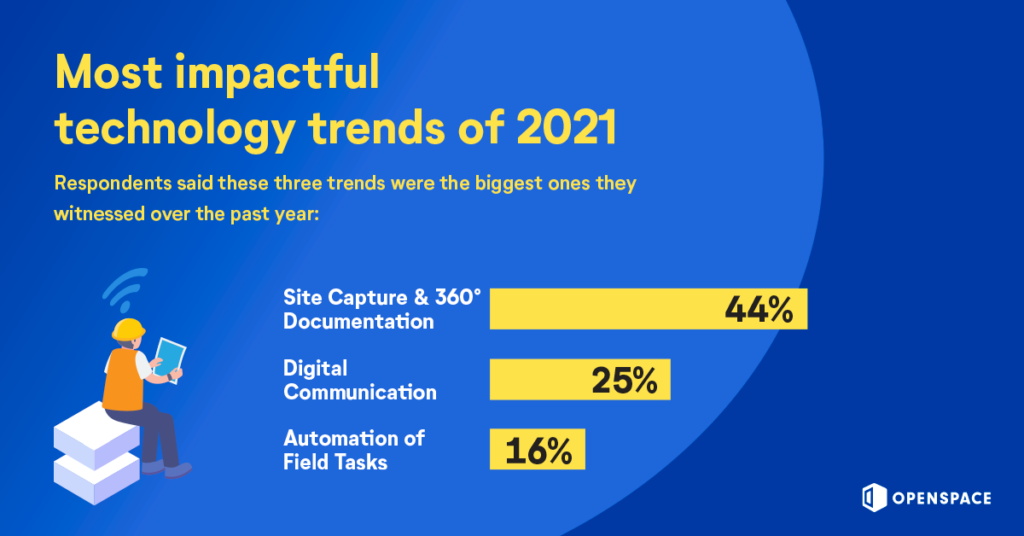
Solutions that enable remote monitoring and management of jobsites have changed how a build gets done. Respondents ranked the most impactful 2021 trends as follows:
|
Trend ranked most impactful in 2021 |
Share of respondents |
|
Better site capture (360° images, 3D laser scanning) |
44% |
|
Better communication (text, email, PM software) |
25% |
|
More automation of field tasks |
16% |
|
More automation of back-office tasks |
8% |
Field automation outranked back-office automation by two to one. Building technology for the field is harder, with obstacles like spotty network connectivity, but the impact it’s having on builders shows the effort is well worth it.
Why are digital twins becoming a priority on construction sites?
Digital twins matter because they turn a single capture into a reusable reference for an entire project. A virtual replica lets a team revisit any part of the site at any point in the build without traveling back to it, so questions about prior conditions can be answered from a desk.
A digital twin, sometimes called a virtual site replica, is a navigable digital model of a physical jobsite built from captured imagery or scans, kept current as the project progresses so it mirrors real conditions.
Looking ahead, 28% of respondents said the most impactful 2022 trend would be wider use of 360° images to create digital replicas of each jobsite. Other predicted trends:
|
Trend predicted most impactful for 2022 |
Share of respondents |
|
More 360° images to create digital site replicas |
28% |
|
Increase in prefab construction |
23% |
|
IoT trackers for equipment, people, and assets |
15% |
|
Better WiFi or 5G coverage of jobsites |
13% |
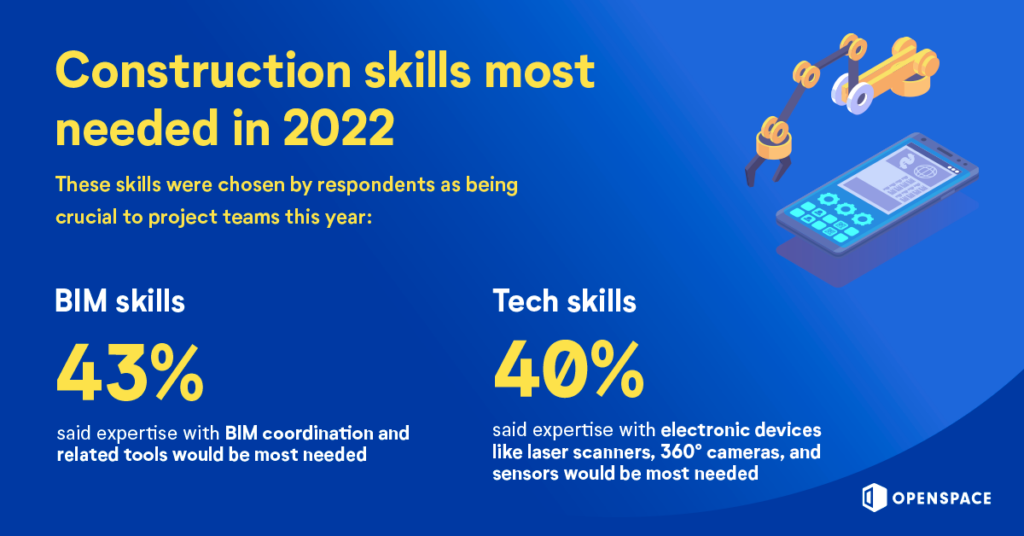
That outlook is also shaping which skills builders value. Asked to select the skills most needed going forward, 79% chose either BIM coordination or BIM modeling:
|
Skill seen as most needed going forward |
Share of respondents |
|
BIM coordination |
43% |
|
ROI evaluation and communicating tech value |
42% |
|
Knowledge of laser scanners, 360° cameras, and sensors |
40% |
|
BIM modeling |
36% |
The prominence of ROI evaluation, at 42%, shows that real-world value and practicality stay top of mind for builders when they weigh new technology.
Who is driving construction technology adoption?
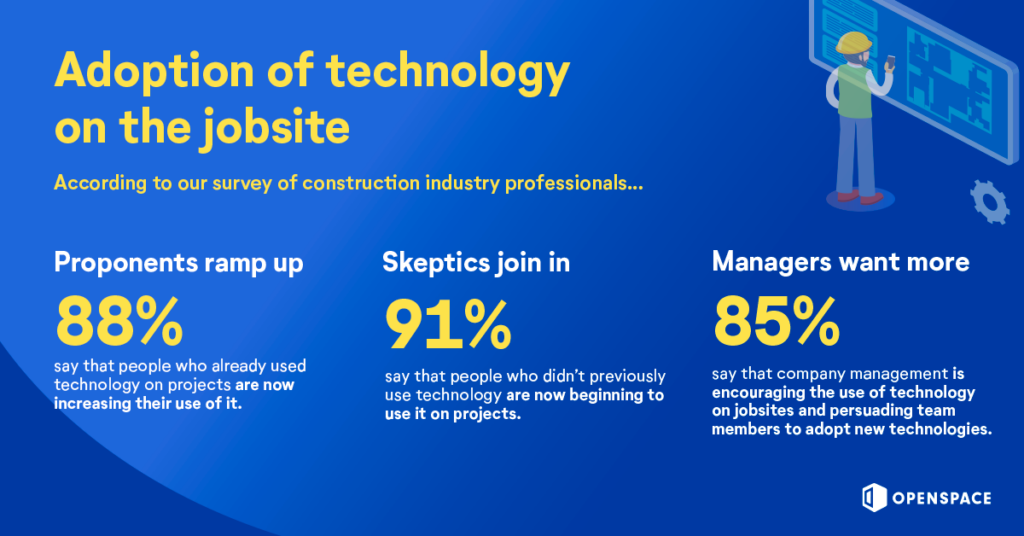
Adoption is being pushed from every direction at once. It isn’t only new users coming on board: existing users are deepening their use, management is encouraging it from the top, and field crews are requesting it from the bottom, which is unusual for an industry where new technology often meets resistance.
Our survey found upticks across every group:
|
Where adoption pressure is coming from |
Share of respondents |
|
New users increasing adoption |
91% |
|
Existing users increasing their usage |
88% |
|
Management encouraging tech use |
85% |
|
Tech-savvy members acting as “tech evangelists” |
82% |
|
Field teams lobbying for more technology |
68% |
Can construction technology help address the labor shortage?
The data on the adoption of technology on the job site makes it clear that there’s widespread interest in and support of contech, and it’s possible that the increased use of tech in construction may help attract new workers into the industry, too. Amid a national “crisis” construction labor shortage, the U.S. Chamber of Commerce Commercial Construction Index for Q3 2021 stated that 93% of contractors had reported a moderate to great concern over the next six months in finding skilled construction workers.
In our year-end survey, 68% felt that technology would attract people who otherwise would not be interested in construction jobs. Part of that attraction may come from the way technology enables hybrid construction, or partly remote, part in-person fieldwork. In a survey we conducted this summer, 72% of respondents cited improved work-life balance as one of the benefits of allowing remote work in construction. While social distancing restrictions may have been lifted in most areas, our year-end survey suggests that reduced onsite visits may be one trend that sticks around, with 83% saying that the use of technology like 360° images, digital twins, and digital communication will continue to reduce the number of site visits that are needed. This can, in turn, increase the capacity of individuals, teams, and the industry (and there’s plenty of construction projected for 2022).
Frequently asked questions
What is hybrid construction?
Hybrid construction is a working model that blends in-person fieldwork with remote work, where some site oversight and coordination happen off-site. It became practical as 360° imagery, digital twins, and digital communication made it possible to review jobsite conditions without being physically present, which can improve work-life balance and widen the pool of people willing to work in the industry.
Why is technology harder to deploy in the field than in the office?
Field technology has to work in conditions an office never imposes: limited or unreliable network connectivity, weather, dust, constant movement, and users who need to keep their hands on the work. Back-office software runs in a stable, connected environment, so it has historically been easier to build and adopt. The survey findings suggest the harder field problem is also the higher-impact one, which is why so much recent development effort has shifted there.
What does growing tech adoption mean for construction leaders?
We expect continued innovation in 2022 and beyond, as more stakeholders embrace the potential for ConTech to improve efficiency and productivity while reducing friction across a project’s many moving parts. Now is the time for construction leaders to take a strategic approach to digitization and unlock gains in collaboration, workforce satisfaction, and productivity.