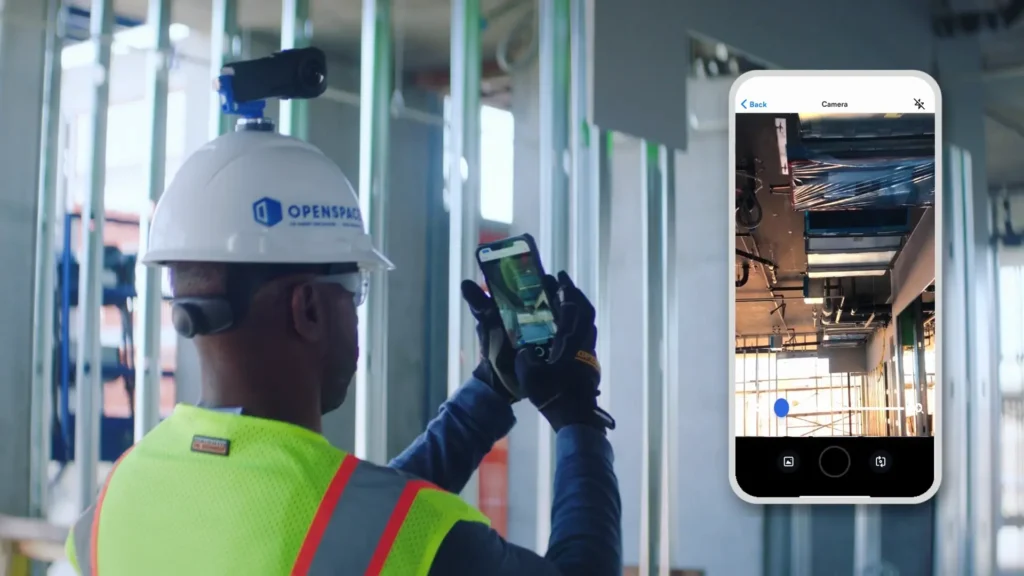
Field Notes is the OpenSpace feature subcontractors use to attach photos, markups, files, assignees, and due dates to an exact point on the floor plan. On a fast-moving job, that keeps each issue, its owner, and the visual proof together in one place the foreman, the GC, and the office can all open, so what gets captured in the field reaches the rest of the project team without a string of calls or a lost text thread.
For subcontractors, disciplined field documentation also protects a scope when a dispute lands, because a note attached to a photo outlasts anyone’s memory of the day.
How do subcontractors simplify field documentation?
By capturing the whole site once and annotating as they go, instead of documenting twice. A single 360° walk produces a timestamped, plan-pinned record of every area, and Field Notes added during that walk inherit the location automatically. The practical shift is that documentation stops being an evening task and becomes a by-product of walking the job.
Capturing site conditions efficiently
Your first step is to capture your site. As you walk, simply attach a 360° camera to your hard hat and tap record in the OpenSpace mobile app. The system captures about 25,000 square feet in just 10 minutes, and automatically timestamps and pins images to your floor plan. Captured this way, those images become a reusable jobsite record, so trades and the GC can revisit any area and date instead of relying on memory. And to document a field observation in greater detail, add Field Notes while you capture, snapping photos and adding relevant details on the go (creating Field Notes won’t disrupt your capture).
Organizing and categorizing observations
In OpenSpace, you can create custom Zones on your floor plans that represent specific areas or project phases. This makes it simple to categorize your observations—Field Notes are automatically tagged to the Zone (or Zones) they’re in. You can easily filter and report by Zones, giving you quick insights into progress and status across different sectors of your project.
Attaching relevant files and markups
You can pack as much information into a Field Note as you want—attach more photos, schematics, PDFs, and more. Use the markup feature to highlight specific issues or sketch correct orientations directly on photos. Being able to add all these details helps you communicate clearly with other team members, ensuring everyone understands the task needed.
How do Field Notes improve collaboration between the field and the office?
By replacing scattered threads with one record that carries its own context. Because a Field Note holds the photo, the location, the assignee and the conversation in one place, nobody has to reconstruct which wall, which date or which decision. The benefit compounds on long jobs: the record follows the project rather than the person, so a handover does not reset the history.
Rather than relying on scattered methods like email, photos in folders, and text messages, Field Notes helps you streamline communication and collaboration among team members, ensuring everyone stays on the same page throughout the project lifecycle.
Centralizing field documentation this way means the record follows the project rather than the person, so when a super rotates off the next one inherits a full history instead of a cold start.
Real-time sharing of Field Notes
With Field Notes, you can instantly share your observations with stakeholders. As you create a note, you can add email addresses for anyone who should receive alerts when it’s created or edited. This keeps everyone up to date on important changes, eliminating the need for back-and-forth emails or phone calls.
Assigning tasks and setting due dates
Field Notes helps you improve workflow management and maintain project momentum. For example, you can easily assign Field Notes to specific team members and set due dates to avoid missed deadlines. The system sends reminders to those on your email alerts list, ensuring tasks are completed on time.
Facilitating discussions through comments
OpenSpace timestamps your conversations in each Field Note, so it’s clear what’s happened and when. Team members can discuss issues, show progress, and make decisions directly within the platform, keeping all project-related discussions organized and easily accessible. When every observation is pinned to a floor plan and time-stamped, teams build a structured jobsite record they can reference long after the work is covered up.
How do Field Notes support quality control and issue resolution?
By turning three separate paperwork workflows—inspections and punch—into the same visual object. Each one starts as a Field Note created during a capture, so the photo, the plan location and the assignment already exist before anyone opens a form. The three workflows differ in who receives the note, not in how it is created.
| Workflow | How a Field Note handles it | What the team gets |
|---|---|---|
| Observations and deficiencies | Start a 360° capture at the top of the inspection, then create a Field Note to flag an issue, attaching photos and relevant details | Every finding is pinned to the floor plan automatically, so problems are easy to locate and address later |
| Model verification | With OpenSpace BIM+, open BIM Compare to view the 360° capture beside the model, then create a Field Note from that view to flag a deviation | Installed work is checked against design intent, and each deviation reaches the responsible trade with the model view attached |
| Punch list | Capture items on a smartphone during the walk, add details, and assign tasks; notes are tagged by Zone and pinned to the plan automatically | A visual punch list built without manual note-taking, shareable as a Field Note PDF report through closeout |
Frequently asked questions
Do subcontractors need their own OpenSpace account, or can they work inside the GC’s project?
Both patterns are common. Trades often work inside a GC-hosted project where access is granted per sheet or area, and many also run their own OpenSpace projects to document scope independently of the GC’s captures. Running your own captures matters most where the record is likely to be used in a scope dispute, because it stays under your control.
Can a Field Note be pushed into Procore or Autodesk?
Yes. Field Notes sync two ways with Procore Punch Items and Observations and with Autodesk Construction Cloud Issues, so the note created on the walk becomes the item of record in the platform the project already runs on. Notes can be bulk-synced or converted individually.
Does Field Notes replace a punch list tool, or sit alongside one?
It depends on where the project keeps its system of record. On projects standardised on Procore or ACC, Field Notes is the field-side front end and the punch items still live in that platform. On projects without one, teams run punch end to end in OpenSpace and share PDF reports. OpenSpace is a system of work, not a system of record.
Learn more about Field Notes for the trades
Reality capture technology from OpenSpace is fast and user-friendly. From capturing to communicating visually with Field Notes, subcontractors can fully document their work, enhance team collaboration, improve quality control processes, and resolve issues faster than ever before.
If you’d like to learn more about using Field Notes on your construction sites, let’s set up a live, one-on-one demo. Schedule a time today!