AI in construction is changing how projects are planned, built, and managed. Builders are using AI to schedule work, catch risks earlier, automate documentation, and strengthen Building Information Modeling (BIM) workflows across every phase of a project. As more is captured from the field, AI’s ability to spot patterns, forecast outcomes, and uncover new efficiencies grows with it.
This article looks at where AI is reshaping construction today, from BIM and workforce productivity to task automation, data security, and predictive analysis.
How is AI changing workforce efficiency in construction?
Artificial Intelligence (AI) is revolutionizing the construction industry by enhancing workforce efficiency through skill enhancements, task automation, and increased job site productivity. These advancements are not only optimizing the current workflows but are also setting a new standard for future operations.
Jobsite productivity
AI raises jobsite productivity in several ways, each one cutting time or waste out of the build:
- Optimizing labor and material allocation to cut costs and shorten timelines
- Scheduling construction tasks more efficiently across phases and trades
- Documenting work quality through cameras and sensors that flag defects early
- Forecasting potential challenges from historical project records and current conditions
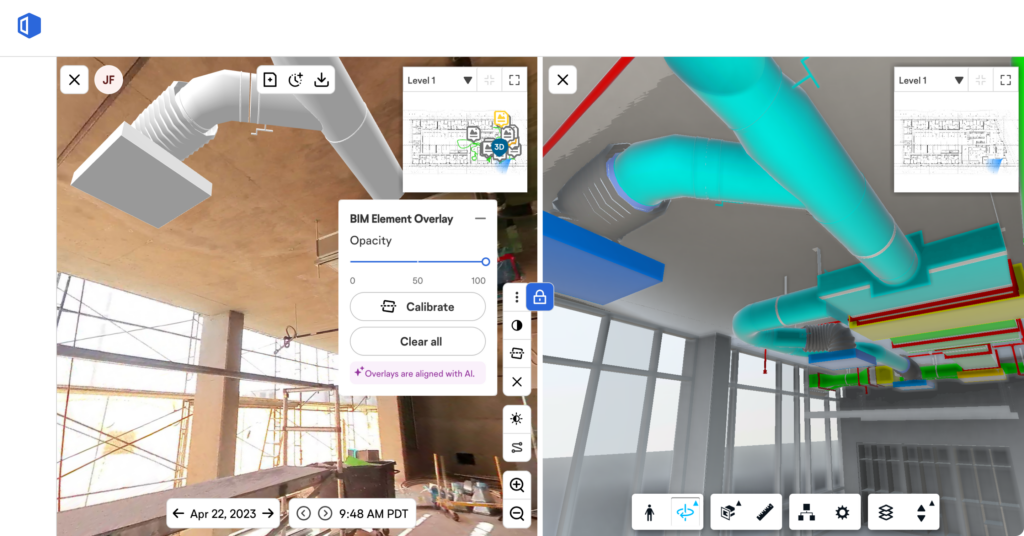
That early-warning loop matters because schedule delays rarely trace back to one big failure. They accumulate from small issues exactly like the ones AI is built to catch. OpenSpace applies this directly on the jobsite: field teams walk the site with smartphones and 360° cameras and fly drones, and the OpenSpace Spatial AI Engine automatically maps every image to the floor plan in real time, flagging what’s there, what’s missing, and what’s changed.
Across all of these, AI helps builders plan better, catch issues sooner, and keep projects moving.
Task automation
AI can automate clash detection, project scheduling, resource allocation, and data extraction from construction documents, reducing the time required for these activities compared with traditional methods and lowering the likelihood of human error. The same automation underpins AI construction progress tracking, where computer vision classifies installed components against the schedule instead of leaving percent complete to a manual tally.
AI handles a growing list of automated workflows, including:
- Clash detection and prevention across design models
- Project scheduling and resource allocation
- Data extraction and review from construction documents
- Site inspection support that reduces manual work and human error
Skill enhancements
We’re also seeing a rise in AI-driven platforms used for the purposes of skill development by providing personalized learning experiences. By processing data sets, AI enables the formulation of tailored training programs that cater specifically to the needs of individual workers, thereby enhancing their capabilities and performance. For instance, the integration of microlearning techniques, which have been shown to increase learning effectiveness by 60%, leverages AI to deliver concise, targeted content that improves skill acquisition and retention.
How do AI systems strengthen data security in construction?
Data analytics
Data analytics plays a crucial role in advanced data security within AI systems. By leveraging predictive analytics, construction firms can foresee potential security threats and devise preventive measures. For instance, predictive analytics can identify when specific structural elements might fail, allowing timely reinforcement to prevent accidents. Furthermore, data analytics supports effective resource allocation, which not only optimizes project costs but also minimizes environmental impact. This analytical approach is pivotal in project planning, significantly enhancing decision-making accuracy and efficiency .
Cybersecurity measures
The construction industry faces unique cybersecurity challenges, from common cyberattacks to niche risks that can infiltrate every aspect of a construction enterprise. To combat these threats, extensive measures are implemented, including multi-factor authentication, robust employee training, and stringent data breach prevention strategies. Additionally, the adoption of cyber-physical systems (CPS) enhances the management of connected construction facilities, integrating rigorous digital security measures to boost resilience and minimize disruptions. These comprehensive cybersecurity measures are critical for protecting sensitive data and maintaining uninterrupted operations in the construction sector.
How is AI used to forecast outcomes in construction?
Predictive analysis
Predictive analysis in construction ai leverages historical data and advanced analytics to forecast future outcomes and trends, significantly enhancing decision-making processes. By utilizing predictive models that incorporate statistical modeling and machine learning, construction professionals can anticipate challenges, optimize resources, and mitigate risks effectively. These tools enable more accurate budgeting and realistic project timelines, improving overall project efficiency and reducing potential cost overruns .
Market trends
The AI in Construction market is experiencing robust growth, with projections indicating a rise from USD 3.21 billion in 2023 to USD 11.85 billion by 2029, reflecting a compound annual growth rate (CAGR) of 24.31%. North America, particularly the United States, remains at the forefront of this expansion, driven by significant technological advancements and a strong infrastructure development sector. This region’s focus on integrating AI into various construction processes, from project planning to operational management, underscores its role as a leader in the global market .
Future AI-driven technologies
Future AI technologies in construction include artificial neural networks for predicting cost overruns, reinforcement learning for project planning, and AI-driven tools for optimizing energy use and indoor air quality.
Emerging applications include:
- Artificial neural networks that predict cost overruns before they hit
- Reinforcement learning that refines project planning through trial and error
- Energy optimization models that improve building performance and indoor air quality
- Pre-design AI tools that support feasibility studies and risk analysis
Together, these tools are moving AI from a supporting role into a core part of how construction projects get planned and delivered.
AI is already reshaping how construction projects get planned, built, and documented. As more builders adopt it, the result is faster work, fewer surprises, and better decisions across every stage of a project.
FAQs
What role will AI play in the future of the construction industry?
AI is poised to significantly enhance productivity and efficiency across global construction sites. Through machine learning algorithms, virtual construction management software can efficiently plan project schedules, minimizing potential delays.
How will emerging technologies influence construction in the future?
Emerging technologies enable contractors and project managers to make more timely and informed decisions by providing real-time data on costs and labor. Intelligent modeling allows for adjustments to building models on-the-fly, helping to assess the financial and labor implications of changes.
What are the future prospects for AI across various industries?
AI is expected to become increasingly integral to various sectors, including healthcare, banking, and transportation, as technology advances. This growth in AI-driven automation will transform the job market, creating new roles and requiring new skills.
How is AI expected to impact construction and engineering?
AI, particularly through machine learning, plays a crucial role in construction and engineering by using statistical methods to analyze data. This analysis helps identify patterns and provide insights, assisting firms in better risk assessment and project planning.