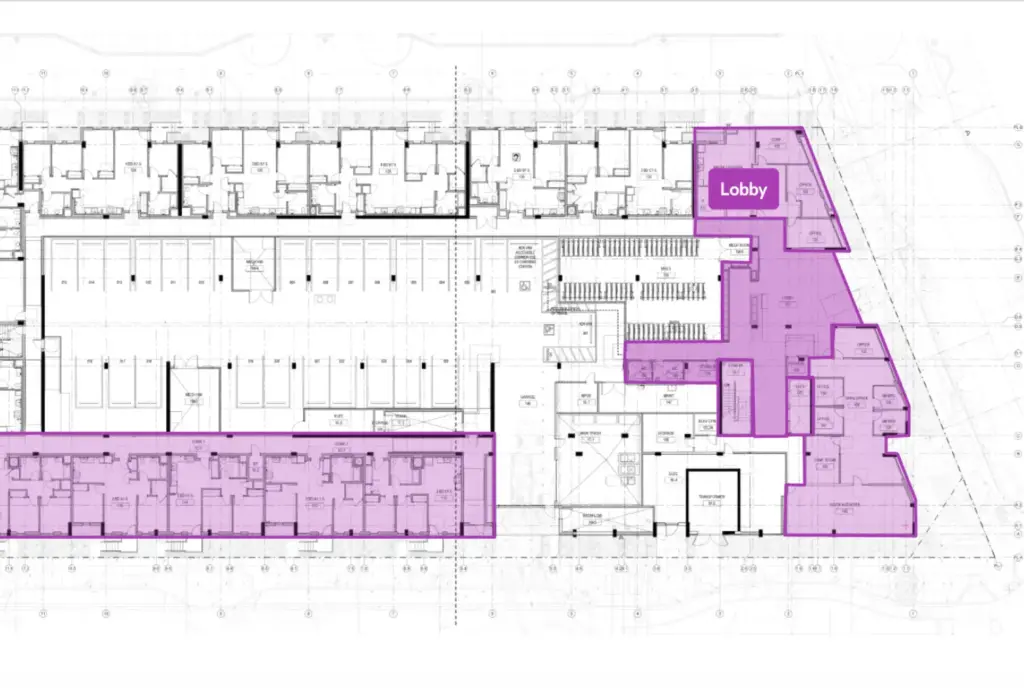
Zones let you draw areas on a floor plan—a room, a sector, a phase of work—so that every Field Note created inside one is tagged to it automatically, with no manual labelling. Field Notes in OpenSpace makes it easy to capture detailed information about your project and send it to the right person—on the jobsite or in the office. Customers use Field Notes to keep track of observations, flag issues, streamline punch lists, and speed up RFIs. Already one of our most-used features, our new enhancement makes Field Notes even more efficient for communication and solving problems. Introducing Zones.
How do Zones tag Field Notes automatically?
Zones are geometric areas you draw on a sheet, so tagging is positional rather than manual. When a Field Note is created, OpenSpace checks which Zone or Zones its pin falls inside and applies those tags. Because the test is geometric, editing a Zone boundary re-tags the notes affected—tags stay correct as the definition of an area changes, which manual labelling cannot do.
Zones streamlines Field Note management by making it simple to create Zones on your sheets (floor plans) that match any area on your project that you want to track. For example, you can create Zones for rooms/units, sectors, or even for phases of your work (such as “Courtyard phase 2”). By creating Zones, you don’t need to manually tag each Field Note to denote location. Instead, OpenSpace automatically tags your notes by the Zone (or Zones) in which they reside.
Organizing notes this way gives teams a cleaner foundation for construction progress monitoring, since every observation already carries the location context that reporting depends on.
Saving you even more time, when you add a new Zone or update an existing Zone, OpenSpace reanalyzes all your Field Notes to ensure they’re tagged to match your updates. With all your Field Notes automatically mapped to Zones, it’s a snap to filter and report by area so you can quickly view progress and status of the electrical room, unit 5, sector B, concrete pour phase 1, or anything you’ve defined.
Tracking findings by area is what makes a walk reviewable later, since the same room can be compared week over week without hunting through a list.
Zones for Field Notes expedites and improves progress monitoring by:
- Giving Admins the power to easily create and manage Zones that match specific areas of a project or phasing for how a project gets built.
- Easily copying Zones you’ve defined for one sheet to another sheet (or multiple sheets)—perfect if you have a project with multiple floors with the same layout.
- Automatically tagging by your custom Zones for easy organization (plus eliminating time-consuming and disorganized manual steps).
- Ensuring accurate reporting of the location or phase for which you want the latest information.
Watch a demonstration of how OpenSpace Site Admins can create and manage Field Notes Zones:
According to David Smith, Technology Integration Specialist at Vankirk Electric, “Zones has been a game-changer for us. We rely heavily on Field Notes to manage and track the progress of our projects. However, with over 1,700 Field Notes on a single project, finding the right information on demand hasn’t been ideal. Zones takes it to the next level by allowing us to label our work areas at a granular level. Now whenever Field Notes are created they’re automatically tagged to the area they are located in. This ultimately speeds up the pace of Field Note creation and ensures greater accuracy of the data being garnered through OpenSpace.”
Granular work areas like these feed directly into construction progress tracking, where status by zone rolls up into a clear picture of what is complete across the project—and they are what makes issue tracking dependable at scale, because every note is pinned to a room or phase the moment it is created.
Frequently asked questions
Do Zone tags carry over when a Field Note syncs to Procore or Autodesk Construction Cloud?
The Field Note itself syncs two ways—to Procore Punch Items and Observations, and to Autodesk Construction Cloud Issues—carrying its title, status, description, due date and imagery. Whether the Zone tag travels with it depends on how location fields are mapped in the destination platform, so check this against your own project setup before relying on Zone filtering downstream.
What happens to a Field Note created outside every Zone?
It is created normally and simply carries no Zone tag. Because tagging is positional, a note only inherits a Zone when its pin falls inside one, so areas you have not drawn a Zone for still get documented—those notes just will not appear when you filter by area. Teams often find the untagged notes are the signal that a Zone is missing.
Do Zones only work during a 360° capture, or on any Field Note?
Any Field Note pinned to a sheet gets tagged, whether or not a capture is running. Zones are geometry drawn on the plan and the tagging test is where the pin sits, so a note added from the mobile app on a walk with no camera is tagged the same way as one created mid-capture.
Learn more
To learn how to set up and use Zones, head to our Support article. If you want to know more about our Field Notes feature in OpenSpace Capture and how you can use it for powerful image-based workflows, check out our Field Notes web page.
Not an OpenSpace customer? How would you like to test out OpenSpace? Head to our free product demo where you can click around and view a real OpenSpace documented project.