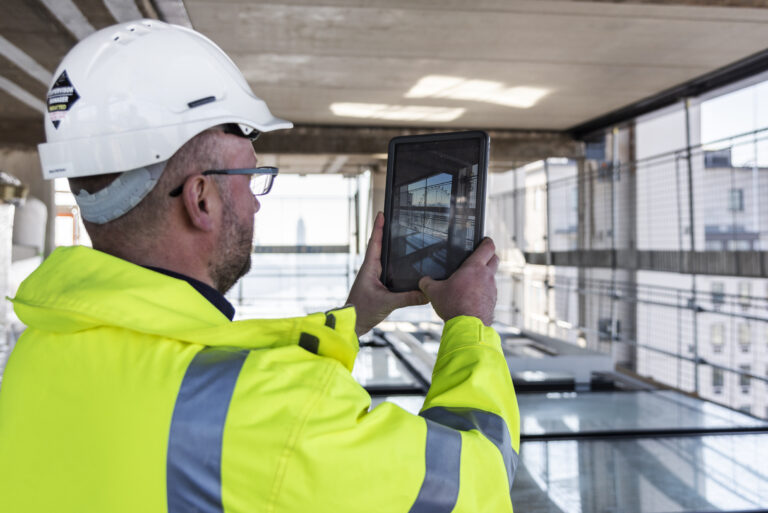
General contractors, trade contractors, and owners from around the globe tuned in to Waypoint 2026, our annual customer summit, to be the first to hear new product announcements and to see customer stories from active jobsites. This year, we shared a simple idea: there’s a new way to work in construction.
It starts with what’s truly happening on the jobsite. Instead of relying on written reports, spreadsheets, and someone’s best recollection, Visual Intelligence gives you a clear view of reality—and increasingly, the intelligence to understand what it means and act on it.
We went deep on new ways to work from your phone, verified progress data that can help teams see what’s coming next, and AI agents that can see the jobsite and take work off project teams’ plates.
And the part we always love: we heard from customers already putting it all to work.
Watch Waypoint 2026 from start to finish.
Visual Intelligence: from seeing what happened to deciding what happens next
OpenSpace co-founder and CEO Jeevan Kalanithi kicked off Waypoint with a look at how far Visual Intelligence has come—and where it’s headed.
The premise is pretty basic: construction happens in the physical world, so some of the most useful information about a project is visual. OpenSpace brings that reality together with context like location, drawings, models, schedules, and progress data so you can make decisions based on what’s actually happening.
And when you have that information at your fingertips, everyday work is easier. It can reduce uncertainty, risk, and cost. And it creates something increasingly important as AI becomes part of construction: real-world context.
Jeevan also introduced live location, the next generation of our groundbreaking AI Autolocation technology. Live location shows users where they are on their project in real-time as they move through the jobsite.
Watch Jeevan’s opening keynote for more.
The future of the field is in your pocket
VP of Product Michael Jones showed what this new way of working looks like in the field, with a first look at some of the biggest product innovations coming to OpenSpace.
At the center is Site Mode, a new mobile experience designed around a basic question: what if your phone already knew where you were on the jobsite?

With live location, OpenSpace can show your position on the sheet as you walk—even indoors, without GPS or hardware beacons. From there, Site Mode opens up new ways to work: pull up BIM based on where you’re standing, see previous captures from that location, open Field Notes near your location, and use Walk and Talk to capture photos and observations without stopping to manually pin everything to a floor plan.
Michael also previewed Site Mode’s live capture, which shows 360° capture coverage as you walk so you can immediately see what you captured and what you missed.
Beyond Site Mode, we shared updates across field workflows, integrations, OpenSpace Air, enterprise capabilities, and a long-requested capability: measurements using 360° captures and the point clouds generated from them.
What do these new capabilities mean for you? Less time dealing with apps, forms, and manual steps. And more time getting work done.
Take it from ISEC, where teams are using AI Voice Notes, AI Autolocation, and our Autodesk integration to create better Field Notes faster and resolve issues sooner. After seeing the results, ISEC is deploying OpenSpace across the company nationwide.
- Watch Michael Jones’ session for the full scoop.
- Watch our quick video to see how ISEC is staying ahead of issues.
Progress you can see—and act on
“How’s the project going?” is one of the most common questions in construction. And the answer still often comes from manual updates and subjective assessments.
Group Product Manager Michaela Rhile showed how OpenSpace Track delivers a better way, giving you a more objective answer by turning 360° and drone imagery into verified progress data. AI powered and human verified.

You can see actual percent complete across a portfolio or drill down by project, trade, floor, Zone, or task. Catch rework and nonconforming work, identify bottlenecks earlier, and combine verified progress with other project data to better understand where a project stands and where it’s headed.
Michaela also shared the exciting update that OpenSpace Track is expanding beyond the OpenSpace platform, announcing a new API for OpenSpace Track, currently in Beta. This will enable you to bring progress data into ERP systems, BI dashboards, project management tools, and other workflows.
That opens up new possibilities for putting verified progress data to work—including construction payments.
OpenSpace customer ibens is already connecting progress tracking with its payment process. The team is using OpenSpace Track to objectively measure work in place and connect that progress to its schedule of values, helping simplify invoicing for both ibens and its subcontractors. Now, ibens is exploring how the OpenSpace Track API could automate even more of the process.
We also heard real-world stories from customers at Canary Wharf Group, McLaren Construction, and Suffolk, who are putting objective progress data to work in different ways—from managing progress across a complex development to improving subcontractor conversations, client reporting, and project performance.
- Watch Michaela Rhile’s product session for more on OpenSpace Track.
- See how ibens is connecting progress tracking and payments.
- See how Canary Wharf Group, McLaren Construction, and Suffolk are keeping projects on track in our quick video.
AI agents need more than documents. They need eyes.
AI can already do remarkable things with documents, contracts, spreadsheets, and schedules. But those sources mostly tell an agent what’s supposed to happen on a construction project.
To be truly useful to builders, AI also needs to understand what is happening. That’s why we’re building the OpenSpace Agent Ecosystem, introduced by Jeevan at Waypoint. We’re giving AI agents access to the visual reality of the jobsite, along with the location and details about the project needed to do useful work.

We demonstrated agents finding housekeeping issues in jobsite imagery, locating them on a drawing, and creating Field Notes for follow-up. Another agent can use current imagery, Field Notes, OpenSpace Track data, and Walk and Talk captures to draft a daily report.
The OpenSpace Agent Ecosystem is currently in early access, with launch planned for early 2027.
NOVO Construction, one of the earliest OpenSpace customers, is already using an OpenSpace AI agent to generate weekly owner reports. One project engineer who previously spent three to four hours every Friday creating her report now spends about 30 minutes refining an AI-generated version that arrives 85–90% complete.
- Watch Jeevan’s introduction to the OpenSpace Agent Ecosystem.
- See AI agents already at work in our video with NOVO.
When AI can close the loop
CTO and co-founder Michael Fleischman closed Waypoint with a look at where AI agents could go next. He shared that giving AI agents eyes is the starting point. The bigger opportunity is helping agents work alongside people to continuously connect plan, reality, and action.

Michael calls that “closing the loop”: see what’s happening on the jobsite, understand how that compares with the plan, take action, then look again to see whether that action worked.
He demonstrated prototypes that bring this concept to life. An agent could revisit a previously identified issue in new imagery and determine whether it appears to have been resolved. Another could compare a pay application against verified OpenSpace Track data before queuing it for human approval.
With Spatial AI and live location, agents can also begin to understand not just what they see, but where they are. Michael showed how that spatial awareness could help an agent identify schedule risks from a Walk and Talk session—or even recognize that it’s missing information and guide someone to the exact location where more data needs to be captured.
He also explored what could come next as these capabilities move from phones to hands-free devices like smart glasses. These are forward-looking prototypes, but they point toward something very practical: AI taking on more of the repetitive work around construction while people stay focused on building.
Watch Michael Fleischman’s Waypoint talk.
Watch Waypoint 2026 on demand
Waypoint covered a lot in about 90 minutes: new ways to navigate and work in the field, major advances in progress tracking, AI agents already doing real work, and a look at where construction technology goes next.
And all these advancements connect back to the same idea. When teams have an accurate view of what’s happening, they can spend less time documenting, searching, debating, and catching up—and more time building.
Watch the full Waypoint 2026 event.
Or jump straight to a session or customer video:
- Welcome & introduction with Jeevan Kalanithi
- The future of the field is in your pocket with Michael Jones
- Customer video: on-site with ISEC
- A new era for progress tracking with Michaela Rhile
- Customer video: on-site with ibens
- Customer video: on-site with Canary Wharf Group, McLaren Construction, and Suffolk
- Introducing the OpenSpace Agent Ecosystem with Jeevan Kalanithi
- Customer video: on-site with NOVO
- Closing the loop with AI agents with Michael Fleischman
Learn more
Want to learn more about anything we announced at Waypoint 2026?
- Not a customer: Fill out this quick form and we’ll be in touch.
- Already a customer: Reach out to your OpenSpace rep.