Every builder budgets for concrete, steel, and labor. Far fewer budget for the argument that lands 18 months later, when a subcontractor swears the work was never in scope and the only proof either side holds is a blurry phone photo nobody can place in time.
Strong construction dispute documentation is what decides that moment. On most construction projects, disputes are filed under bad luck. They should not be. A dispute is an argument about what happened on site and when—exactly the question a time-stamped 360° visual record answers before anyone calls a lawyer.
This guide covers what construction disputes cost, why ordinary jobsite photos fall apart as evidence, and how a defensible record changes the outcome of scope, change order, delay, and payment disputes—using real results from firms already working this way.
What construction disputes cost, & who absorbs it
The numbers are not small. According to Arcadis’s 2025 Global Construction Disputes Report, the average construction dispute in the United States is worth $60.1 million, and disputes in North America take roughly 12.5 months to resolve.
That is a year of tied-up cash, distracted project teams, and stalled decisions on top of the sum in play. One of the most common contributors is mundane: parties failing to understand or comply with their contractual obligations. A paperwork gap—and paperwork gaps are fixable.
That distinction drives everything below. Most construction contracts already put the burden of proof on the party bringing a construction claim, long before a dime of additional cost or a single day of extended time changes hands. The question in nearly every dispute is the same: can you show what was built, when, and under what conditions?
Firms that can settle in weeks through negotiation: the most common form of dispute resolution. Firms that cannot spend a year in construction arbitration reconstructing a story from memory, and dispute resolution on those terms is rarely cost-effective.
Why traditional jobsite photos fail as construction claims evidence
Here is the uncomfortable part: the photo folder most firms lean on would not survive a serious challenge. Contemporaneous records—evidence created at the time an event occurred—are consistently treated as the strongest proof in construction cases, precisely because they cannot be reworked after the fact to fit an argument. Ordinary jobsite photos rarely clear that bar, and unreliable records sit at the root of most jobsite documentation disputes.
Three failures repeat:
- Inconsistent coverage: The one area now in dispute is the one nobody photographed.
- Missing time and place: A photo with no reliable timestamp or location proves something happened somewhere, sometime, which proves nothing.
- Exploitable gaps: A contractor carries the burden of proving a construction claim by a preponderance of the evidence, and boards have denied otherwise-valid claims for exactly that reason—a differing site conditions claim with no photograph of the condition, a weather delay with no daily report to anchor it.
The work may have been real. Missing documentation lost the argument anyway. Sound familiar? Phone photos and phone calls are the default across construction; a weak hand when the contract is unclear, and someone decides to test it.
What makes a 360° visual record defensible
A defensible record fixes each of those failures by design. With 360° reality capture, a single walk produces evidence that holds up:
- Complete coverage: The platform maps every frame to the floor plan automatically, so coverage is complete rather than selective.
- Automatic time and place: The Spatial AI Engine time-stamps every image and pins it to a spot on the plan without anyone typing a note—each frame carries the two facts a dispute turns on: where, and when.
- A tamper-proof record: Captures live in tamper-proof cloud storage, so the record stays what it was on the day it was made—the point customers name the moment a contractual argument starts.
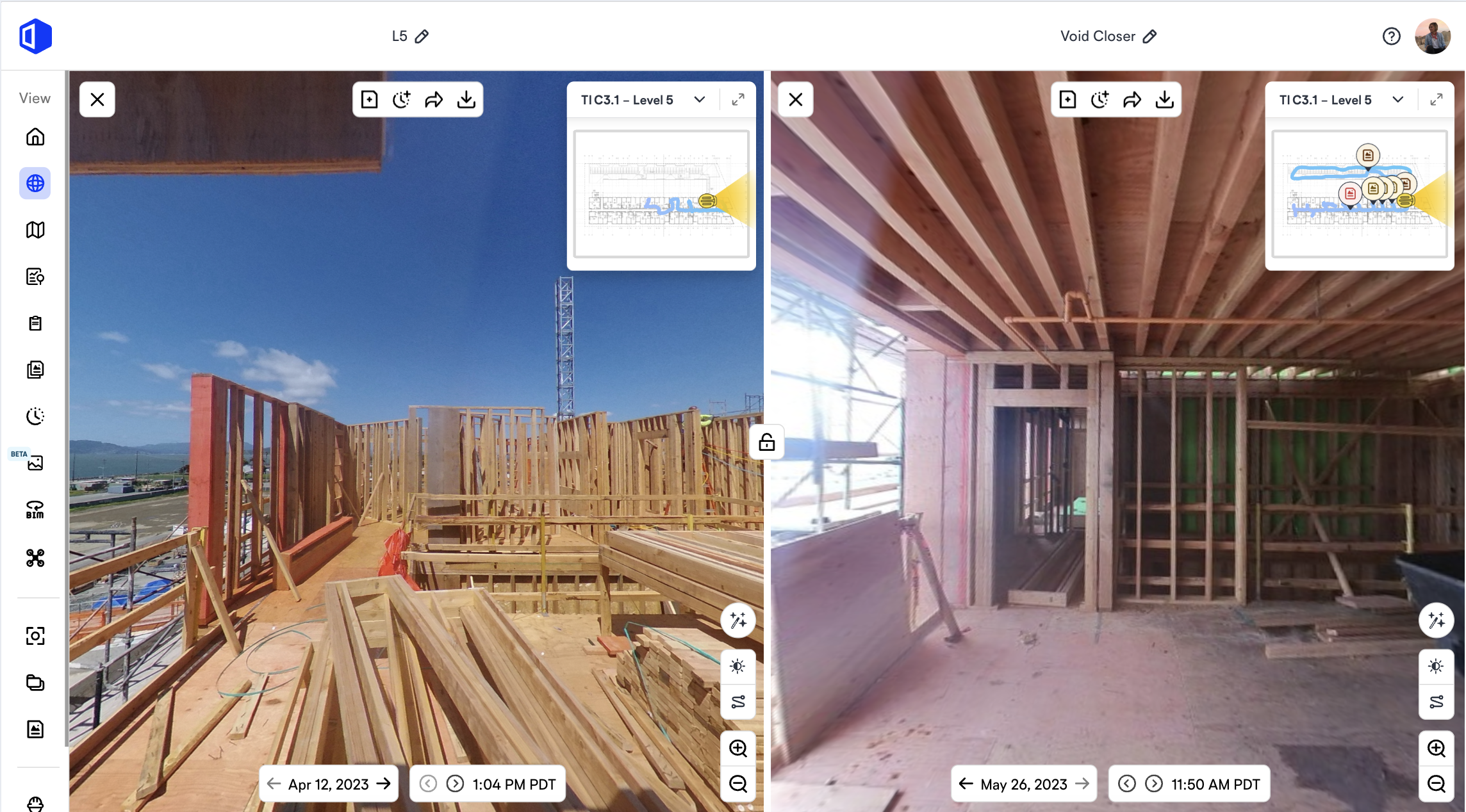
- A rewindable history: Because walks repeat, you build a documented history: pick two dates and see what sat behind a wall before the drywall closed it, or under a slab before the pour.
As a system of document management, it turns loose electronic documents into one located, dated record—the capture-to-intelligence shift the Visual Intelligence Platform is built on, where a raw walk becomes evidence a firm can act on.
“Two years later, nobody remembers what a photo shows. They remember what it can prove. I have sat in enough OAC meetings where someone pulls out a phone photo and the first question is always when was this taken and where. If you cannot answer both in the same breath, the photo does not help you. Most teams get one right and skip the other. A record only holds up if it answers both without anyone having to vouch for it.”
—Wesley DuBose, Product Manager, OpenSpace
Which construction disputes does a visual record resolve fastest?
Not every dispute suits a visual record. The ones that do share a trait: they hinge on a fact the imagery already holds. Here’s how that plays out across the disputes builders see most.
| Dispute type | What the visual record settles | Proof in practice |
| Scope disputes | What was included when a subcontractor took over | JJ Rhatigan, BESIX Watpac |
| Change order disputes | The condition that triggered a change and the work that followed | Nibbi, Vinci Construction UK |
| Damage and defective work | Who caused damage, and the condition at handover | Level 10, Valley Interior Systems |
| Delay claims | Whether scheduled work happened when the program says it did | RG Construction |
| Payment disputes | Whether billed work is actually in place | HAP Construction, RG Construction |
Scope disputes & subcontractor accountability
When JJ Rhatigan swapped subcontractor packages mid-project, its OpenSpace captures acted as a clear demarcation record of the work done before and after the change, ending any argument over the incoming subcontractor’s scope before it started.
BESIX Watpac describes the same effect in blunter terms. “When you have an indisputable record of the history of the site, you can stand your ground and say, ‘We know what the facts are; now let’s get on with the job,'” says the firm’s Seamus Egan, who calls it peace of mind for an executive.
Change order disputes
Change order disputes and owner changes create a he-said problem at a larger scale, usually with additional compensation on the line. Nibbi resolves billing discrepancies against the record rather than the invoice; Vinci Construction UK credits its captures with the speedy resolution of a dispute that saved significant time and money.
Owner changes get murkier when a design professional revises drawings late. The implied warranty on owner-supplied plans matters here—a record showing the field built exactly what the revised design issued keeps a variation claim honest.
Damage attribution and defective work
Few disputes turn uglier than damage attribution. On a Level 10 Construction project, the crew installing metal panels blamed the scaffolding team for a damaged panel; a review of the OpenSpace record showed the damage predated the scaffold, clearing the scaffolding team in minutes rather than weeks.
Valley Interior Systems built the same protection into a weekly routine—time-stamped Field Notes marking each room complete and damage-free—which, in its own words, lets the firm “recover costs” instead of leaving one party to absorb another’s mistake. The same record answers a poor workmanship claim: it shows the condition at handover rather than a version rebuilt for the hearing.
Delay claims and the schedule record
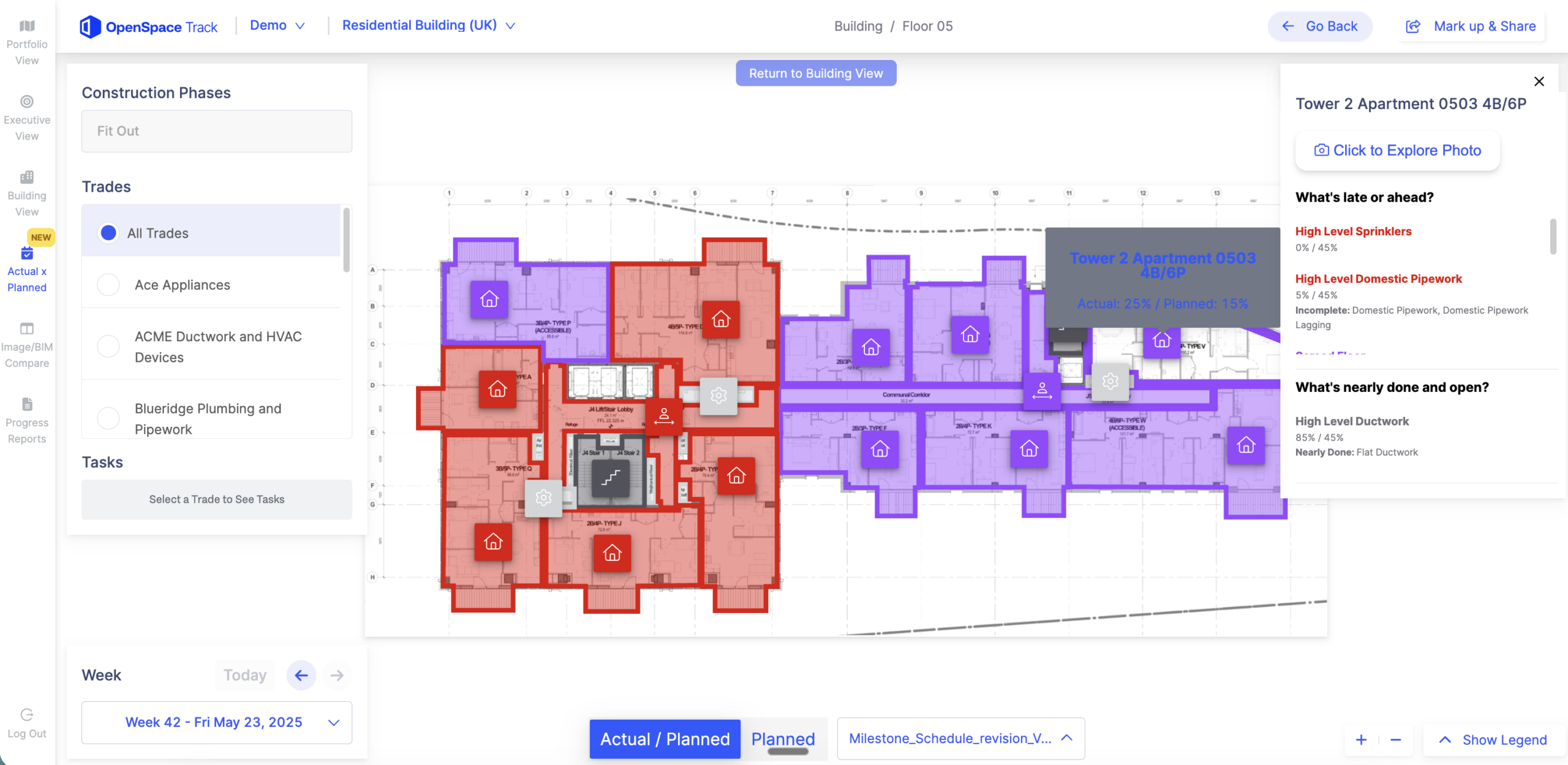
Delay claims are the most document-hungry disputes in construction, and the ones where a liquidated damages clause turns lost days into hard dollars. Compared against the plan, OpenSpace Track turns each capture into schedule evidence—its planned versus actual progress tracking lets RG Construction show when it is ahead of the program and course-correct a slip early rather than discovering it at 50% complete.
In complex construction disputes with several parties, that contemporaneous timeline is what apportions responsibility. Whether a firm is pursuing an extension of time or defending against liquidated damages, the record shows cause and effect where a schedule narrative alone can only assert it.
“A schedule narrative asks someone to trust the story. A time-stamped record lets them check it themselves. I spent three years on the finance side watching people underwrite risk off someone else’s word, and I spent summers before that actually doing the work being reported on. The gap between those two jobs is the whole problem. When an owner or a lender can see the same date-stamped image the project team is looking at, they are not taking anyone’s word for where the schedule stands. That changes the conversation from ‘trust me’ to ‘see for yourself.”
—Michaela Rhile, Manager, Product Management, OpenSpace
Payment disputes & work-in-place verification
Payment disputes come down to one question a visual record answers on sight: was the work actually in place? HAP Construction confirms subcontractor-billed work virtually during bank requisition invoicing meetings, so a claim for drywall on the seventh floor gets verified without a site visit. When work-in-place is visible and time-stamped, payment moves closer to the day the work was done—and the direct costs that pile up while an invoice is contested never accrue.
When the record settles a construction claim before it becomes a fight
The strongest outcome is the dispute that never matures into a formal construction claim. OpenSpace has described a stick-frame project in Texas where fire damage from a neighboring lot was fully captured before and after, letting the insurer process the claim almost instantly and keep the job moving. In another case, floor tile peeling weeks before handover was traced back through the record to the wrong adhesive, naming the responsible party before it ever became an insurance claim.
At the ENR FutureTech panel on reality capture, The Christman Company’s Carey McIlrath described a single capture that caught a $250,000 fix before a floor was poured on one project, with several more catches of similar scale. OpenSpace’s Jeevan Kalanithi has pointed to an insurer’s own analysis showing a 41% drop in insurance claims among firms using the same visual record.
That is construction claims prevention in practice: early identification closes potential claims while they are still cheap, and the same imagery that would win in arbitration can significantly reduce how many disputes get there at all.
Request a demo. See how a defensible visual record holds up in your next dispute.
How lenders read construction projects through visual documentation
Risk does not stop at the general contractor. Lenders carry it too, and some now use the same visual record to manage it. Nedbank deployed OpenSpace across development-finance projects to verify inspections and payments remotely—and kept lending on construction projects when other banks pulled back because they could not monitor risk on the ground. For a commercial or risk audience, that is the tell: when a bank underwrites its exposure on a visual record, the record has cleared a high bar for reliability across the project lifecycle.
Documentation best practices that survive a dispute
A record only protects a firm if it exists before the argument. A defensible cadence follows a few best practices:
- Capture on a fixed rhythm, so coverage is even rather than reactive.
- Walk the whole floor, not only the interesting corners.
- Assign ownership to a role, so it happens whether or not the schedule is tight.
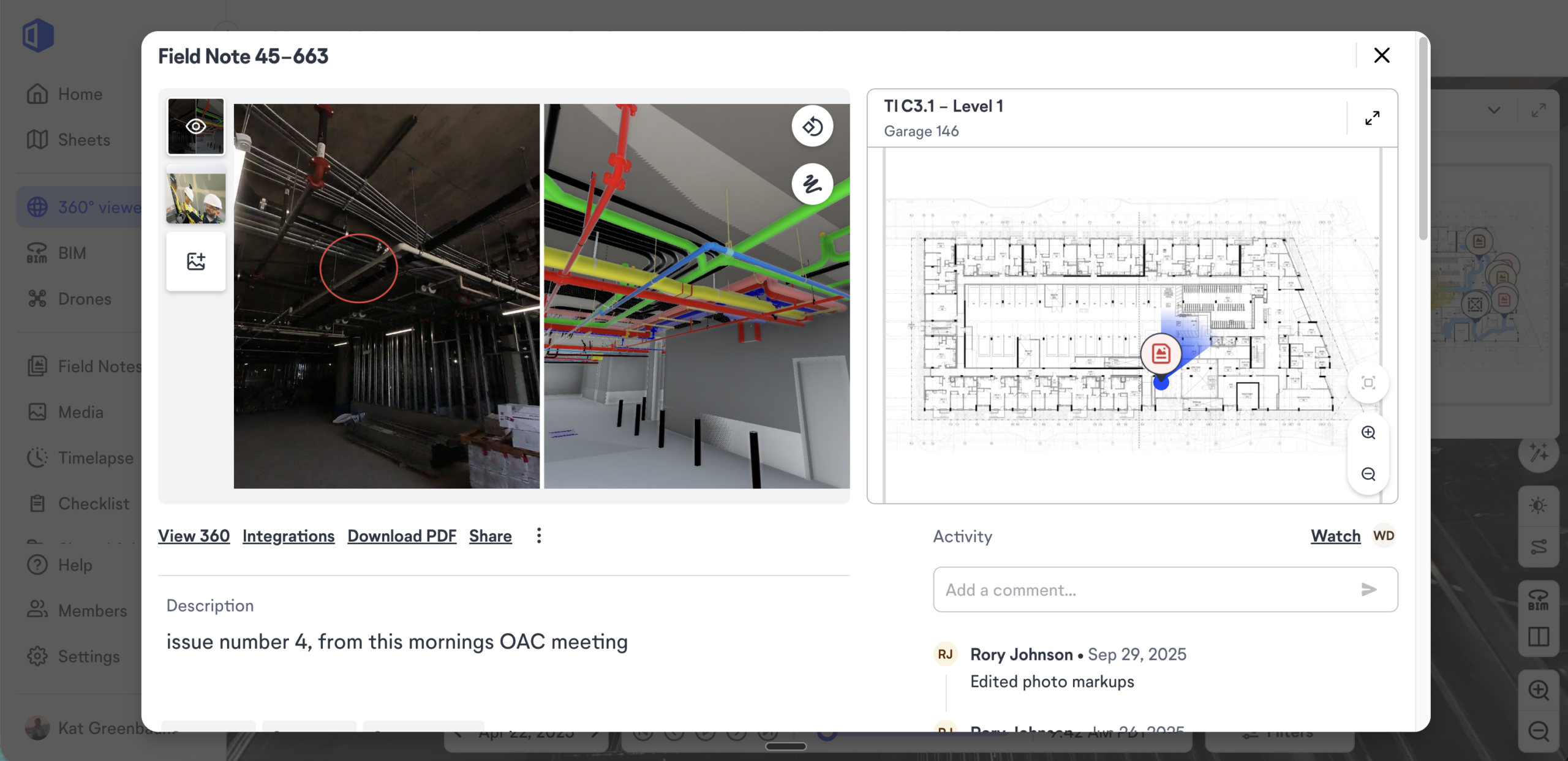
Field documentation closes the last gap—a foreman can log an issue in seconds while AI Autolocation, built on artificial intelligence, pins it to the plan, then syncs it two ways to Procore Punch Items and Observations or Autodesk Issues so the record and the project management system never drift apart.
Meeting minutes and inspection reports still matter; the visual record is what ties them to the physical condition they describe. On a well-managed project, notice requirements move faster because the evidence is already located and dated, and later document production becomes a search rather than an archaeological dig.
“Every team that asks me about capture frequency is really asking a different question: how do I get this to happen without adding a job to somebody’s day. I have watched plenty of well-intentioned capture plans die in the first month because they asked the field team to do too much. What actually survives is tying the walk to something that already exists, like a weekly OAC meeting or a Friday walkthrough, so nobody has to remember to do it. The rhythm that lasts is the one nobody has to think about.”
—Jess Lam, Staff Product Manager, OpenSpace
Build the record before you need it
Disputes are a permanent feature of the construction industry, but a year in construction arbitration does not have to be. Firms that treat their site record as infrastructure—captured on a fixed rhythm, mapped automatically, stored where no one can quietly edit it—spend their disputes settling facts rather than arguing about them. The record is cheap. The argument is not.
Request a demo or contact OpenSpace. Turn your jobsite record into your strongest evidence before the dispute starts.
Frequently asked questions
How long should jobsite documentation be retained for dispute protection?
Keep it at least as long as your construction contracts and the applicable law leave you exposed to a claim—commonly around six years after completion, and longer for higher-value or deed-executed contracts. Because 360° captures live in cloud storage rather than a filing cabinet, retaining the full project record for years adds cost but little effort. When in doubt, keep it, and confirm exact retention periods with your own legal counsel—this is general guidance, not legal advice.
Can 360° captures be used as construction claims evidence in construction arbitration?
Time-stamped, location-pinned captures are exactly the kind of contemporaneous record that carries weight in the arbitration process, a formal route of dispute resolution where a neutral third party weighs the strongest available evidence in a binding process. Admissibility and weight still depend on the forum, the applicable law, and how the record was kept, so treat this as a reason to keep good records rather than as a guarantee. If your contract’s arbitration provisions apply, a clean, unbroken visual history gives your legal counsel far more to work with than a reconstructed one.
What happens if a firm doesn’t have a dedicated capture role?
Coverage gets inconsistent fast. Without ownership, capture becomes the first task skipped when the schedule tightens—usually right when a dispute-relevant condition is about to get covered up. Firms that don’t have a dedicated role often tie the walk to an existing routine instead, like a weekly progress meeting, so it happens without adding headcount.