Quality control in construction is one of the most consequential, and often misunderstood, disciplines on any construction project. Most quality programs describe what needs to happen: inspections, checklists, sign-offs. What’s more challenging is if they can address why quality still breaks down on projects that have all of those things in place.
The answer: quality issues rarely stem from a shortage of standards. They stem from a shortage of visibility. When project managers can’t see what’s happening on a construction site in real time, problems compound quietly behind drywall and above ceilings until they become expensive to fix. By the time a construction quality control checklist catches the error, the solution is already a rework order. Closing that visibility gap is how teams get ahead of rework risk, flagging a deviation while it is still a quick fix instead of a line item.
That timeline is why reducing rework is less about stricter inspections and more about seeing problems while they are still cheap to fix.
This guide covers the quality control process in construction, from preconstruction through closeout, and makes the case that a successful approach starts with a clear picture of what’s actually being built. Not what the schedule says, not what was signed off last week. What exists right now.
What is quality control in construction?
Quality control in construction is the systematic evaluation of materials, workmanship, and construction activities to verify they meet project specifications, acceptance criteria, client specifications, and applicable building codes. Construction quality control focuses on identifying and correcting nonconformances before they progress into the next phase of work.
Where quality assurance is proactive, establishing the processes, standards, and systems that are supposed to prevent defects, quality control is the verification that those processes are actually working in the field. Both are necessary.
A quality assurance plan without construction quality control is a policy document; quality control without a quality assurance framework is reactive firefighting.
Together, quality assurance and quality control in construction projects create the feedback loop that keeps work aligned with design intent, regulatory requirements, and client expectations, from the first pour to final handover.
Construction quality assurance vs. quality control: understanding the difference
Quality assurance and quality control are often used interchangeably in the construction industry, but they operate at different levels of the management system. Understanding the distinction is one of the more critical aspects of building a quality program that actually holds up under pressure.
| Dimension | QA | QC |
| Focus | Process design and prevention | Verification and corrective action |
| When it happens | Before and during construction, system-wide | During and after specific construction tasks |
| Who owns it | Quality manager, project leadership | Inspectors, superintendents, trade leads on the jobsite |
| Output | Plans, procedures, training, audits | Inspection records, test results, punch lists |
| Goal | Make defects unlikely | Catch defects before they move forward |
A construction quality assurance program sets quality requirements and quality objectives at the project or portfolio level.
Construction quality control is what ensures those requirements are met trade by trade, day by day.
Both are essential to client satisfaction, and both depend on the same thing: an accurate picture of what’s happening on-site.
The real cost of poor quality control in construction projects
Rework is the most visible symptom of a failed construction quality control program, and its financial impact is consistently underestimated. Research from the Construction Industry Institute (CII) puts the direct cost of rework at an average of five percent of total project cost, and that figure only captures what gets formally reported.
A 2005 study referenced by the Chartered Quality Institute found that major projects lost an average of 12 percent of project value to rework. In an industry where contractor margins rarely exceed three to five percent, that’s a significant number. The financial cost of quality issues ripples far beyond the moment of correction.
A structural integrity problem caught at rough framing is a fix. Caught during closeout, it’s a dispute. Caught after handover, it’s litigation. A construction quality control plan that finds nonconformances early does more than save labor. It protects margin, schedule, and the relationship with the project owner.
Without it, margin erosion compounds across a portfolio in ways that rarely show up as a single line item—who absorbs the cost, and where early detection pays it back, is broken down in our analysis of the cost of rework in construction.
Cost control in construction is inseparable from quality management. Both disciplines share the same enemy: uncertainty about what’s actually been done and whether it was done right.
For an independent look at rework cost research across the industry, the Construction Industry Institute’s quality management resources offer a solid evidence base.
The quality control process in construction, phase by phase
A strong quality control process starts in preconstruction, and it runs as a continuous thread through every project phase.
Here’s how quality control procedures apply across a construction project’s lifecycle.
| Phase | Quality control activities | Key outputs |
| Preconstruction |
|
Quality control plan, quality assurance plan, specification review |
| Procurement |
|
Submittals, material testing, compliance records |
| Active build |
|
Inspection records, field notes, deficiency logs |
| Systems / MEP |
|
Pre-cover inspection reports, coordination logs |
| Closeout |
|
Punch list, QC documentation package, owner sign-off |
The quality control process in construction is only as strong as the documentation that runs alongside it. Verbal confirmations and informal walkthroughs leave gaps, and gaps become disputes. Every phase needs a written record tied to a specific location, time, and responsible party.
That requirement gets harder as the systems get denser, which is why pre-cover inspections tend to drive the documentation plan on MEP-heavy builds.
What goes wrong: the hidden drivers of quality control failures
When construction quality breaks down on a project that has a documented construction quality control plan, the instinct is to blame workmanship. Sometimes that’s right. More often, the root cause is somewhere else.
The most persistent quality issues in the construction industry come from three places that don’t show up on a deficiency log.
Visibility gaps
Work gets covered before anyone confirms it was done right. Pre-cover inspections are scheduled but get deprioritized. By the time a quality control manager spots the framing deviation, it’s behind drywall.
Pre-cover checks like this sit closer to the evidence-grade tier of construction surveying than to a legal boundary survey, which is exactly why they get skipped when nobody owns that middle ground.
Construction site inspections that run on a fixed cadence catch that framing before the drywall crew is scheduled, not after.
Documentation inconsistency
Different construction team members capture the same conditions differently. One superintendent uses a clipboard. Another uses their personal camera roll. Neither record is searchable, location-tagged, or defensible. The construction quality control plan says ‘document everything’ but doesn’t specify how.
Field-to-office disconnect
Project managers and owners are making decisions based on status reports, not site conditions. By the time quality information travels from the jobsite to the office, it’s been filtered, delayed, or stripped of useful detail.
Out-of-sequence installs
Work can happen in the wrong order. Not maliciously, but because no one could see that a downstream task had already started. The quality control process assumes a linear sequence that construction rarely follows.
“From your experience, where do quality issues most often surface first on a construction project, and what’s typically missing when they get caught too late?”
“In my experience, quality issues almost always surface at transition points. When a phase closes before the next trade has confirmed readiness, there’s usually a documentation gap right behind it. A location-tagged record of what was actually there before it got covered is what separates the teams that catch things early from the ones that don’t. Without it, ‘when did this happen?’ is already an unanswerable question.”
-Aaron Baker, OpenSpace Senior Solutions Engineer
Getting the construction team aligned on quality standards before problems surface requires more than a kickoff meeting. It requires a shared, real-time view of what’s happening on-site, one that doesn’t depend on anyone remembering to send an update.
How visual documentation strengthens construction quality control
The traditional quality control checklist in construction tells teams what to look for. Visual documentation tells them what’s actually there. That distinction matters more than most quality programs acknowledge.
Aerial site views add another layer to that documentation, since some conditions, drainage patterns, staging logistics, site-wide sequencing, are only legible from above.
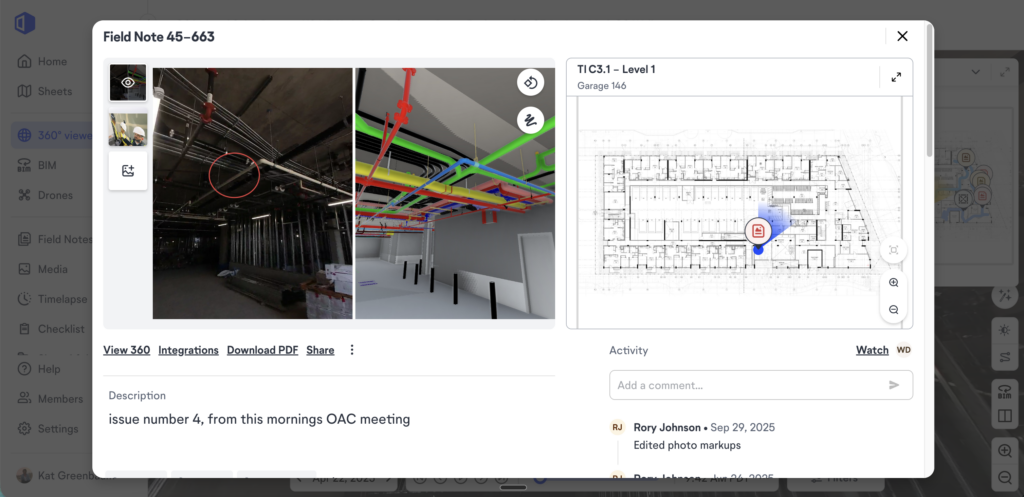
When teams capture site conditions consistently—with smartphones, 360° cameras, drones—they’ll have a complete visual record. Then it’s easy to pull up a 360° walkthrough, timestamped and mapped to plans, to view conditions before they were covered up. Field teams can assign, track, and resolve issues without leaving the platform.
This is what Visual Intelligence brings to construction quality control: the ability to close the gap between what the quality control plan requires and what can actually be verified. When visual site documentation is complete and searchable, quality control inspectors can review conditions remotely, project managers can confirm work-in-place without traveling to the jobsite, and project owners get the transparency they expect without a dedicated walkthrough.
For builders who want to see how this applies to their quality program, construction QA/QC workflows page covers the core use cases in detail.
Quality control in practice: results from the field
The strongest case for visual documentation in quality control isn’t theoretical. It’s what builders are actually experiencing when they shift from paper-based QC to image-first workflows.
Nibbi Brothers General Contractors
On an $80 million affordable housing project in San Francisco, with 26 percent of work being self-performed, Nibbi needed a way to verify that work was being carried out per design intent across a complex, fast-moving construction project.
They deployed OpenSpace Capture on all projects, with builders walking and capturing the jobsite twice a week. The results: a defensible visual record that helped identify and resolve billing discrepancies, reduced travel costs by $58,000 on a single project, and verifying work-in-place with greater efficiency.
CEC, MEP contractor, Irving, Texas
CEC’s 10-person QA/QC team was spending a disproportionate amount of time on documentation—time that wasn’t going toward actually verifying quality.
With OpenSpace Capture running in the background during regular site walks, the team could multitask: capturing site conditions, pinning imagery to the project plan, and improving communication with general contractors, all without adding a separate documentation workflow. The quality control process didn’t change; it became faster and more complete.
Both examples point to the same pattern: when builders remove the friction from quality documentation, the construction team actually uses it. Builders catch quality issues earlier, resolve them faster, and spend less time in disputes.
See OpenSpace in action. Request a demo to see how OpenSpace supports your construction quality control process.
Standardizing construction quality control across multiple projects
One of the biggest challenges in quality management for enterprise builders is achieving consistent quality standards across a portfolio where every site has different personnel, subcontractors, and site conditions.
The problem is as much cultural as operational. Quality control procedures on a well-run project often reflect the habits of one experienced superintendent. Move that superintendent, and the standard moves with them. Builders that rely on individual expertise rather than system-level documentation will see quality performance vary as much as their staffing does.
Standardizing construction quality control across multiple projects requires three things:
- A consistent documentation format that every team member uses.
- A centralized view of quality status across the portfolio.
- A way to flag deviations before they become costly.
When site imagery is captured, organized, and accessible in the same way on every project, project managers can review quality conditions remotely, compare current state to design intent, and keep all parties aligned, without a site visit.
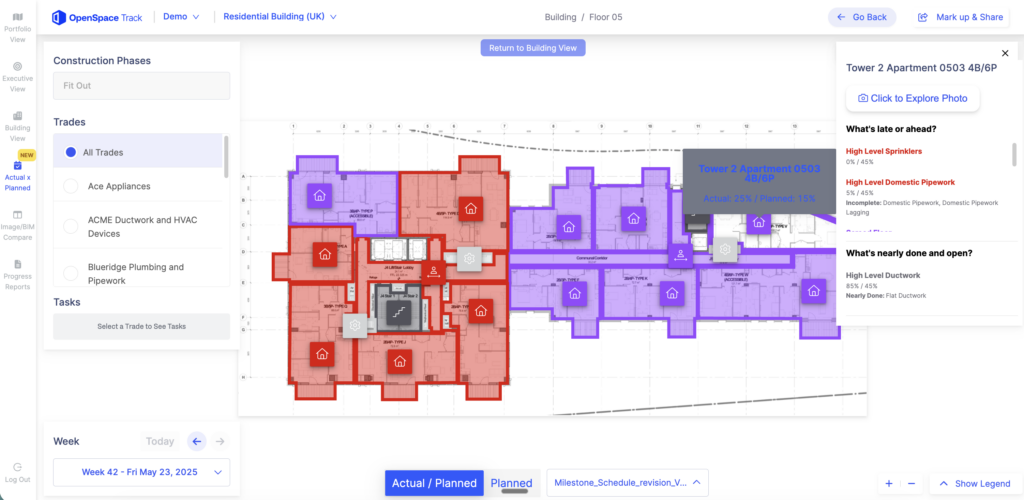
Using this imager, OpenSpace Track connects quality verification to schedule, catching out-of-sequence work and deviations early, across every trade and every floor.
How to build a construction quality control plan
A construction quality control plan has to be specific enough to act on and simple enough for the field to actually use. The best plans define quality management expectations clearly and tie every element to a responsible party, an inspection point, and a documentation standard.
Here’s a practical framework for building a quality control plan that holds up under real construction conditions:
| Step | What it involves |
| 1. Define quality objectives and acceptance criteria | Establish what ‘done right’ means for each scope item, tied to project specifications, client specifications, and building codes. Acceptance criteria should be specific enough that a quality control inspector can confirm compliance without calling the office. |
| 2. Assign quality control responsibility | Every construction project needs a named quality control manager or quality control coordinator. Responsibility must extend to trade leads and specialty contractors. |
| 3. Identify inspection hold points | Map critical aspects of the project that require verified sign-off before work can proceed. Pre-cover inspections, structural integrity checks, systems testing—these are the moments where quality control procedures must be enforced, not suggested. |
| 4. Set documentation standards | Define how the construction team captures, stores, and shares quality documentation. Consistency matters more than complexity. A simple, repeatable standard beats an elaborate system that no one uses. This is where construction management software comes in. |
| 5. Integrate with the project schedule | Quality control plan checkpoints should be built into the schedule, not treated as separate events. Safety inspections, material testing milestones, and pre-cover windows all belong on the schedule alongside construction activities. |
| 6. Plan for closeout from day one | The quality documentation package a project owner receives at handover is built from records created throughout the project. Define closeout deliverables early, or the package at handover will be incomplete, and the client will know it. |
| 7. Define escalation paths | Not every quality issue can be resolved in the field. The quality control plan should define how issues escalate, who has authority to approve remediation, and what documentation is required before closing a nonconformance. |
“What’s the first thing you’d tell a general contractor who says their quality control program ‘works fine’ but they’re still seeing rework creep up on every project?”
When asked what the first thing he’d tell a general contractor who says their quality control program works fine, but they’re still seeing rework creep up on every project, OpenSpace Senior Solutions Engineer, Aaron Baker says:
“I’d ask to see their pre-cover documentation from the last job. If the answer is ‘it’s on someone’s phone’ or ‘it depends on the superintendent,’ that’s usually where the rework is coming from. ‘We checked it’ and ‘we have a record that proves we checked it’ are two different things. Rework tends to live in that gap.”
A quality assurance plan and a quality control plan working together, supported by real-time documentation from the field, give builders the conditions to consistently achieve high quality results consistently, on all projects.
Quality control roles & responsibilities on a construction project
Quality construction is a shared responsibility, but it requires clear ownership at every level of the project. Here’s how quality control roles typically break down across a construction project:
| Role | Quality control responsibility |
| Quality control manager / QC coordinator | Owns the construction quality control plan. Sets quality standards, coordinates inspection scheduling, reviews documentation, and manages nonconformance reports. On larger projects, this is a dedicated role; on smaller projects, it often falls to the project manager. |
| Construction manager / superintendent | The primary quality control authority on the jobsite. Responsible for verifying that construction activities are carried out per construction plans and project specifications. Manages day-to-day quality control procedures at the field level. |
| Quality control inspectors | Conducts formal inspections at defined hold points. Documents findings, confirms remediation, and signs off on work before it advances to the next phase. Often engages external or third-party inspectors for specialized systems or regulatory requirements. |
| Trade foremen / specialty contractors | Owns quality work within their scope. Responsible for self-inspection before requesting formal sign-off. A construction team member who finds a nonconformance in their own work before it’s flagged externally is the most cost-effective quality control outcome. |
| Project managers | Maintains line of sight to quality status across the project. Bridge between field conditions and office-level decisions. Responsible for ensuring that quality objectives are reflected in schedules, budgets, and owner communications. |
| Project owner / owner’s representative | Sets client’s quality expectations, reviews documentation at key milestones, and provides final acceptance at closeout. Increasingly, project owners are requesting real-time visibility into quality status, not just in the end-of-project package. |
Construction quality management across these roles is guided at the framework level by ISO 9001:2015, the internationally recognized standard for quality management systems. Many enterprise general contractors align their quality assurance and quality control programs to ISO 9001 requirements, particularly when working on projects with regulatory requirements, public sector clients, or cross-border delivery teams.
Industry standards like ISO 9001 provide the framework. Safety standards, building codes, and local regulatory requirements set the floor. A quality management system that meets both keeps builders in compliance and out of disputes.
The shift from paper to reality-based quality control
Paper-based quality control made sense when projects were simpler. Today, construction projects move faster, involve more trades, and carry higher accountability demands than any paper system was designed to handle. The shift to digital quality management is a response to that reality.
Most construction management software was built around documents and workflows. Visual Intelligence is built around reality. That distinction matters. When quality records are tied to a physical location and a moment in time rather than a form field, they become searchable, defensible, and actually useful in the field.
OpenSpace CEO Jeevan Kalanithi described this shift directly in his 2025 year-end message:
OpenSpace is “reinventing punch, QA/QC, safety, and other workflows, to be fundamentally faster and more reliable, because they’re oriented around reality, not just words.” That reorientation, from document-based to reality-based quality control, is the direction the industry is heading.
For builders working toward that standard, image-based field task management gives field teams the ability to log quality issues, assign follow-ups, and document conditions in seconds, directly from the jobsite. And all automatically tagged to the right location on the floor plan.
Learn more about how image-based field task management streamlines processes so that quality work is verified, documented, and resolved faster than problems can hide. Without adding more software.
Frequently asked questions about construction quality control
What should a construction quality control checklist include?
A construction quality control checklist should cover the critical aspects of each scope item that must be verified before work advances to the next phase. At a minimum, it should include:
- Specific acceptance criteria for the work being inspected.
- The construction activities and materials being reviewed.
- References to relevant project specifications or building codes.
- Names of responsible parties and quality control inspectors.
- Pass/fail status, with notes on any nonconformances.
- Required remediation actions and resolution sign-off.
- A date and location reference tying the record to a specific condition.
A checklist without location context or clear acceptance criteria is difficult to enforce and nearly impossible to use as a record for disputes later.
Digital checklists tied to site imagery, where the inspection record links directly to a photo of the condition, are significantly more defensible than paper-based alternatives.
How do you control quality in construction?
Controlling quality in construction requires a quality control plan that is documented and enforced. That means assigning a quality control manager with clear authority, defining inspection hold points that must be signed off before work proceeds, establishing consistent documentation standards that every construction team member follows, and integrating quality checkpoints into the project schedule rather than treating them as separate events.
Technology plays an increasingly central role. When project managers have access to real-time site documentation and field teams log quality issues with location context and images, quality control shifts from reactive to proactive.
The construction team can catch deviations early, assign remediation before work progresses, and close out the project with a complete quality record that meets client specifications and satisfies the project owner.
What is the role of QA/QC in a construction project?
Quality assurance and quality control together form the complete quality management function on a construction project.
Quality assurance sets the framework. It:
- Defines quality objectives.
- Establishes quality control procedures.
- Ensures the construction team is trained and aligned.
- Creates the quality assurance plan governing how quality is managed.
Construction quality control is the execution layer. It verifies that the work actually done meets project specifications, acceptance criteria, and client expectations at each phase of the build.
The role of QA/QC in a construction project extends beyond preventing defects during active construction. It produces the documentation that protects the general contractor in disputes, supports payment approvals, and provides the project owner with a defensible as-built record at handover.
That defensible visual record is what turns a QA/QC program from a compliance exercise into evidence a firm can actually stand behind if a disagreement reaches arbitration.
On projects where construction quality control is done on an ongoing basis as opposed to a closeout task, the results are consistently better: fewer quality issues, less rework, and faster project delivery.
The same discipline is what keeps the punch list process manageable at the end, since issues caught and closed phase by phase never pile up into a closeout backlog.
See clearer. Build better.
Quality control in construction is ultimately about closing the gap between what a project is supposed to be and what it actually is. Every construction quality control plan, every checklist, every inspection exists to answer one question: does reality match intent?
The builders achieving high quality results across their portfolios aren’t necessarily running more inspections. They’re running better ones, because they have a complete, real-time picture of site conditions that makes quality work visible, verifiable, and defensible from preconstruction through handover.
Successful quality control isn’t a function of checking more boxes. It’s a function of seeing more clearly.
See how OpenSpace supports quality construction from capture through closeout. Talk to an expert today.