Michael Fleischman is CTO and Co-Founder of OpenSpace
I’ve been trying to figure out how to talk about the importance of reality capture in the agentic age for a while now, especially for the “real world” economy: construction, power, industrial process businesses, and so on. The technology is changing so fast, and I’ve been struggling to find the right frame—something that would make it obvious why visual, spatial data from actual reality belongs at the center of this conversation, not on the sidelines.
Then I had an experience that made it click. I was booking flights to a conference in Amsterdam a few months ago and ran into a problem that no travel app could solve for me. You see, I’m an unusual traveler because when I fly to Europe for work, I often don’t care which city I fly into. I just want to make sure that the long haul from California to Europe is nonstop (I really value that 10 hours of uninterrupted time). But searching for flights this way requires a lot of tab-juggling and effort. In other words, it requires time and labor. So this time, I decided to try vibe coding myself a solution. And lo and behold, a few hours (and a few tokens) later, I had a custom flight search engine that did exactly what I wanted.
The thing that struck me about this (other than how good vibe coding has become) is who actually made money off of me building this. Because, there were only two companies that I swiped my credit card for: 1) the vibe-coding platform (who sent most of that money back to the foundation model company), and 2) the company that supplied the flight data. The AI couldn’t do anything without it. And that is the frame I’d been looking for. In this new agentic age, data wins. And in construction, no data is better than reality data.
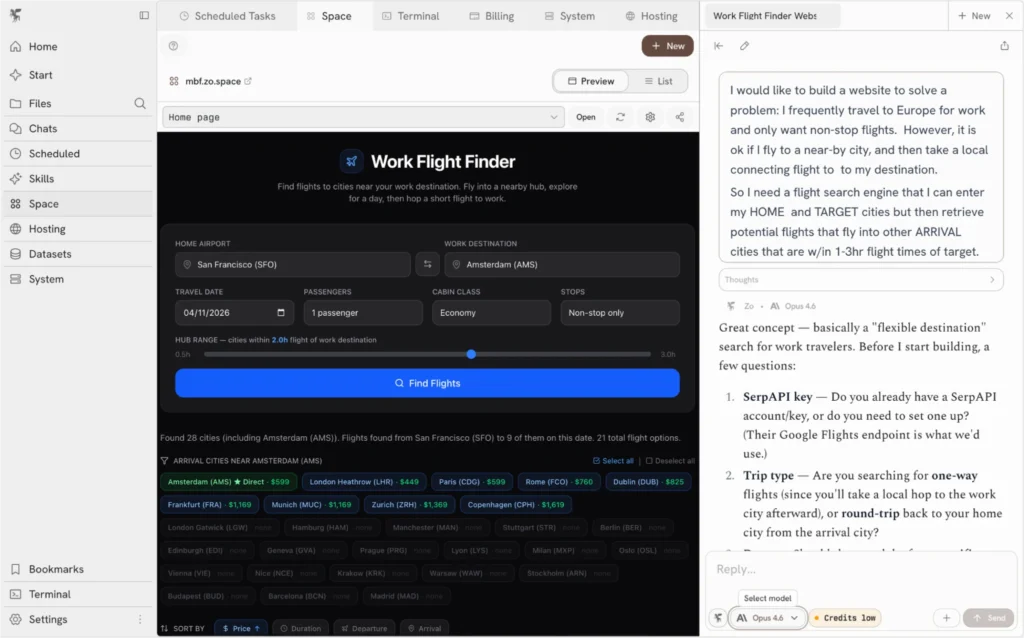
My vibe-coded travel buddy
Reality data wins
AI is only as good as the data you feed it. And the real winners in the agentic age aren’t going to be just the model providers—they’re also going to be the companies sitting on rich, hard-to-replicate data.
In construction, that data is reality data: visual evidence of what’s actually happening on a jobsite. OpenSpace has been building and accumulating that data for the better part of a decade—we now have over 65 billion square feet of captured job site data across 95,000 projects in 132 countries.
And as AI agents become more capable, that data is becoming more valuable than ever.
Agents with eyes
We’ve been thinking a lot at OpenSpace about what it means to build AI agents that are truly grounded in reality data—agents that don’t just answer questions about your documents but can actually see what’s happening on your jobsite and act on it. We call this concept “agents with eyes.”
Let me walk you through an example that illustrates how this works in practice.
The issue review agent
Vibe coding an agent with eyes
It started with a simple request from a customer. They had a subcontractor who was generating a large volume of open issues that were never getting closed. The customer wanted an agent that would, at the end of the week (or even every night, say during punch), pull all of those open issues, organize them, and present them in a clean way for quick review. Simple enough.
Working with that customer, we built this agent on top of our existing OpenSpace APIs. Every week the agent pulls all the open issues, maps them to the floor plan, and presents the user with a simple UI to step through and resolve them one by one. Useful, but not yet remarkable: it was something a handy intern in his or her first week might usefully do for a superintendent. But instead of saddling an intern with this task—and freeing up her time for something more important—this agent was vibe-coded in a few hours, and customized to the user.
That was act one.
Act two is where it gets interesting.
Because this customer regularly captures their jobsite with OpenSpace, we have a complete spatial history of every location on that project. With less than an hour of additional work, we updated the agent to do something new: alongside the original issue photo, it now automatically pulls the most recent 360 capture of that exact location—creating a before-and-after comparison. Suddenly the reviewer can see, without leaving their desk, whether the problem in the photo has actually been addressed on-site. Our “intern” now has a superhuman photographic memory, and is doing something a PE might do.
Act three is where the real power of agents comes in.
Once the agent had access to those before-and-after images, we gave it the ability to make its own judgment call. Using our tuned VLM (vision language model), the agent can now look at both images and assess whether the issue appears resolved. The agent can even close those issues themselves—no human review required.
What started as a simple weekly data pull became an agent capable of genuine autonomous decision-making, offloading cognitive work so that people can focus on what they do best: building buildings.
This is what becomes possible when you give agents eyes. Agents that can directly save labor costs—perhaps for the first time in construction technology! (Something we will have more to say about in the future.) And it was built in a matter of hours, entirely through vibe coding, working directly with a customer. No months-long sprint. No roadmap approval. A real problem, solved in a day.
Building the agent sandbox
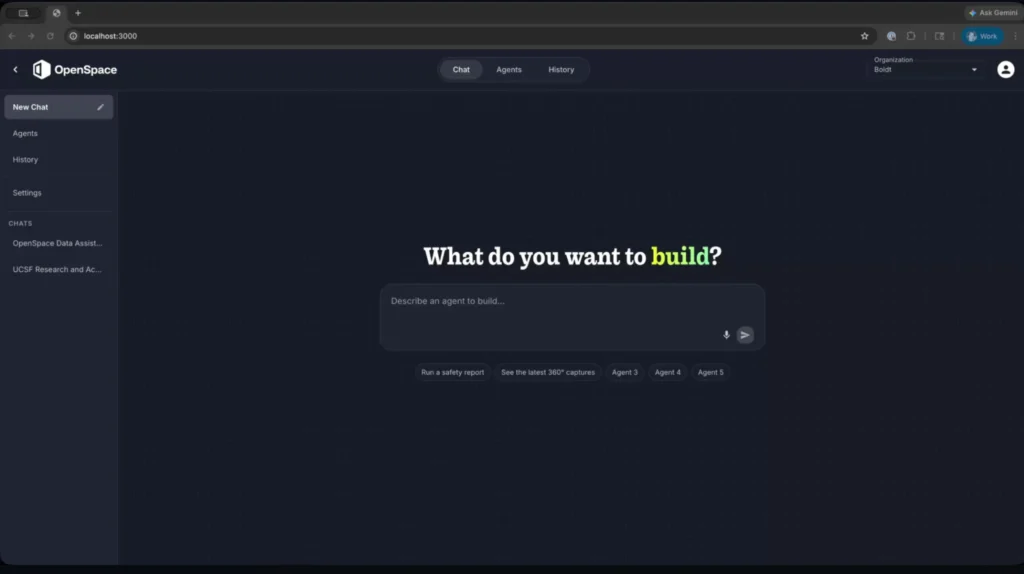
A glimpse of the future?
The issue review agent isn’t a one-off experiment. It points to something that we believe is fundamental about where construction technology is heading: customers are going to become developers.
The era of filing feature requests and waiting for a vendor to build what you need is ending. In its place, something more powerful is emerging: customers who can describe what they want and have it running in hours, customized exactly for their project, their workflow, their team.
To support this, we are building the OpenSpace agent sandbox—a dedicated environment designed to make it easy to build, run, and iterate on agents that are grounded in reality data. The agent sandbox gives customers and partners access to spatially enriched data via OpenSpace spatial APIs, in a form that’s purpose-built for agent development.
And we’re just getting started.
The agentic age is here. The companies that will thrive in it are the ones with the best, richest, most complete, and most up-to-date data.
For construction, that data is reality, and that platform is OpenSpace.
About the author
Michael Fleischman is the CTO and a Co-Founder of OpenSpace. He spoke at Autodesk DevCon 2026 in Amsterdam on the topic of agents with eyes in the agentic age.