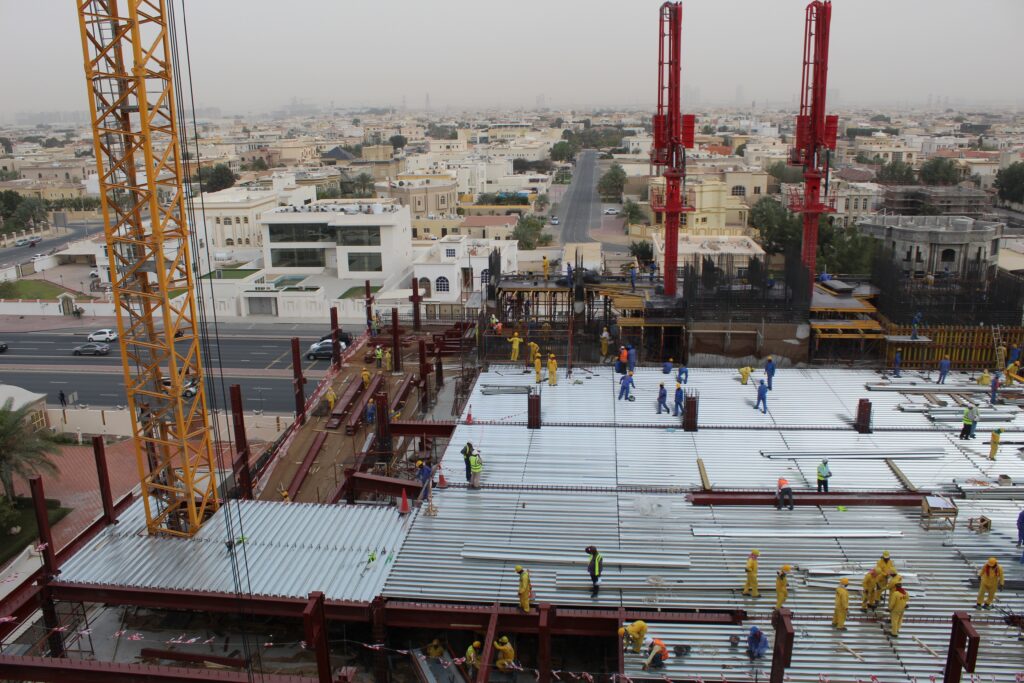
The cost of rework in construction is one of the most reliably underreported numbers in the industry. Most builders know it’s a problem. Few have a clear picture of what it costs across a portfolio. Project teams absorb it into labor variance, bury it in change orders, or write it off as schedule slippage.
The result is that construction rework continues to account for a significant and largely avoidable share of project costs on commercial builds, with no clear trend toward improvement.
Beyond immediate costs, rework in construction has broader implications, impacting project timelines, reducing productivity, straining stakeholder relationships, and increasing safety risks.
This article examines what the research says: the scale of the problem, who absorbs the costs, how poor site visibility turns field errors into legal disputes, and where early detection delivers the clearest return. It also introduces the Construction Rework Reduction Framework (CRRF), a five-dimension model project teams can use to assess their current approach and identify where gaps are driving cost.
What rework actually costs: industry-wide estimates and the measurement problem
The Construction Industry Institute (CII) puts direct field rework at an average of 5 percent of total project costs, with a range of 2 to 20 percent depending on project type. Some studies place the figure as high as 30 percent in certain regions. On a typical project valued at $50 million, even the floor-level estimate represents $2.5 million in avoidable project costs. At $200 million, the exposure reaches $10 million or more.
Joint research by PlanGrid and FMI (2018), surveying nearly 600 construction professionals, tied more than $31 billion in annual U.S. rework costs to poor communication and missing project information. The findings confirm a consistent pattern—miscommunication drives 26 percent of rework in construction projects, while bad documentation and inaccurate drawings account for a further 14 to 22 percent. Poor workmanship makes up the remainder.
The measurement problem also matters. Figures vary widely across the construction sector because most rework never formally registers. Builders absorb corrective labor into overhead, and what counts varies by organization.
Research by Love (2002) found that rework contributes to an average of 52 percent of total cost growth on construction projects—not a measure of rework costs alone, but of how central the problem is to financial outcomes.
![[Capture] Split View](https://www.openspace.ai/wp-content/uploads/2026/06/Capture-Split-View-scaled.png)
Who bears the cost of rework in construction: GC, subcontractor, and owner
The project costs of rework in construction are not distributed evenly, and the party that causes the rework is frequently not the one that absorbs it. Understanding this distribution is where the financial case for rework prevention becomes most compelling.
| Party | Cost exposure | Primary mechanism | Financial implication |
| General contractor | Broadest | Design-related errors produce corrections regardless of origin. Without documentation to assign accountability, direct costs become a negotiation. | Margin erosion on fixed-price contracts; overhead burn on every corrective coordination event |
| Subcontractor | Disproportionate at trade level | Work executed to outdated drawings or out-of-sequence installations requires labor and material correction at their cost | Project delays compress float, drive up project costs across phases, and reduce productivity on subsequent work |
| Owner | Downstream | Schedule overruns, liquidated damages, and loss of repeat-work relationships compound when project delays go unresolved | Capital allocation slips, financing costs grow, profit margins erode; design teams carry professional liability exposure |
The broader issue is that rework costs rarely stop at the corrective work itself. Every rework event consumes management time, disrupts trade sequencing, and generates conflict between project stakeholders of the kind that becomes claims.
The Construction Rework Reduction Framework (CRRF)
Understanding the cost of rework is only the first step. Containing it requires a consistent way to evaluate how effectively a project detects, documents, and prevents errors as they occur.
The Construction Rework Reduction Framework (CRRF) defines five dimensions that determine how much rework a project generates—and how quickly builders can contain its impact. These dimensions apply regardless of project size, contract type, or technology stack. They give project teams a structured way to assess their current approach and identify where gaps are costing them money.
The 5 dimensions of rework control
1. Detection speed
Most construction projects surface errors during periodic walkthroughs or coordination meetings—often days or weeks after the work was performed. By that point, corrective action is more complex, more expensive, and more disruptive to downstream trades.
Shortening the detection window is where rework reduction starts. Projects that identify issues earlier consistently experience lower cost escalation and less schedule disruption. With continuous visual documentation, builders can detect sequencing and productivity issues as early as 10 percent project completion. Without it, the same issues typically surface at 50 percent—when the financial and schedule impact is largely locked in.
2. Documentation quality
Documentation is the foundation of rework prevention. When site conditions go poorly recorded or inconsistently captured, builders lack the visibility to validate work-in-place, resolve discrepancies, or defend against claims.
High-quality documentation is time-stamped, location-specific, accessible across stakeholders, and verifiable after the fact. Without it, rework becomes harder to detect, harder to prove, and harder to resolve.
3. Information accuracy
Rework frequently originates in the gap between what was planned and what was built. Outdated drawings, miscommunication between office and field, and incomplete scope updates create conditions where work is performed incorrectly—even when field execution is otherwise sound.
4. Accountability clarity
Rework costs are rarely borne by the party that caused them. Without clear documentation of who performed work, under which conditions, and against which drawings, responsibility becomes ambiguous. Resolution turns into negotiation—or dispute.
Projects with strong accountability clarity can trace work to specific trades and timelines, validate which instructions were in effect at the time, and assign responsibility with confidence. That reduces both direct rework cost and downstream legal exposure.
5. Cost visibility
One of the most persistent challenges in construction is that rework rarely gets measured directly. Builders fold costs into labor variance, material overages, or general overhead, which makes the true financial impact difficult to quantify—and difficult to act on.
The Construction Industry Institute estimates direct rework at an average of 5 percent of total project costs. Actual exposure is frequently higher due to underreporting. Builders that improve cost visibility can identify true rework exposure across projects, pinpoint repeat failure points, and prioritize process improvements based on financial impact rather than intuition.
The documentation gap: how poor site visibility creates rework blind spots
Poor communication and bad documentation drive nearly half of all rework in the construction industry, but communication is a symptom. The root cause is a visibility gap: project managers and design teams making decisions without an accurate picture of current site conditions.
Why visibility fails—planning gaps and design errors
Poor project planning is a key factor leading to design errors and omissions, as inadequate initial planning often results in costly rework and overlooked details during construction. Research across builders consistently shows that design errors compound undetected when limited site visibility leaves teams without an accurate picture, and by the time anyone confirms the problem, it’s buried under subsequent work. Quality assurance built on periodic snapshots cannot close that gap. Thorough project planning early in the process is essential to avoid overlooked details and costly adjustments later.
48% of rework in construction ties directly to information failures: bad data, inaccurate drawings, and miscommunication between project stakeholders. (PlanGrid / FMI).
The detection window: how late discovery compounds cost
Most construction sites rely on someone walking the floor to catch something wrong. That process is periodic and slow. Avoidable rework becomes costly rework not because the field executed poorly, but because no one closed the gap between what was planned and what was built until corrections were expensive.
Vito Antuofermo, VP at Commodore Construction, put a number on it. Using OpenSpace Track, his team identifies productivity problems at 10 percent project completion. Previously, significant cost overruns wouldn’t surface until 50 percent, at which point the financial and schedule impact is largely locked in.
What closing the gap looks like in practice
Quality assurance processes built on periodic walkthroughs leave the same blind spots open project after project. Periodic walkthroughs leave the same blind spots open project after project, and closing them is a phase-by-phase discipline. Our guide on how to reduce rework in construction covers where it starts and how to prevent it at each stage.
OpenSpace Capture documents 25,000 square feet in 10 minutes, with every image time-stamped and mapped to floor plans, creating a permanent searchable record that gives the project team verified site conditions between formal inspections.
![[Capture] Capture Path](https://www.openspace.ai/wp-content/uploads/2026/06/Capture-Capture-Path-scaled.png)
Claims and disputes: how construction rework becomes a legal problem
Rework that isn’t documented doesn’t just cost money in the field. It becomes a legal liability at closeout. Rework in construction projects generates cost overruns, significant delays, and extended timelines that trigger claims between parties who no longer agree on who directed what work, to which drawings, and when.
How rework triggers claims and disputes
The Arcadis Global Construction Disputes reports have tracked the leading causes of disputes for over a decade. For six of nine consecutive years, errors and omissions in contract documents ranked as the top cause in North America.
Average dispute values rose 42 percent from 2021 to 2022. The highest single dispute reported reached $2 billion, with average disputes taking 16.7 months to resolve.
Without documentation, disputes arise over who directed the work, who bears the cost of rework, and whether corrections met required specifications.
Why documentation determines who wins
Construction firms with documented, time-stamped site records are in a materially different position when a dispute moves toward litigation. The evidence is the record: what was built, when, against which drawings. Teams can assign duplicated work and its costs with specificity rather than argue from anecdote.
Getting to that level of specificity depends on having dispute documentation in place before the disagreement starts, not assembled afterward from memory.
What the research says about early detection of design errors and cost avoidance
The financial return on early detection is not speculative. CII’s Field Rework Index research, built on a database of over 150 industrial construction projects, found a direct correlation between the cost of rework and total cost growth.
Projects scoring below 30 on the CII Field Rework Index didn’t just experience less rework in construction. They finished under budget, with preserved schedule float available for the unexpected and overhead savings flowing directly to profit margins.
What early detection looks like on a live project
McKinsey’s research on digital transformation in construction found a 12 percent reduction in rework hours at one contractor’s job site by closing the communication gap between field and office. Teams tagged defects in a shared environment, the supplier monitored them, and project managers addressed root causes before they compounded.
Turning rework intelligence into a financial asset
Reducing rework across a portfolio requires more than quality control measures on individual projects. It requires a verified, time-stamped visual record that makes patterns visible at scale—which project types carry the most exposure, which phases drive the highest project costs, and which trade coordination failures repeat.
Builders consistently finishing on budget are not simply better at executing. They have shorter detection windows, tighter documentation, and a verified picture of site conditions at each phase. WPI saved $10,000 in rework and backcharges using OpenSpace—a financial outcome made possible by having clear, objective evidence when it matters.
Frequently asked questions about the cost of rework in construction
Does contract type affect who absorbs rework costs?
Yes, and the difference matters. Under lump sum contracts, the GC absorbs rework costs directly. Corrective work comes out of margin. Under cost-plus, costs may flow to the owner depending on how the contract defines rework versus approved scope changes. GMP contracts fall between—rework-driven overruns typically trigger shared-risk provisions. Understanding which rework events fall under which category is where documentation of field directives and drawing revisions becomes directly relevant to project accounting.
What is an acceptable rework rate in construction?
There is no universal benchmark. Industry research places rework between 1 and 20 percent of total project costs, with most studies clustering between 4 and 10 percent. CII notes that while best practice quality management aims for zero rework, experienced project teams understand that some level remains outside their control. The more actionable question for most project teams is not what rate is acceptable industry-wide, but what rate their own portfolio is actually running at. Because rework is systematically underreported in most construction accounting systems, establishing an accurate baseline is the prerequisite to reducing it.
How does rework exposure affect bonding capacity and insurance premiums?
Persistent rework patterns signal to surety underwriters and insurance carriers that quality management and project controls are weak. For bonding, a track record of cost overruns can compress bonding capacity on future projects. On the insurance side, builder’s risk and professional liability underwriters evaluate documented project controls as part of risk assessment. Builders that demonstrate systematic documentation practices, including time-stamped visual records and verified progress reporting, present a materially different risk profile.
Some carriers now put a number on that difference, offering premium credits for documented projects that hold as long as capture continues through the policy term.
How is rework tracked in construction accounting, and why does it get underreported?
Most construction accounting systems don’t have a dedicated rework cost code. Organizations fold corrective labor into general labor variance, material waste lands in materials overage, and overhead consumed re-sequencing trades rarely traces back to a specific cause. The result—the true cost of rework in construction projects is systematically underestimated. Builders that implement formal rework tracking, even at a basic level, typically find their actual exposure is higher than initial estimates.
What is the difference between rework and warranty work in contract terms?
Rework is corrective work performed during construction because something was built out of conformance with approved plans, without a covering change order. Warranty work occurs after handover, when defects emerge during the contractual warranty period. Rework affects current project costs and margin; warranty claims are a post-delivery liability. Both trace back to the same root causes—design-related errors and inadequate quality assurance. Minimizing rework during the build through adherence to quality standards and continuous documentation directly reduces warranty exposure after handover.
Ready to close your detection window?
OpenSpace gives builders a verified, time-stamped picture of every project – the foundation for reducing rework, resolving disputes faster, and protecting margins. Contact OpenSpace to learn more or request a demo.