BIM coordination is the process of aligning discipline-specific building models into a single, unified model so that conflicts between systems get resolved before construction begins. It’ is the project’s best defense against costly rework, schedule overruns, and disputes that stall progress.
A problem some software vendors don’t talk about: what gets resolved in the model doesn’t always reach the crews doing the work.
This article covers what BIM coordination is, how the coordination process works, where it tends to break down, and what it takes to make it work on the jobsite, not just in the office.
The role of BIM coordination across project types
The role BIM coordination plays varies in scope and complexity across project types, but its function is consistent: integrating discipline-specific building information modeling (BIM) models from architecture, structure, and MEP systems into a single federated model so you can resolve conflicts between design and construction elements before physical work begins. The higher the system density and trade count, the more coordination work there is to do.
On a straightforward tenant improvement, BIM coordination may focus primarily on MEP routing. On a hospital or data center, mechanical electrical and plumbing systems spanning multiple disciplines compete for the same ceiling space, making the coordination process one of the most schedule-critical activities on the project. Each trade must federate and clear their respective BIM models before installation crews can sequence their work. Skip that step, and crews discover the conflicts instead.
Across AEC projects, BIM coordination reduces the risk that physical systems compete for the same space. No walkthrough or 2D drawing review catches what a unified model catches.
The BIM coordination process, step by step
Understanding the BIM coordination process means understanding where it can go wrong. Most construction projects follow the same general stages, but the quality of execution at each step varies significantly.
Model creation
Each discipline creates its own BIM model using its preferred BIM software. These models reflect the design intent within that discipline’s scope.
Model integration
Once individual models reach a sufficient level of development, the BIM coordinator brings them together into a unified, federated environment using formats like IFC or tools like Navisworks.
Clash detection
Automated clash detection runs on the combined model to surface conflicts across disciplines.
Coordination meetings
Project teams from each discipline work through the issues, assign responsibility, and agree on resolutions.
Model updates
Models get updated and the cycle repeats until the model is clean enough to release for construction. The coordination phase continues in parallel with actual construction, but for most teams, the workload peaks in preconstruction.
Field verification
The step that receives the least attention. Confirming that field conditions match what the model resolved is what keeps coordination decisions connected to the work actually being built. Without it, the design process and the construction process stay disconnected, and the value of coordination is only partial.
That verification only means something if the construction staking and control underneath it was accurate to begin with, which is why that work stays a licensed surveyor’s job even on a fully coordinated BIM project.
What are the benefits of BIM coordination in construction?
Effective BIM coordination produces measurable benefits across the project lifecycle, and they compound when coordination is done consistently rather than treated as a preconstruction checkbox.
Fewer clashes & less rework
When clash detection resolves conflicts before construction begins, the model gives installation crews a path that actually works in the field. Early clash detection is what separates smooth project delivery from costly rework cycles.
Project teams avoid the cost of tearing out installed work and redoing it, a significant impact BIM coordination has on overall project quality and budget. A joint study by FMI Corporation and PlanGrid found that miscommunication causes 26 percent of all rework on U.S. construction jobsites, with an additional 22 percent attributed to inaccurate or inaccessible project information. Better coordination addresses both sources directly.
Better communication & collaboration
BIM coordination creates a collaborative environment where all project stakeholders work from the same model, keeping field and office teams aligned. Shared visibility keeps project goals front and center and improves collaboration between every discipline involved.
Stronger project efficiency
Fewer RFIs, a smoother construction process for every trade, faster issue resolution, smoother project delivery, and cleaner closeout documentation all trace back to a well-run coordination process. Cost savings from reduced rework and better schedule adherence compound over the course of a project.
“Coordination meetings surface conflicts. They rarely carry resolutions all the way to the field. Teams log clashes, make decisions, and update models—and then those resolutions have to travel through three layers of communication before they reach the crews doing the install. That’s where teams lose a large share of coordination value, and it happens on almost every project.”
— Molly Taylor, Senior Product Manager, OpenSpace
A structural beam conflict resolved in Navisworks but never communicated to the installing crew still becomes one of the most costly mistakes on a project. Effective coordination requires a clean model and a way to verify that decisions stay aligned with field reality.
What is a BIM coordinator in construction?
A BIM coordinator is the person responsible for managing the BIM coordination process across disciplines on a project. They own the federated model, identify clashes through detection runs, facilitate coordination meetings, and track issue resolution through to sign-off. On large or complex construction projects, there may be multiple coordinators, one per discipline or zone.
Day to day, a BIM coordinator manages model submissions, runs clash detection, handles solution management for open issues, and updates the central model as changes are made. Good lifecycle management of the model keeps it accurate as the design process evolves.
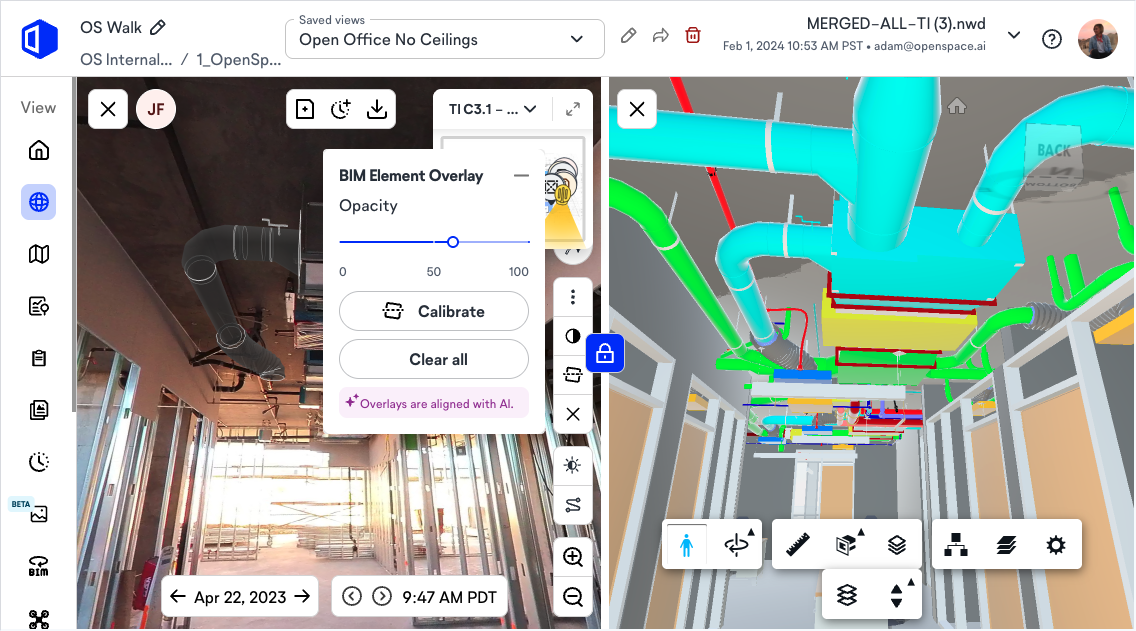
When field teams can navigate the model without VDC support
When field teams can access and navigate the BIM model directly, without specialized training or hardware, VDC resources shift from answering routine questions to doing actual coordination work. On the most digitally mature projects, that’s already the norm.
Common BIM coordination challenges builders face
Even on well-run construction projects, the BIM coordination process runs into predictable friction. Most of it traces back to the same root cause—coordination decisions made in the office don’t automatically reach the people doing the installing.
Incomplete or late model submissions
When one discipline submits its BIM model late or at an insufficient level of development, the entire coordination phase slows down. Clash detection is only as useful as the models fed into it—missing or underdeveloped sections of the federated model mean you can miss catching issues before construction begins.
No clear ownership of clash resolution
Automated clash detection surfaces issues, but identifying clashes is only half the work. Without defined responsibility for each issue, clashes might get logged, but not resolved. Coordination meetings stall when project teams show up without decisions made.
Version control failures
Early identification of version discrepancies matters just as much as catching clashes. When team members work from outdated drawings or an older version of the model, install errors go up even when coordination was done correctly. Design phase changes that aren’t reflected quickly in the federated model create a disconnect between what the coordination meeting resolved and what crews are building to.
Field access limitations
BIM software is complex and has a learning curve most superintendents don’t have time for. Coordination decisions stay in the office unless there is a deliberate way to get them to the field. That’s where coordinated models stop delivering value.
VDC bottlenecks
The more a project depends on a single VDC resource to answer every field question about the model, the slower coordination decisions move. On large construction projects or programs, that bottleneck limits how much value coordination can actually deliver to the people doing the work.
What is the difference between BIM & BIM coordination?
Building information modeling (BIM) refers to the broader process of creating, managing, and using intelligent 3D digital models throughout a project’s lifecycle. BIM technology and BIM adoption together shape the model and the workflows built around it.
The coordination workflow is the specific process within that broader practice. Think of BIM as the map, and coordination as the ongoing process of making sure everyone navigates by the same version of it.
| BIM | BIM coordination | |
| What it is | The process of creating and managing intelligent 3D models across a project’s lifecycle | The workflow of integrating disciplinary models, detecting clashes, and resolving conflicts |
| Who owns it | Project owner, architect, or BIM manager | BIM coordinator, VDC team |
| When it happens | From preconstruction through closeout and facilities management | Primarily in preconstruction, continuing through construction |
| Primary output | A digital model that represents the built asset | A coordinated, clash-free model ready for construction |
| What happens without it | No unified model connecting all disciplines | Clashes discovered in the field, leading to rework and delays |
How to improve BIM coordination on your next project
Effective BIM coordination starts before the first model gets submitted. Here’s where to focus:
Standardize model exchange formats early
Establish Industry Foundation Classes (IFC) for open format sharing and BIM Collaboration Format (BCF) for issue tracking so that design teams and all disciplines are aligned on project goals from the start. Clear project goals reduce ambiguity during the coordination phase and keep stakeholders involved in the same decisions.
Schedule coordination meetings consistently
In the design phase, coordination meetings need to be scheduled proactively, not reactively, with all disciplines present and decisions logged before the next session. Coordination that happens in bursts rather than consistently is one of the most common reasons issues slip through.
Bring BIM to the field
An efficient coordination process depends on information reaching the field. When team members in the field can access the model and answer their own questions, overall project efficiency improves meaningfully.
Verify that coordination decisions hold in the field
With OpenSpace BIM+ and the site imagery captured in OpenSpace Capture, project stakeholders can compare design intent to actual field conditions and confirm that coordination decisions from the design phase are being followed. Without that verification step, coordination stops at the office door.
Bringing BIM coordination into the field with OpenSpace
Builders invest significant time in preconstruction coordination and then rely on informal communication and VDC callbacks to reach the crews doing the work. Without a way to connect the model to the field, that investment delivers only partial value. OpenSpace BIM+ was built for exactly that handoff.
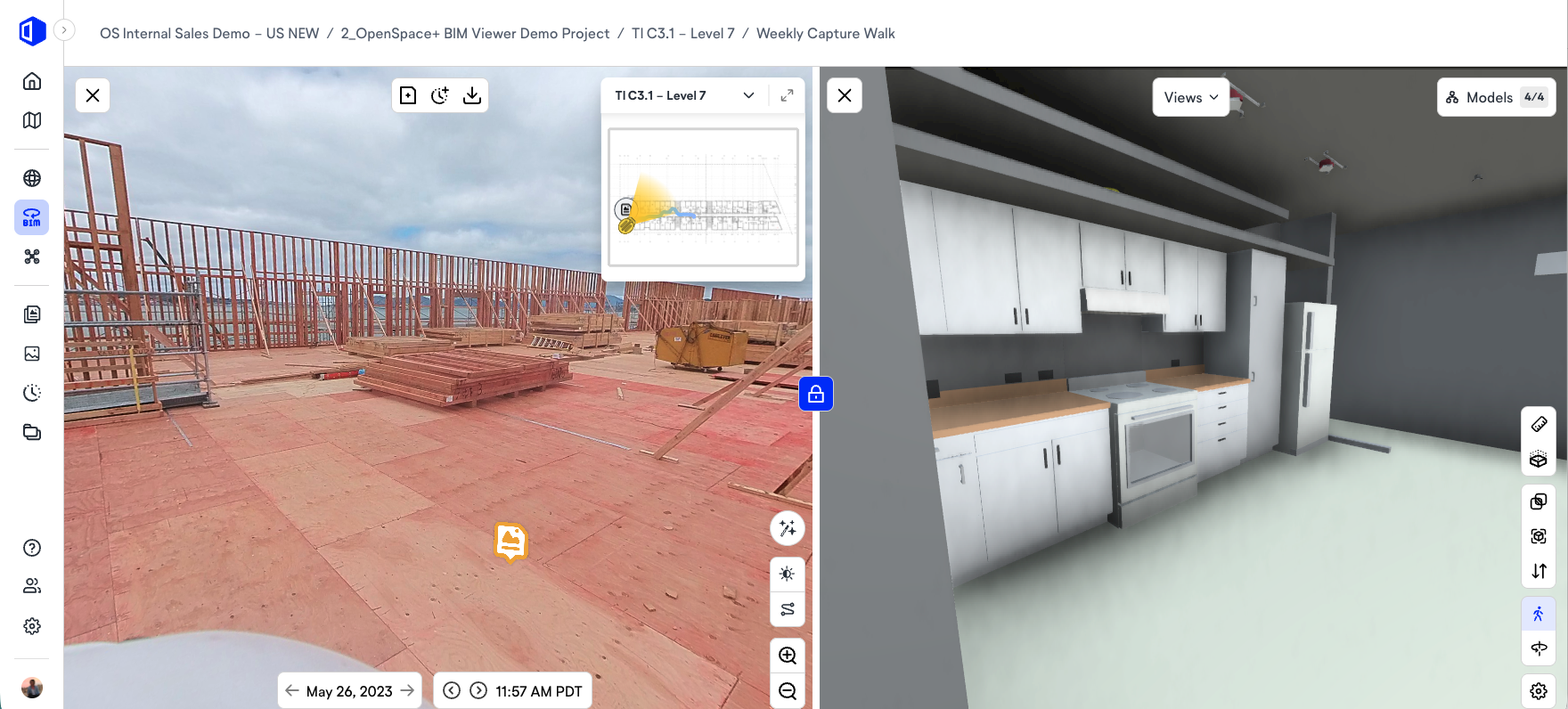
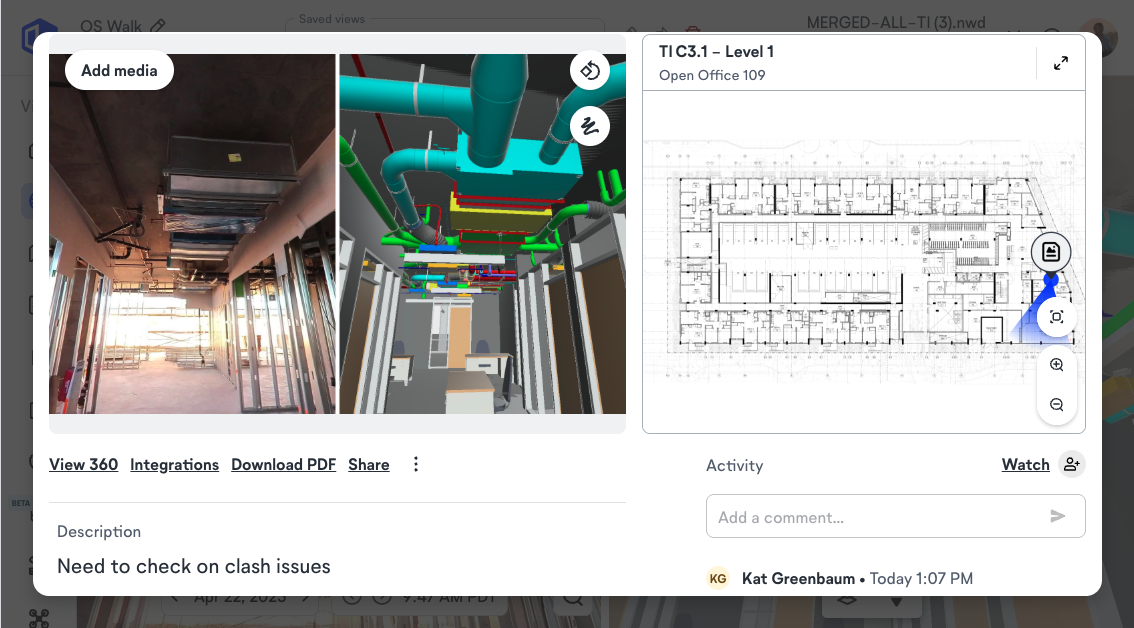
OpenSpace BIM+ is a package of 3D tools that bring BIM coordination to the field—no BIM expertise needed.. Field teams can view the latest BIM model, overlay 2D sheets and BIM elements directly onto 360-degree site imagery, compare design intent to work-in-place in a single view, and create BIM Compare Field Notes with markup, tags, and assignees.
For builders managing complex MEP systems across multiple floors, BIM Element Overlay lets a superintendent select a duct run or pipe system from the model and see it placed into actual site imagery. Field teams can answer coordination questions on the spot rather than waiting for a VDC callback, which is where this coordination delivers day-to-day value.
Polk Mechanical, a Texas-based mechanical contractor, found that Saved Views teams can access directly in the field significantly reduced VDC callbacks. Read how Polk Mechanical improved field BIM coordination with OpenSpace BIM+.
“When field teams have to route every model question through a VDC manager, you end up with two problems: the VDC team spends their day answering the same questions instead of doing coordination work, and the field slows down waiting for answers. Once a superintendent can pull up the model on their phone and see exactly where a duct run sits relative to what’s already installed, both problems go away. The model starts doing what it was always supposed to do.”
— Molly Taylor, Senior Product Manager, OpenSpace
Frequently asked questions
What is clash detection in BIM coordination?
Clash detection uses specialized software to identify clashes across disciplinary models. Hard clashes occur when elements physically intersect, such as a duct running through a structural beam. Soft clashes involve clearance violations—workflow clashes involve sequencing conflicts. Teams that resolve clashes before construction begins gain significant cost savings, since a digital fix costs a fraction of a field correction.
Is BIM better than CAD?
For construction coordination, BIM is significantly more capable than CAD. CAD produces 2D drawings that represent design intent, while BIM produces intelligent 3D models where multiple disciplines can federate their designs, run clash detection, and resolve conflicts before installation begins. That capability is what makes coordinated field execution possible on complex construction projects.
Why is BIM coordination necessary for large scale projects?
On large-scale construction projects, the volume of overlapping systems makes manual coordination essentially impossible. A hospital or data center may involve dozens of specialty trades, each with their own installation sequences and clearance requirements. Without BIM coordination, those conflicts surface in the field after crews have mobilized and work has begun, where they cost significantly more to resolve.
The gap widens on data center construction, where power, cooling, and cable tray routes all compete for the same overhead space and one unresolved clash can stall an entire data hall.
BIM coordination that reaches the field
The construction industry has invested heavily in building information modeling and BIM technology, and the results in preconstruction are measurable. What hasn’t kept pace is verifying that coordination at the point where it matters.
The builders getting the most value carry the coordinated model into field execution rather than hand it to a superintendent at the start of a job and walk away. That’s where the rework risk lives, and where the next generation of BIM coordination is being won.
See OpenSpace BIM+ in action—request a demo.