Construction risk management is one of the most discussed topics in the industry, and one of the most misunderstood. Builders invest heavily in risk registers, insurance programs, and project controls.
Yet the global average value of a construction dispute still reached $43 million in 2024, according to Arcadis insights compiled by Autodesk.
Most construction risk management frameworks focus on what might go wrong before a project starts. Far fewer address what happens when plans meet the ground. The gap between what builders think is happening on-site and what is actually happening is where risk lives. Reality capture is where that starts to change—and the full shift comes from what a Visual Intelligence Platform like OpenSpace does with what it captures.
What is risk management in construction?
Effective construction risk management is the process of identifying and responding to threats affecting a project’s budget, schedule, quality, or legal standing.
Risk management plans typically describe a logical sequence: identify risks, conduct risk analysis, put risk response strategies in place, and monitor. In practice, those steps are only as reliable as the information feeding them.
“What you plan for in preconstruction and what you face a year into a project can be very different. Good risk mitigation isn’t a better spreadsheet tracker. It’s every team member having access to the latest information from the field, and real communication between the office and the trades. The teams I see manage risk well aren’t planning harder. They’re closing the gap between something happening on-site and the right person knowing about it.”
-Jonah Walton, Senior Solutions Engineer, OpenSpace
What are examples of risks in construction projects?
Construction risks span several categories across construction projects, each presenting a unique risk profile. Understanding the potential risks in each category is the starting point for any construction risk management plan.
| Risk category | What it includes | What amplifies it |
| Financial risks | Cost overruns, payment disputes, and change order disagreements that erode a project’s budget | Undocumented scope changes and unverified work-in-place |
| Schedule risks | Delays from supply chain disruptions, sequencing failures, and subcontractor breakdowns | Lack of early visibility into what’s actually happening on-site |
| Quality and rework risks | Out-of-sequence installs, defects built over, and missed inspections—rework accounts for 4 to 10 percent of total project cost | Poor project documentation and miscommunication between field and office |
| Legal and contractual risks | Contractual disputes and claims that accelerate when documentation is absent | No time-stamped visual record to anchor disputed conditions |
| Environmental and safety risks | Hazardous materials exposure, safety hazards, and site conditions requiring contingency plans | Absence of ongoing compliance documentation leaves environmental risks undetected until they trigger fines or shutdowns |
| Visibility risk | The risk that nobody on the project team has an accurate, shared picture of what’s actually happening on site | Every other risk category. Visibility risk sits beneath and amplifies all of them |
The construction risk management process: where it works & where it breaks down
A sound construction risk management process follows five steps, each dependent on the quality of information available as the project progresses.
| Step | What it requires | Where it breaks down |
| Risk identification | Construction risk identification requires continuous awareness of site conditions, not just a pre-project register | Unforeseen circumstances emerge throughout the construction process and go undetected when site visibility is periodic |
| Risk assessment | Accurate field documentation to score potential risks and project risks by likelihood and impact | When estimated status updates produce subjective scores nobody can trust under pressure |
| Risk response | Timely information so construction project managers can deploy risk mitigation strategies before a significant risk escalates | When information arrives days late, risk mitigation strategies become reactive |
| Monitoring and control | Continuous coverage of site conditions and key risk indicators | Periodic site visits leave gaps measured in days—long enough for a construction risk to escalate before anyone acts |
| Review and learning | A historical record of what happened, when, and why | Without one, builders repeat the same failures on the next project |
How reality capture & Visual Intelligence fit into risk management in construction projects
For most of construction’s history, builders managed risk with manual photo folders, inconsistent site walks, and spreadsheet-based progress reports. These produced retrospective snapshots—useful for record-keeping, not for managing risk as it develops. By the time a dispute arose, crews had already built over the relevant conditions.
Reality capture changes the starting point. Using smartphones, 360° cameras, and drones, project teams can document the full construction site on a consistent cadence, with images automatically mapped and time-stamped by AI. The result is a living visual record instead of a folder of photos.
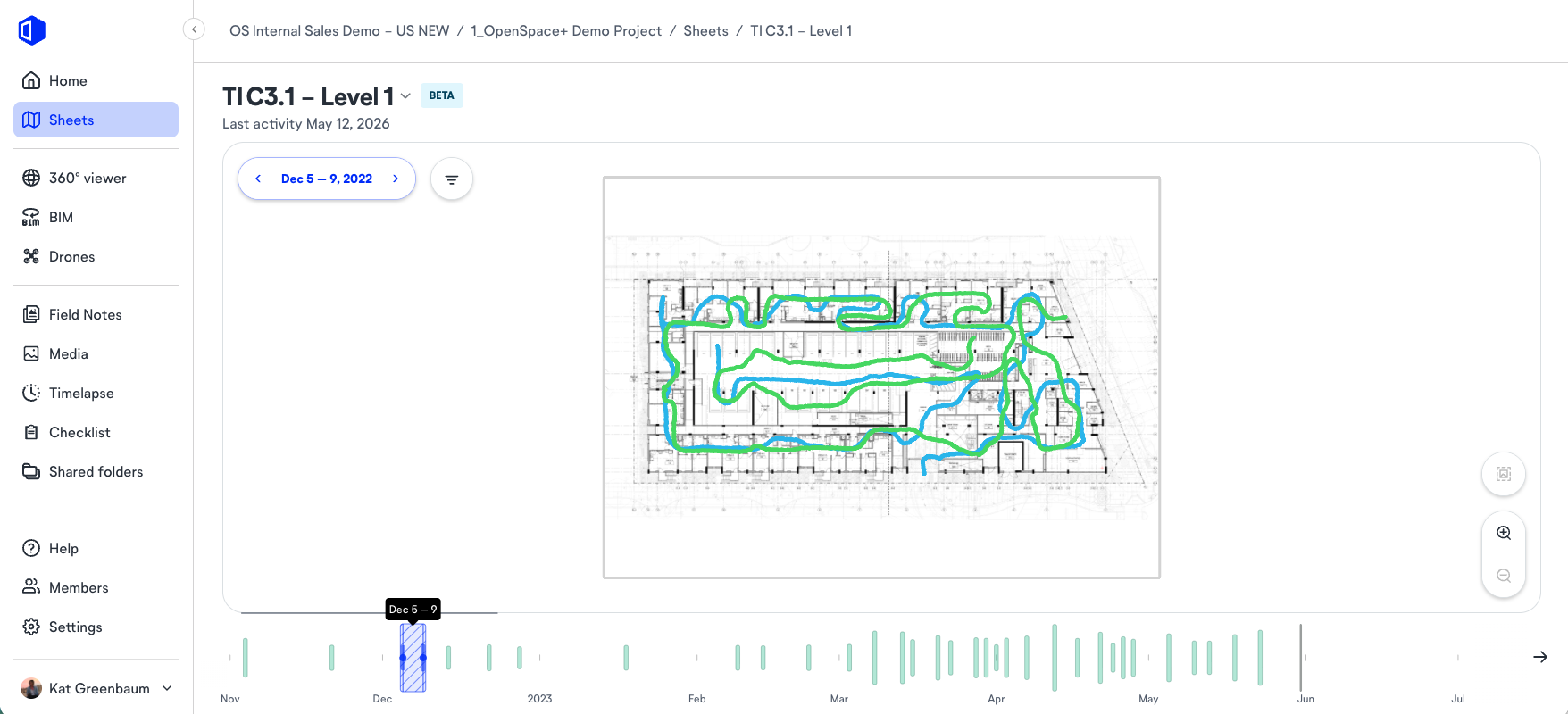
But a Visual Intelligence Platform goes further. It turns that captured reality into actionable intelligence: progress against plan, field issues mapped to exact locations, verified work-in-place for billing, and early warnings when conditions deviate from design. The full platform is what moves construction risk management from reactive to proactive—and capture is the foundation.
OpenSpace is the Visual Intelligence Platform for builders. Its Spatial AI Engine autolocates images in space and time, connecting what happened, where, and when, bringing project management and risk management into a single platform. That intelligence flows directly into jobsite documentation workflows for builders across every project role.
Risk identification becomes continuous rather than periodic. Progress tracking and issue management connect field conditions to office workflows in real time. The risk management process becomes embedded in daily site activity, rather than a separate layer competing with the work.
Reducing financial & legal risk through defensible documentation
Time-stamped visual records eliminate key risk factors that fuel disputes—when objective evidence exists, claims rarely reach litigation.
Documenting construction disputes this way is also why insurers increasingly treat a documented project as a lower-risk one when they price a policy.
Through the OpenSpace partnership with Shepherd Insurance, owners on a $260 million Owner Controlled Insurance Project (OCIP) saw a 15 percent reduction in insurance premiums and 100% of their cost of OpenSpace purchase covered. A documented project is a lower-risk project, and construction risks that are verifiable lead to better rates.
For more detail on using documentation as a safety net to cover unexpected costs, see how builders are using visual documentation to reduce insurance costs and manage construction risk.
“Before joining OpenSpace, I was a customer. This is a story that exemplifies why I made the switch. Our team had about $50,000 in material on a jobsite that another subcontractor accidentally destroyed. Immediately, there was pushback—claims that we hadn’t stored it properly. Rather than let it drag into a weeks-long dispute, we pulled OpenSpace footage from the week before. It showed exactly how the material was stored. The other party reviewed it and agreed to cover the cost. What could have been a drawn-out back-and-forth was resolved in a week.”
-Jonah Walton, Senior Solutions Engineer, OpenSpace
Billing disputes are one of the most common sources of legal and financial risks. When payment applications are anchored to a visual record of work-in-place, the conversation changes.
OpenSpace customers documented $10,000 in savings from fewer billing disputes and $10,000 in avoided rework on individual construction projects. These are the project outcomes that separate a successful project from a costly one, compounding across a portfolio.
To see how OpenSpace can reduce construction risk on your next project, request a demo to chat with one of our experts.
Quality control & rework prevention as risk strategy
Rework is one of the most expensive and underreported construction risks in construction projects. Research from the Construction Industry Institute places rework at 4 to 10 percent of total project cost. On a $50 million project, that math adds up fast.
OpenSpace Track gives project managers a way to catch deviation before it becomes rework on construction projects. By comparing site conditions against planned work, project managers on construction projects can identify out-of-sequence installs and surface rework risks early. OpenSpace Field extends this to QA/QC workflows, with AI Autolocation mapping field notes to exact plan coordinates.
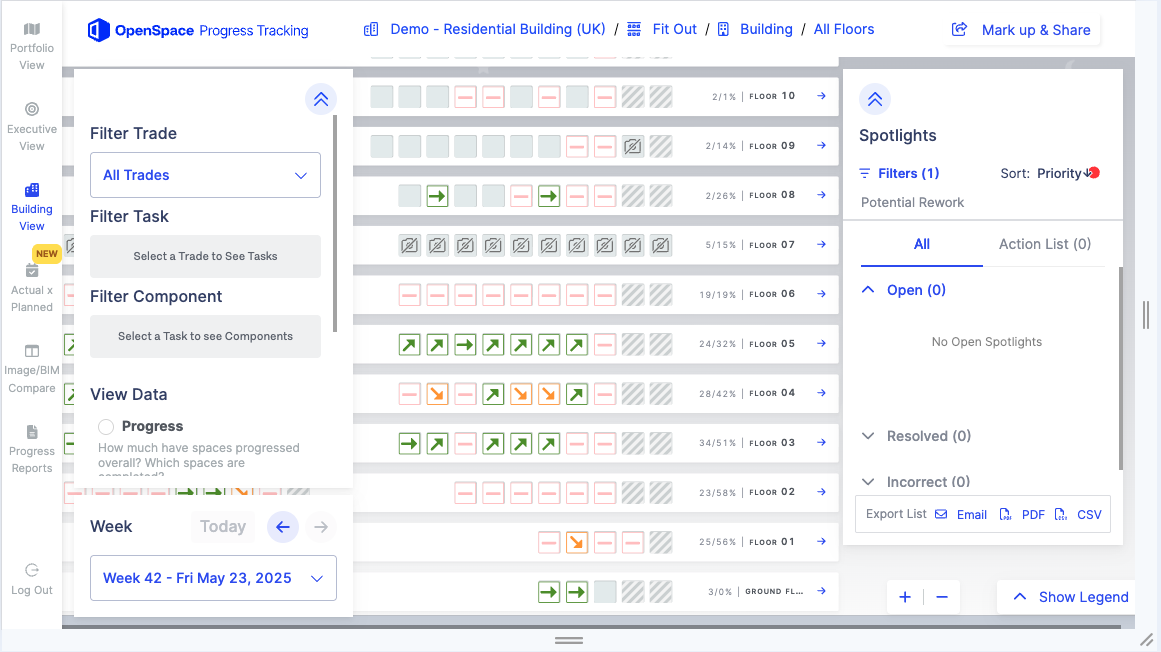
The risk indicators that matter most for quality are completion rates by trade, open punch items, and flagged deviations. These are visible in real time. Unaddressed project risks compound into schedule delays and cost overruns.
Remote visibility & owner risk: seeing is knowing
Owners managing capital-intensive construction projects face a distinct set of construction risks. On these construction projects, they rely entirely on GC reporting. Without independent verification of construction site conditions, payment applications are hard to validate.
Global real estate services firm, JLL’s experience illustrates the shift. Managing a 40,000-square-foot project remotely, VP of Project Management Steve Borup found that manual documentation was taking four hours per walkthrough, with photos outdated before they arrived. With OpenSpace Capture, the team completed a site walk so that images—automatically mapped to project plans—were ready before each weekly meeting. Borup could now run 15-minute virtual walkthroughs from his desk, reducing travel costs by 50 percent. Check out the full JLL case study for more on how that visibility changed the accountability dynamic.
The model is spreading beyond individual project teams. Nedbank now offers OpenSpace to borrowers as a condition of project financing. For owners managing construction risk across multiple active projects, portfolio-level visibility is increasingly a baseline expectation rather than a premium capability.
Common challenges in construction risk management
The most common challenges in construction risk management are operational. Builders face the same challenges—project managers understand the framework, but execution is where it breaks down.
Inconsistent documentation
Teams skip site walks, photo coverage is uneven, and project documents that do exist don’t hold up in a dispute. Project timelines slip and risk occurring goes unrecorded as the project progresses. Any construction risk management plan that relies on manual documentation leaves construction risks untracked.
Siloed systems
When teams track construction risks in one system, QA/QC in another, and progress in a third, project stakeholders rarely have a coherent picture. Effective risk management requires connected information across the full project.
Slow response to identified risks
When information reaches construction project managers days after conditions developed, the window for effective risk management has often closed. A risk management plan requires continuous information to function as intended.
The future of risk management in construction
The future of construction risk management is predictive. AI agents—trained on the kind of construction imagery that only a platform like OpenSpace can provide at scale—will be able to identify risks before they develop, flag deviations across a portfolio, and act on behalf of project teams without waiting for someone to notice. Reality capture products the data those agents need. The Visual Intelligence Platform is what makes that data usable.
The OpenSpace Spatial AI Engine connects images to plans, BIM models, and historical insights so deviations from plan are flagged and key risk indicators monitored at portfolio scale. That same foundation—built on billions of square feet of construction imagery—is what makes agents capable of acting on what they see.
The pressure is also coming from outside the project team. Insurers are factoring visual documentation into underwriting decisions.
On some policies that shows up as a credit applied at quote, which means jobsite documentation can lower your insurance premium before a single claim is filed.
Institutional developers are building risk management plan requirements into contracts. Banks are conditioning financing on demonstrated risk management investment, and a documented risk management plan is becoming a baseline requirement.
Carriers apply the same lens after a loss, when a builders risk claim comes down to whether the project can show its condition before the fire, storm, or theft that triggered it.
Construction risks are not going away. The difference between a successful project and a costly one often comes down to how clearly the project stakeholders could see what was actually happening on-site, and how early.
Reality capture makes risk visible. A Visual Intelligence Platform makes it manageble—turning what teams can see into what they can act on, before issues compound into delays and disputes.
Frequently asked questions
What’s the difference between traditional photo documentation, reality capture & Visual Intelligence?
Traditional photo documentation leaves you with a folder of images with no spatial context, typically results in inconsistent coverage, and makes it nearly impossible to verify when or where someone took the photo. Reality capture produces a continuous, AI-mapped visual record of the entire jobsite—automatically time-stamped and pinned to floor plans. But reality capture is the foundation, not the full story. A Visual Intelligence Platform takes that record and connects it to progress tracking, issue management, and field workflows, so teams are not only documenting what happened—they’re managing what happens next. The difference matters most when a dispute arises: a folder of photos is evidence of what someone chose to photograph; a complete visual record is evidence of what actually existed.
Do you need special equipment to capture a jobsite with OpenSpace?
No. With OpenSpace you can capture with smartphones, 360° cameras, drones, and laser scanners. Our mobile app runs on any iOS or Android device. The platform puts documentation in the hands of every worker on-site, not just specialists. You can start capturing in seconds without additional training.
How does reality capture help reduce construction insurance costs?
Insurers price risk based on how well a builder manages and documents a project. A continuously documented project is a verifiably lower-risk project—one with a defensible record of site conditions, compliance, and progress at every stage. Through our partnership with Shepherd Insurance, owners on a $260 million OCIP project saw a 15 percent reduction in premiums and 100% of their cost of OpenSpace purchase covered. Visual documentation gives underwriters objective evidence that the project team is actively managing risk.
Ready to see what’s really happening on your projects? Request a demo with OpenSpace.