If you’re managing a complex project, construction progress monitoring sits at the centre of nearly every critical decision: whether to release payment, escalate a concern, reallocate crews, or flag a potential delay before it compounds.
Done well, it keeps your projects on track and your stakeholders aligned. Done poorly, it leaves you reacting to problems you could have seen coming weeks earlier.
This guide covers:
- What effective progress monitoring in construction projects looks like.
- The methods and tracking tools available to project teams today.
- The biggest challenges builders face.
- How current approaches to data collection and verification are raising the bar.
What is construction progress monitoring?
Construction progress monitoring is the systematic process of capturing the current state of a build, comparing it against the planned schedule, and communicating findings to the people who need to act on them. It spans everything from daily site walkthroughs and photo documentation to integrated platforms that overlay visual reality data directly onto Gantt charts and BIM models.
At its core, progress monitoring answers three questions on any active project:
- What work is completed?
- What is in progress?
- What is behind plan?
The answers feed into reporting cycles, owner updates, subcontractor coordination, and billing validation. For informed decision making, you need trustworthy answers to those questions. Otherwise, you’re managing your project on gut feel.
Why accurate construction progress monitoring keeps projects on track
Accurate progress monitoring matters most in the middle phases of a project, when small variances can still be corrected without significant cost.
Research shows that large construction projects run 20 percent behind schedule on average and can go as much as 80 percent over budget.
In North America specifically, 98 percent of projects face delays, with average durations stretching 37 percent longer than originally projected. The gap between planned and actual progress isn’t primarily a planning failure. It’s a visibility failure. You can’t correct a trend you can’t see.
Effective progress tracking gives you financial protection alongside operational clarity. Keeping an objective record of site conditions while tracking progress means the same evidence is available later if a schedule disagreement turns into a formal claim. When owners request payment validation, verified progress records answer the question quickly and defensibly. When disputes arise, you can refer to a time-stamped visual record of what was built, and when: the difference between a resolved claim and a costly arbitration.
“Finding out you’re behind schedule can happen at any point in a project because construction schedules are living documents that are constantly evolving. Teams are always monitoring the overall project schedule, cost loaded schedules, material delivery logs, RFIs, submittals, 4 or 6 week look-aheads, etc., trying to keep the project on track. Even on the most successful jobs there’s always something fighting the schedule like weather impacts, procurement delays, crew availability, and sequencing conflicts. And it’s the team’s job to manage and adjust as those issues come up.
The real schedule problems are the ones you can’t see right away. Maybe there’s a quality issue hidden behind a wall that was never corrected, incorrect material installed that was never caught, or maybe a trade looks ahead in one area while they are actually falling behind somewhere else. Catching those issues early can save cost and schedule, but it also improves quality of life for everyone involved in the project. There’s less stress, less finger pointing, less putting out fires, and less need for overtime or weekend work trying to recover schedule. Early visibility gives teams time to make workforce, sequencing, or material adjustments before small problems turn into major schedule impacts.”
–Tom Gutowski, Solutions Engineering Manager, OpenSpace
Core components of an effective progress monitoring system
A reliable construction progress monitoring system depends on five interconnected components. Each serves a distinct function, and a gap in any one of them can undermine the rest.
| Component | What it does | What it affects |
| Capture and documentation | Regular, systematic recording of site conditions using smartphones, 360° cameras, drones, or laser scanners | Inconsistent capture creates blind spots in the timeline that make it impossible to trace when an issue first appeared |
| Schedule integration | Maps site observations to Gantt charts, work breakdown structures, and milestone lists using P6, MS Project, Asta, or Excel imports | Progress information only becomes progress tracking when it connects to what should be done and when |
| Verification | Determines whether completed work meets the standard required to claim milestone completion | Critical for billing accuracy and dispute resolution—raw images alone cannot confirm compliance |
| Reporting and dashboards | Turns captured insights into formats each stakeholder can act on, from task-level detail to executive pacing views | Information that cannot be acted on by the right person at the right time does not drive decisions |
| Stakeholder access | Makes relevant progress insights available in real time to everyone responsible for decisions and approvals | Progress information confined to one team member or system is a liability, not an asset |
Why most construction projects still fall behind schedule
Poor planning isn’t the lone cause of project delays. Supply chain disruptions, labour availability, weather, design changes, and regulatory approvals each introduce schedule risk that no single team can fully control. But a significant share of delays, and often a larger share of the cost that comes with them, trace back to a monitoring gap: problems that were visible, just not seen in time.
A study published in Buildings (MDPI), reviewing 405 scholarly works on construction cost overruns between 2000 and 2024, identified design changes, planning errors, and scope creep as the strongest interconnected drivers of cost escalation. Each compound the others when left undetected. The longer a variance goes unaddressed, the more expensive it becomes to correct.
Before adopting image-based progress tracking, most teams relied on manual photos in folders, inconsistent site walks, spreadsheets, and subjective status updates. These methods leave gaps in accountability and communication between field and office. Gaps that show up later as costly delays and disputes.
The shift to image-based construction progress tracking only works if the technology is reliable. Tracking progress is straightforward; tracking what’s actually happening on-site is harder.
What are the most effective methods for tracking construction site progress?
The most effective approach uses visual capture in order to create a direct comparison between what’s been built and what the schedule says should be built. There’s no single method that fits every project type or team size, but most builders aren’t using the full range of what’s available.
Daily reports & site walkthroughs
Daily site walkthroughs are still the most direct way to understand what’s happening on-site. Superintendents and project managers who walk the site regularly develop an instinctive sense of pacing and risk. The limitation, though, is that observations are subjective, not systematically recorded, and entirely dependent on who’s present and how much time they have.
Photographic documentation
360° photo documentation captures a visual record you can reference later to view progress or resolve disputes, and share with stakeholders who aren’t on-site. The challenge with manual photos is organisation. Without spatial context or time-stamps image folders are difficult to search and impossible to compare over time.
360° reality capture
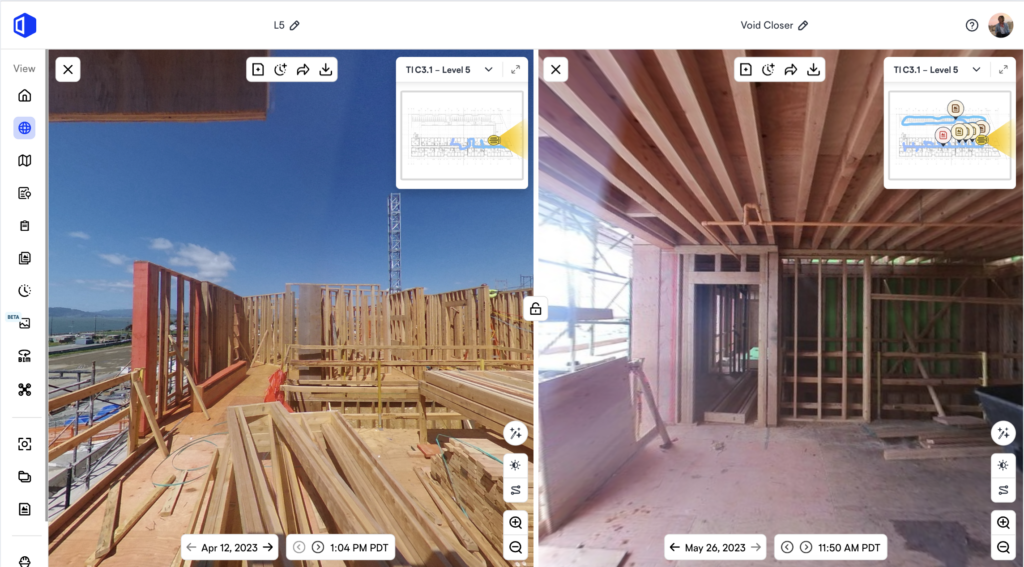
After capturing with a 360° camera, AI technology automatically timestamps and maps images to floor plans, turning your site walkthrough into a visual record you can navigate from anywhere. With OpenSpace Capture, teams can document 25,000 square feet in roughly 10 minutes, with images processed and ready to view in about 15 minutes.
This turns documentation from a reporting burden into something that happens during a normal site walk. And if you follow proven site walk best practices, you’ll improve consistency, coverage, and the overall value your captures.
Drone capture
For sitework, civil phases, and large-scale exteriors, aerial imagery provides spatial context that ground-level capture cannot. OpenSpace Air processes drone imagery into orthomosaics, 3D meshes, and point clouds that teams can use to compare planned and actual site conditions, assess drainage, and measure earthworks.
Those measurements only carry weight if the underlying construction surveying methods tie back to the same control points the schedule and billing records assume.
BIM overlay & field verification
To help compare design intent against work-in-place, you can overlaying BIM models onto site imagery. This helps teams see exactly where conditions deviate from the model, assign issues directly in the field, and maintain a connected record from preconstruction through closeout. No BIM expertise is required when the overlay is built into the capture workflow.
AI-assisted & verified progress tracking
The most reliable approach for verified progress tracking combines AI-powered capture and image analysis with expert human review to produce. That means you can run advanced and verified progress reports tied to schedule milestones.
How AI & human verification are changing construction progress tracking
Automated image analysis has changed what’s possible in construction progress monitoring. Computer vision trained on construction imagery can now identify installed components, measure percent complete by trade and zone, flag out-of-sequence work, and surface potential rework from 360° images captured during a normal site walk.
But AI-only tracking has a known limitation: it produces estimates, not verified facts. When those estimates feed into payment applications or schedule compliance reporting, their accuracy has real financial and contractual consequences. That’s the gap a hybrid model addresses.
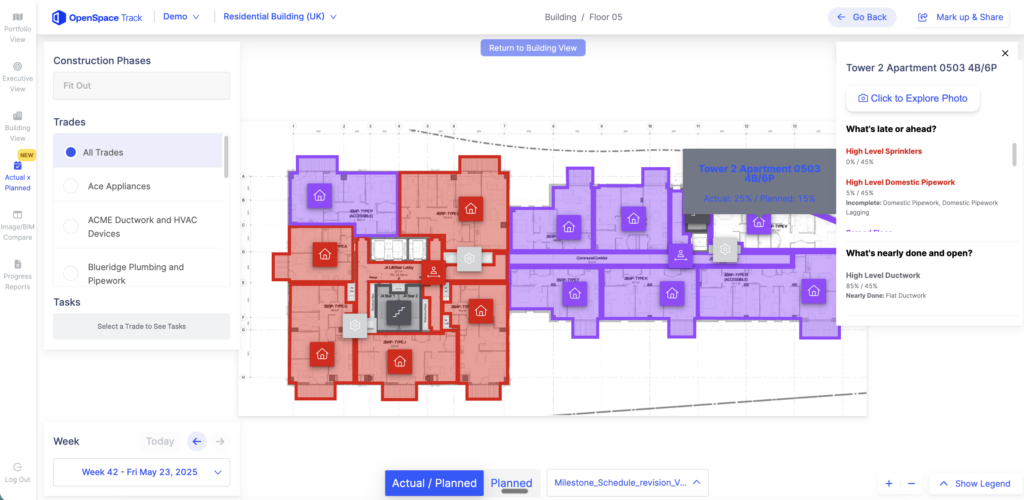
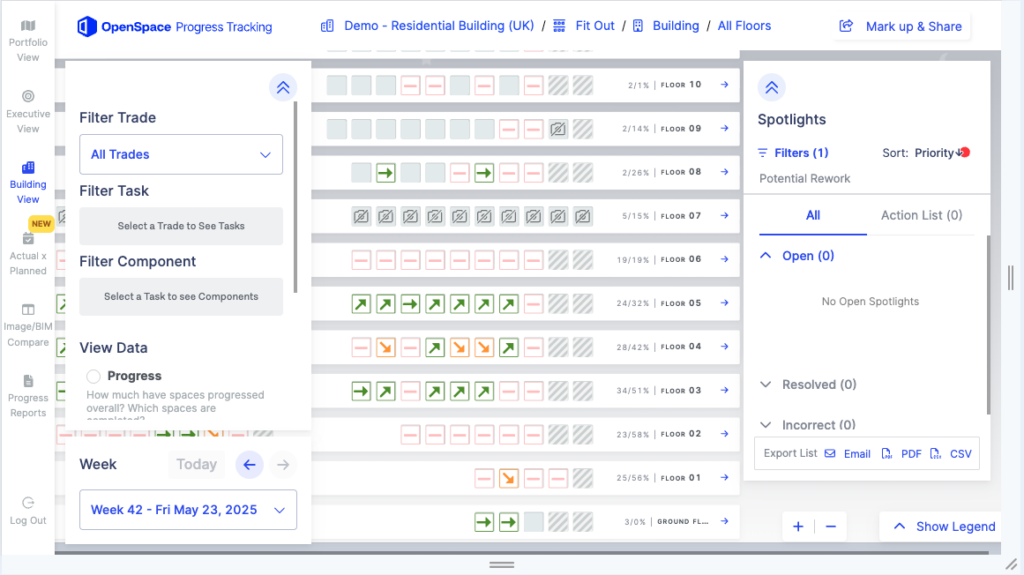
As part of the OpenSpace Visual Intelligence Platform, OpenSpace Track combines AI-powered image analysis with expert human review to deliver verified progress reports. Every piece of reality data is reviewed for accuracy and context before it surfaces as a project insight.
See what verified progress tracking can look like on your projects. Request a demo.
As Elliot Christiansen, Sr. VP of Operations at Cleveland Construction, described after deployment:
“Because the data was accurate we could have effective two-way conversations with our field team and get answers quickly, without having to play twenty questions with them like we used to.”
OpenSpace tracks over 700 visual components across more than 200 scheduled tasks, from framing and MEP rough-in to finishes and fireproofing. It integrates directly with project schedule and progress tracking workflows using native connections to P6, Asta Powerproject, MS Project, and Excel, so builders can compare actual progress against plan without manual reconciliation.
What are the common challenges in construction progress reporting?
The biggest challenges in construction progress reporting are rarely technical. They’re organisational and behavioural, rooted in how teams have historically approached site documentation and communication.
Subjectivity & inconsistency
When progress reporting depends on individual observation, the same conditions can be described very differently by different people, or by the same person on different days. Subjective status updates create disputes and erode trust between general contractors, subcontractors, and owners.
Infrequent capture
Teams that document construction work once a week or less miss the detail that matters for schedule management. If a variance appears between weekly snapshots, it’s impossible to determine exactly when it started or what caused it. Real-time visibility requires a capture cadence that matches the pace of site activity.
Disconnected reporting
Progress information stored in one system, schedule data in another, and BIM models in a third create a reporting burden that falls on project managers to reconcile manually. This manual process is slow, error-prone, and often delays the reporting that stakeholders need for decisions.
Office & field communication gaps
The most common source of reporting breakdown is the gap between what’s happening on-site and what the office knows about it. If you don’t have a reliable mechanism for real time updates from the field, progress reports reflect what was true at the last scheduled walkthrough, not what;s true now.
Verification for billing
Payment applications that rely on unverified progress claims create friction with owners and increase the risk of disputes. When actual progress is not objectively documented, conversations about payment become negotiations rather than confirmations.
Scope creep
Changes that don’t trigger a formal schedule update accumulate quietly. Without systematic progress monitoring, scope creep often goes undetected until it has materially affected the critical path.
Best practices for documenting construction milestones
Reliable milestone documentation starts before work begins. Setting clear standards for how progress will be captured, verified, and reported at the outset of a project prevents the improvisation that leads to inconsistent records later.
Set a capture cadence tied to milestone frequency
The cadence for documenting construction work should reflect the pace of scheduled milestones. A fast-moving floor plate with weekly milestone completions needs more frequent capture than a long-lead structural phase. Build the cadence into the site walkthrough schedule so it becomes routine, not reactive.
Keep progress records complete, connected & accessible
When progress photos are scattered across email threads, shared drives, and individual devices, context gets lost and nothing is searchable. Centralising records in a platform that time-stamps and geolocates every image to the corresponding floor plan means every stakeholder is working from the same picture of site reality—no digging, no version confusion, no gaps.
Connect documentation to the live schedule
Images and site notes that aren’t mapped to specific schedule tasks have limited value for progress tracking. Integrating capture workflows with construction progress tracking software that links images to Gantt charts and work breakdown structures turns documentation into insights you can actually act on.
Document pre- & post-milestone conditions
For significant milestones, capturing conditions both before and after completion creates a defensible record that supports billing validation and reduces the risk of payment disputes. This is particularly valuable for MEP rough-in, concrete pours, and fireproofing installations where the completed work is subsequently concealed.
Ensure stakeholder access is appropriate to role
Owners and capital programme managers need high-level progress visibility across their portfolio. Project managers need task-level tracking. Field crews need to be able to log observations and flag issues from their smartphones. When access levels don’t match roles, reporting slows and communication breaks down.
See how OpenSpace turns milestone documentation into a record you can take to the billing table. Request a demo.
What does good progress monitoring look like across project phases?
Progress monitoring doesn’t start at groundbreaking and end at closeout. The information needed, the audience for that information, and the consequences of a monitoring gap shift significantly as a project moves through its phases.
Preconstruction
Establishing the monitoring framework before work begins is as important as the capture itself. This means connecting the schedule file to the progress tracking platform, defining capture zones and milestone definitions, and aligning on the reporting format that owners and stakeholders expect. Work that begins without this foundation typically produces inconsistent records that create friction later.
Structure & envelope
Early construction phases set the pace for the entire project. Real-time progress tracking during structural and envelope work gives teams the earliest possible signal of productivity variances and potential delays, before they affect downstream trades. Building view dashboards that show work progression by floor and zone are particularly valuable here.
MEP rough-in and finishes
As multiple trades work concurrently, the risk of out-of-sequence installation and coordination conflicts increases. Progress monitoring during these phases needs to track percent complete and work sequence, flagging potential rework before it’s concealed by subsequent trades.
Closeout & handover
A complete visual record of every phase of construction is the most defensible asset a builder can provide at handover. When owners or future facility managers need to understand what is behind a wall or above a ceiling, the captured visual record replaces destructive investigation. As-built documentation generated from systematic monitoring is increasingly an expected deliverable on enterprise projects.
Sweet Projects, a UK-based construction management company delivering critical infrastructure projects including data centres, uses OpenSpace to give project director Andrew Moss and his team daily visual documentation across their most complex builds.
The result: complete transparency from preconstruction through handover, with a record that resolves questions on the spot, avoiding sending someone back to the site.
Moss’s team treats that record as standard practice on data centre construction, where a closed ceiling can otherwise hide weeks of mechanical and electrical work.
Linxon, the joint venture between AtkinsRéalis and Hitachi Energy that delivers critical power infrastructure globally, uses OpenSpace to connect international project teams to site reality across projects where remote stakeholders need reliable progress visibility without being physically present on-site.
How to choose construction progress tracking software
Construction progress tracking software spans simple photo documentation apps to full-stack platforms that combine capture, schedule integration, verified tracking, and executive reporting. For project teams evaluating options, the most important criteria aren’t feature counts but practical fit with how the field actually works.
| Criteria | What to look for |
| Field adoption | Minimal added steps for field crews; capture integrates into the existing site walkthrough without separate hardware |
| Schedule integration | Native support for P6, Asta, MS Project, and Excel; two-way sync so planned vs. actual comparisons happen without manual reconciliation |
| Verification methodology | Whether the platform produces AI estimates or verified outputs; only verified outputs are defensible for payment applications and dispute resolution |
| Integration with existing systems | Native connections to Procore, Autodesk, or any other construction project management software, so issues flow into the right systems automatically |
| Scalability across projects | Consistent workflows, standardised reporting, and portfolio-level dashboards that compound in value as project count grows |
For general contractors specifically, the general contractor overview at OpenSpace covers how Visual Intelligence applies across the workflows that matter most: documentation, coordination, QA/QC, and progress reporting at scale.
Frequently asked questions
How does construction progress monitoring integrate with existing project management software?
Integration with project management software is one of the most important factors in whether progress monitoring delivers real value or adds reporting overhead. The best construction progress tracking platforms connect directly with construction documentation and coordination workflows and support native integrations with platforms like Procore and Autodesk.
Issues identified during progress monitoring—out-of-sequence work, quality concerns, or schedule variances—flow directly into the systems where project managers and owners track and resolve them. Schedule file integrations with P6, Asta, MS Project, and Excel mean planned versus actual progress comparisons happen without manual reconciliation.
How often should progress be captured on an active construction site?
Capture frequency should match the pace of scheduled milestones and the rate of site activity. As a baseline, weekly capture is the minimum for meaningful progress tracking on most projects. Daily capture is standard on fast-paced builds and during critical phases where out-of-sequence installation risks are high.
Some teams on large, complex sites capture multiple times per day during peak activity periods. The practical constraint is adoption: a capture cadence that adds significant burden to field crews won’t stick. Solutions that integrate capture into the existing site walkthrough, without requiring separate hardware or workflow steps, make higher frequency practical.
Who is responsible for construction progress monitoring on a project?
Construction progress monitoring rarely has a single owner. It’s distributed across roles, part of why it breaks down in practice. The project manager carries primary accountability for ensuring that progress is tracked against the schedule and reported to stakeholders on time. The superintendent is responsible for the accuracy of field observations and for ensuring that capture happens at the agreed cadence.
On projects with a VDC or BIM lead, that person often owns the integration between reality data from the field and the model. Owners and capital programme managers have their own monitoring responsibilities, typically focused on validating milestone completion for payment and maintaining visibility across their portfolio.
The projects where progress monitoring works best treat it as a shared discipline with clear ownership at each layer, supported by a platform that makes it easy for every role to contribute and pull what they need without duplicating effort.
The shift from reporting to real visibility
Construction progress monitoring has always existed in some form. What’s changing is the reliability of what it produces. The shift from subjective walkthroughs and manual spreadsheets to image-based, schedule-integrated, verified tracking means project teams, owners, and stakeholders are working from better information.
The builders getting the most out of progress monitoring aren’t necessarily those with the most sophisticated technology. They’re the ones who have made monitoring a consistent habit, connected it to their schedules, and chosen platforms that their field crews actually use.
When those conditions are in place, progress monitoring stops being a reporting task. You see problems early, communicate status clearly, and keep projects moving with confidence.
Ready to make progress monitoring your team’s competitive advantage? See OpenSpace Track in action.