Builders around the globe tuned in to Waypoint 2025, our annual customer summit, to be the first to hear new product announcements and to see customer stories from active jobsites. But that wasn’t all—this year’s Waypoint marked a turning point for OpenSpace and the construction industry.
We unveiled the Visual Intelligence Platform, a unified system of work that moves beyond reality capture to power faster, better-informed decisions that reduce risk and help you get work done more efficiently.
If you missed it, here’s a recap of everything we covered, and links to the on-demand recordings.
Unlocking the future of building
OpenSpace CEO Jeevan Kalanithi set the stage with the big picture: the construction jobsite holds the most valuable data in a project, yet it’s historically been the hardest to capture and act on. Even with 1000s of pictures taken with smartphones on jobsites every day, along with 360° captures, drone imagery, and laser scans—if you can’t make sense of all the imagery, you’re flying blind. With the Visual Intelligence Platform, OpenSpace is changing that.
Jeevan announced game-changing capabilities in our new product, OpenSpace Field:
- AI Autolocation. This groundbreaking and patent pending new advancement works like GPS but for indoors, enabling us to provide indoor location, in real time, to devices like the smartphone for anyone on the OpenSpace platform.
- AI Voice Notes. Simply talk and our AI logs your Field Note (for punch items or any issues or observations) with everything filled in and placed in the right location—automatically.
- Two-way integrations with Autodesk and Procore. When you log an issue in OpenSpace, it automatically syncs into your project management system, and both stay in sync—flawless and seamless data flow where decisions get made.
- AI Search. With the significant amount of imagery we’re harnessing from new mobile phone workflows, we made sure to make that information easy to find. If you’re looking for something, just type it in, and our AI will find it. AI Search is tuned for builders and construction terminology.
Powered by our Spatial AI Engine, OpenSpace Field is a new way of working built for the realities of the field.
We are graduating from a tool that captures data that you can refer to when you need it into an essential platform—a system of work centered on reality that allows you to make better decisions, faster.
Watch the recording to hear more details and all of Jeevan’s announcements.
Customer spotlights
We debuted videos filmed on active jobsites with three top customers during Waypoint:
- Gilbane shared how OpenSpace Air and OpenSpace Capture help them manage projects spread across regions, from Reno to Phoenix, with speed and clarity. Drone flights combined with 360° site walks give them a complete perspective—from the ground and from above—making it easier to track progress, manage risk, and deliver value to clients. Watch the video.
Having drones in OpenSpace really helps me out because I’m able to go to the site, do my flight, and by the time I’m back in the office and finish my lunch, it’s finished processing and I can present it to the team.
- Balfour Beatty highlighted how simplicity and field-first workflows make technology stick. OpenSpace helps them save minutes, hours, and days by consolidating visual data in one platform, powering faster punch, quality control, and communication across dozens of active projects nationwide. Watch the video.
It’s all about time. [OpenSpace] saves so much time and lets me get back to what I’m really getting paid for: quality, safety, and production.
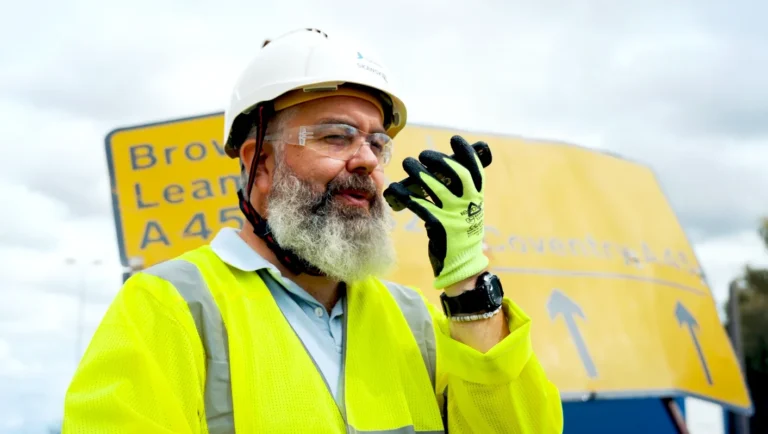
- Skanska shared how they’re using OpenSpace across both building and infrastructure projects—from skyscrapers in London to highways near Birmingham. With distributed teams across countries, OpenSpace helps them coordinate, reduce risk, and create an immutable record of site conditions. Watch the video.
With AI Voice Notes, you can assign people to the snag and assign a date when it needs to be completed—it’s removing the desk work after the actual photo has been taken.
OpenSpace Air: one platform, from day one
Director of Product Jess Lam walked through how OpenSpace Air brings aerial data into the Visual Intelligence Platform, expanding the value of visual data on a project starting from day zero. Just four months after launch, customers are already using nearly one million uploaded drone images for bidding, planning, QA/QC, and progress tracking.
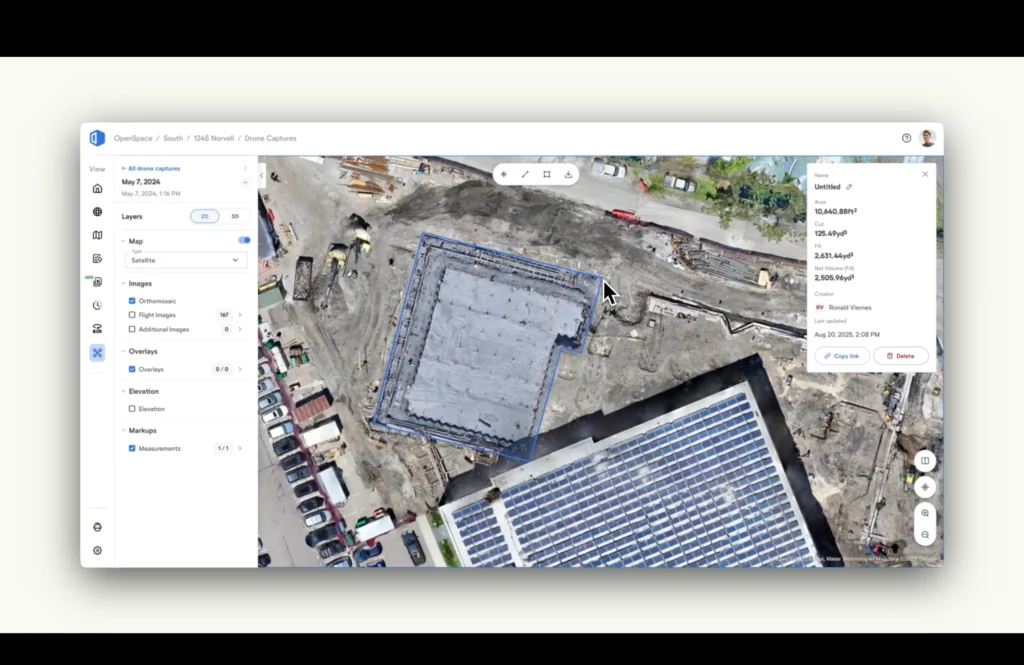
Jess also previewed what’s next: measurements (distance, area, volume, cut/fill), exports to integrate data into tools like ArcGIS and Civil 3D, georeferencing for improved accuracy, and Field Notes within OpenSpace Air to tie issues directly to drone captures.
OpenSpace Air isn’t just evolving; it’s accelerating how we build. From the first flight to final handover, OpenSpace Air gives your team clarity and speed to take action.
Field-first workflows and smarter BIM
Product Team Manager Michael Jones was up next to tell us more about OpenSpace Field, a new way of working that brings reality data, AI, and integrations together into one seamless, field-ready system.
He outlined why OpenSpace Field matters: construction is becoming more complex, but most tools are still built for the back office—handling documents, forms, and finances. When it comes to punch, deficiencies, snags, or design challenges, visual data is what matters most. And the jobsite is where that data is—the truth that defines if money is made or lost.
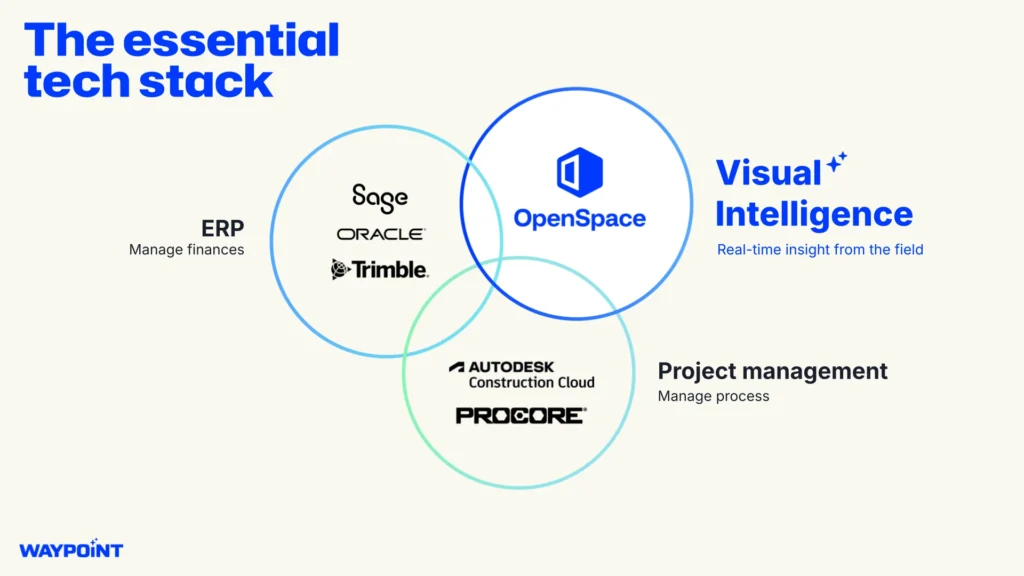
With Visual Intelligence, OpenSpace becomes the essential system of work for the field—the place the whole team goes to understand what’s really happening on the ground. And importantly, this data feeds those back office systems, making your PMIS and ERP smarter. That means you’re equipped to make faster and better-informed decisions. Clarity to know what’s next.
Michael shared impressive results from early OpenSpace Field early customer Suffolk: an 86% speed improvement in documenting issues versus their old system, with high-quality notes, properly assigned trades, drawings, zones, location, and other critical data. And that we’ve seen customers with very large projects where this type of time savings at scale would be even more impactful. For example, a customer recently told us that one of their more complex projects had 17,000 issues or punch list items. With OpenSpace Field, they could have saved about 730 hours of labor, or about $55,000 dollars in wage costs.
Great products remove work—they don’t add it. With OpenSpace Field, teams are capturing more value from what they’re already doing, effortlessly.
Molly Taylor, Senior Product Manager, then shifted the focus to 3D. She noted that while BIM is a powerful investment, it has traditionally been locked away with design and VDC teams. For field crews, models were too resource-intensive to load and too complex to navigate on mobile devices everyone uses in the field.
That’s why OpenSpace built a smarter, mobile-friendly BIM Viewer, powered by a modern streaming engine so even large models load smoothly on a phone. Molly described it as “more like Netflix than VHS”—fast, intuitive, and ready for the field.
Our new viewer makes BIM actionable for everyone on-site. With one tap, a superintendent or trade partner can pull up the model in context, validate work against design intent, and even create Field Notes directly from that BIM view. No screenshots, no back-and-forth emails—just immediate clarity. And because these notes sync with drawings and PM tools, the entire team stays aligned.
Together, Michael and Molly painted a clear picture of how OpenSpace is moving beyond documentation to orchestration. The combination of OpenSpace Field and the smarter BIM Viewer makes it easier for teams to see what’s happening, act on it in real time, and keep projects moving forward.
This is the future of construction: intelligent, connected, and driven from the field.
OpenSpace Field is available in early access to select customers—fill out our form if you’re interested in learning more.
Watch Michael and Molly’s Waypoint presentation for more details on everything OpenSpace Field has to offer and about our new OpenSpace BIM Viewer.
Under the hood of the Visual Intelligence Platform
Co-founder and CTO Michael Fleischman closed the day with a deep dive into the technology powering our Visual Intelligence Platform. He explained how our Spatial AI Engine combines advances in vision, language, and now location data to deliver unprecedented intelligence from the field.
He showcased our groundbreaking AI Autolocation capability—a breakthrough that transforms every smartphone into a sophisticated, real-time indoor positioning system for active jobsites, completely eliminating the need for costly and cumbersome hardware that’s historically been necessary to provide indoor location. Like GPS for indoors, AI Autolocation pinpoints a user’s location on a jobsite making every note, issue, and capture location-aware.
Looking ahead, Michael revealed how AI Autolocation technology lays the groundwork for advanced Spatial AI agents. By combining image and location data to proactively detect and resolve issues, these agents will provide executive-level insights for the entire industry. Prototypes show a future where agents can guide field teams through BIM models, surface issues in real time, and even deliver “X-ray vision” of past construction phases.
Just as GPS transformed the outside world, AI Autolocation will transform how builders work indoors—creating spatial AI agents that redefine construction technology.
Catch Michael’s full Waypoint presentation on demand.
Welcome to a new way of working
Waypoint 2025 wasn’t just about product announcements—it was about a new way of working. With the Visual Intelligence Platform, OpenSpace is becoming the front end for construction, where reality flows seamlessly from the field to the office to the C-suite.
With the Visual Intelligence Platform, you can operate in a way that is always visible and never in doubt.
If you’d like to watch the full event from beginning to end, head to this on-demand recording. For more on why we built the Visual Intelligence Platform, see our CEO Jeevan’s blog post. ‘Why Visual Intelligence’.